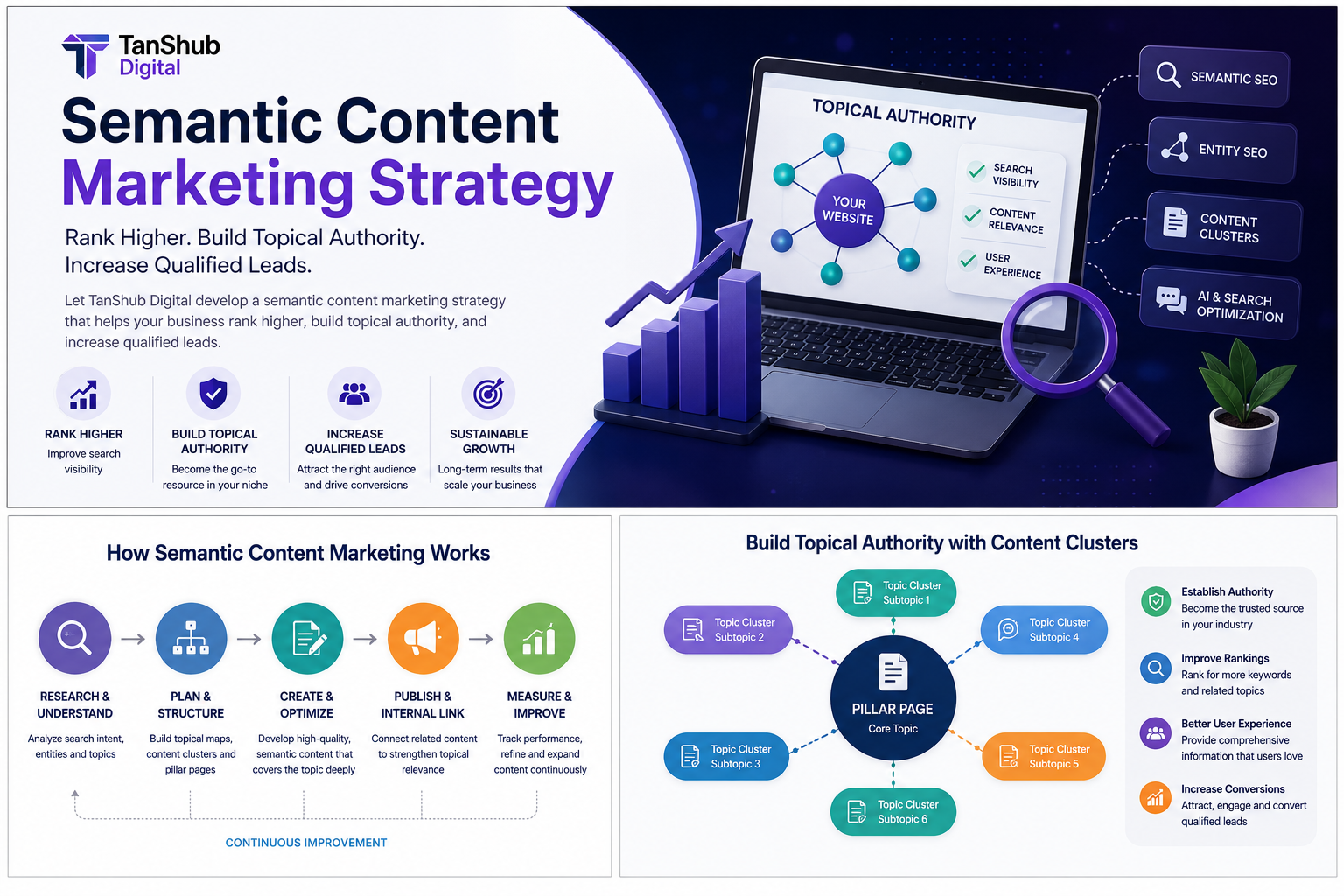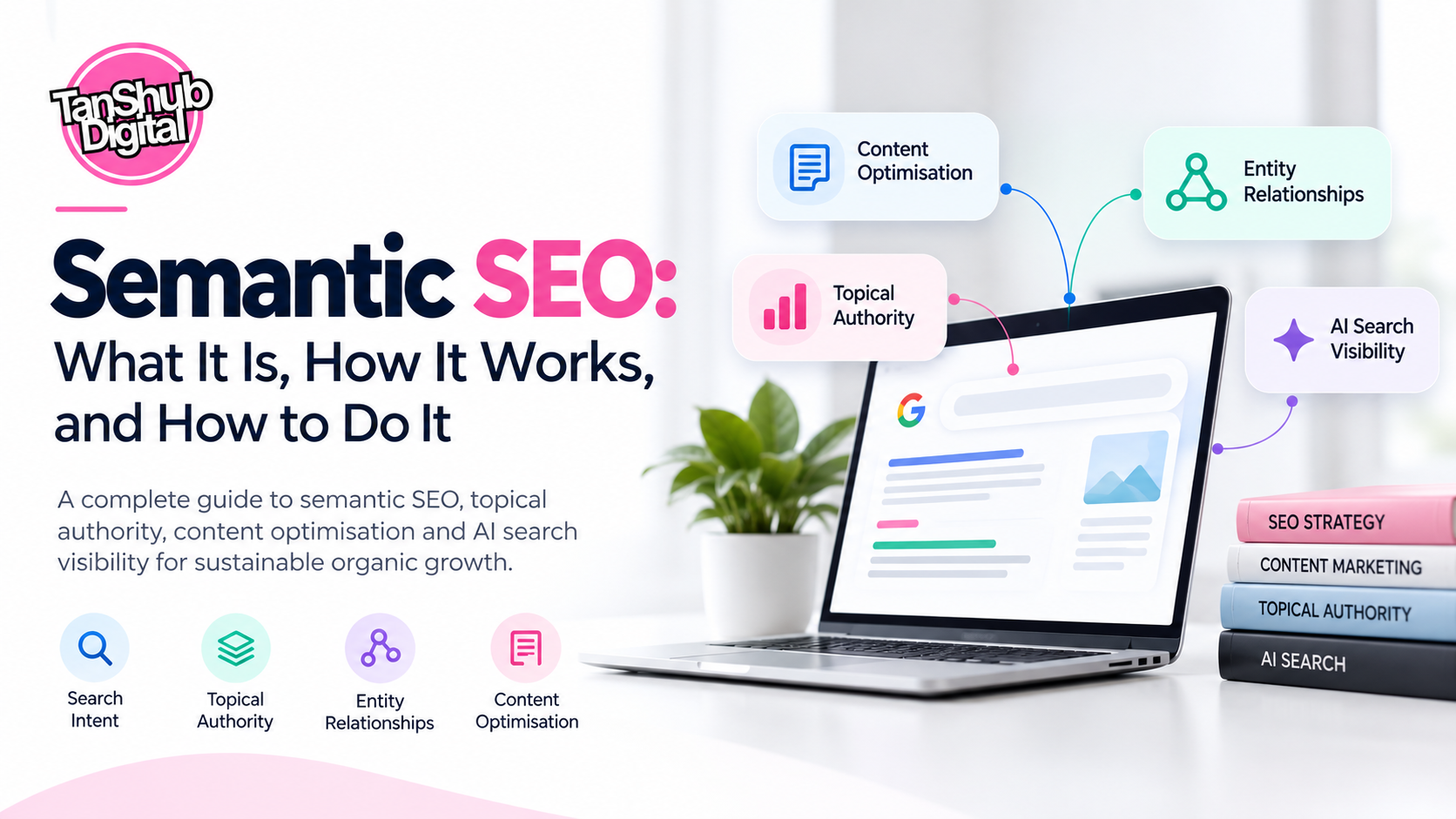
Semantic SEO is the practice of creating and organizing content around topics, entities, relationships, meanings, and search intent rather than relying on keywords alone. This approach uses Semantic SEO Services to structure information for better relevance and discovery.
A modern search strategy needs to answer more than one query.
Someone searching for “semantic SEO services” may first want to understand what semantic SEO means. Additionally, they may ask how it works and which techniques are involved. Moreover, they may ask how it compares with traditional SEO and what a service includes. Also, they may want to know how much it costs and whether a specialist can implement it for their website.
Additionally, that journey with Semantic SEO Services creates a much larger opportunity than one keyword.
Your website needs to demonstrate that it understands the topic behind the query, not simply repeat the phrase “semantic SEO” across a page.
This is where semantic SEO, topical authority, content architecture, entity relationships, search intent and AI search visibility come together.
Google’s current guidance is particularly relevant here. Google recommends creating helpful, reliable, people-first content, ensuring that pages are technically accessible, using language people search for, and creating content that provides substantial value rather than content produced primarily to manipulate rankings.
At the same time, Google’s guidance for AI features states that the same foundational SEO practices apply to AI Overviews and AI Mode. There is no separate technical checklist that guarantees inclusion. Pages still need to be crawlable, indexable and eligible to appear in Search.
That leads to a practical conclusion:
Semantic SEO should not be treated as a replacement for SEO. It is better understood as a way of making SEO, content strategy and information architecture more meaningful and comprehensive.
What Is Semantic SEO?
Semantic SEO is an approach to search optimization that focuses on meaning and relationships between concepts, rather than treating keywords as isolated strings.
Traditional keyword-focused SEO might begin with:
semantic SEO services
A semantic approach asks a much broader set of questions:
- What does semantic SEO mean?
- What problem does semantic SEO solve?
- What is semantic search?
- What is search intent?
- What entities are associated with semantic SEO?
- What topics naturally belong within semantic SEO?
- What questions do users ask before and after this query?
- What evidence should support the explanation?
- What related concepts should the website cover?
- How should those concepts be connected?
- Which pages should explain, demonstrate or commercialize those concepts?
The research behind this pillar page illustrates exactly this behavior. The seed query “semantic SEO services” generated related questions covering semantic SEO definitions, techniques, case studies, SEO services, semantic search, pricing, comparisons and implementation.
That is the fundamental idea behind semantic SEO.
You are not trying to create a page for every slight variation of a keyword.
You are trying to build a useful body of information around a subject.
Semantic SEO does not mean adding more keywords
This distinction is important.
Semantic SEO is not:
- adding synonyms to every paragraph
- inserting dozens of related keywords
- creating hundreds of thin pages
- stuffing entities into content
- writing separate pages for every minor keyword variation
- generating AI content at scale simply because a keyword tool produced a list
Google explicitly warns against creating large quantities of content primarily to attract search traffic and against producing pages without adding meaningful value.
The objective is meaningful coverage, not maximum keyword density.
How Do You Do Semantic SEO?
A practical semantic SEO process can be broken into several stages.
1. Define the core topic
Start with the primary subject.
For example:
Semantic SEO Services
Then define what the subject actually encompasses.
A useful topic model might include:
- semantic SEO
- semantic search
- search intent
- entities
- entity relationships
- topical coverage
- topical authority
- content clusters
- topic clusters
- content architecture
- internal linking
- structured data
- content optimization
- content auditing
- SEO analysis
- information architecture
- AI search
- generative search
- AI Overviews
- AI search visibility
Not every concept deserves its own page.
Some belong together.
Others require dedicated explanations.
The goal is to establish the conceptual boundaries of the topic.
2. Research questions, not just keywords
Your research demonstrates why question research is valuable.
The dataset contains queries such as:
- What is semantic SEO?
- How do you do semantic SEO?
- Can semantic SEO help content?
- What are semantic SEO techniques?
- What is a semantic SEO tutorial?
- What is a semantic SEO course?
- What is SEO topical authority?
- What is an SEO content audit?
These questions represent different stages of understanding.
Someone asking “What is semantic SEO?” is probably trying to understand the concept.
Someone asking “How do you do semantic SEO?” is moving toward implementation.
Someone asking “What are semantic SEO services and who offers them?” has moved closer to commercial investigation.
Therefore, the questions can become the foundation of your content architecture.
Can Semantic SEO Help Content?
Yes, but the mechanism needs to be understood correctly.
Semantic SEO does not provide a magic ranking boost simply because a page contains related words.
Its value comes from improving the completeness, clarity, relevance and organization of information.
Consider an article targeting:
“Payroll compliance in India.”
A shallow article might repeatedly use:
payroll compliance
A stronger article might explain:
- payroll compliance
- employee deductions
- provident fund
- ESI
- professional tax
- TDS
- salary records
- statutory deadlines
- payroll audits
- compliance risks
- employer responsibilities
- employee records
- payroll software
- compliance checklists
These concepts are not included simply because they are “semantic keywords.”
They belong because they are genuinely relevant to the subject.
That distinction matters.
Semantic SEO improves content when relationships are meaningful
A strong semantic page should help a reader understand:
What the topic is
↓
Why it matters
↓
What concepts are connected to it
↓
How those concepts work together
↓
How to apply the information
↓
What to do next
This is also consistent with Google’s people-first content guidance, which asks whether content provides a substantial, complete description of a topic and whether it provides information beyond what is obvious.
What Are Semantic SEO Techniques?
There is no single official Google checklist called “semantic SEO techniques.”
Instead, practitioners generally use several complementary techniques to improve topical coverage, meaning and discoverability.
1. Search intent analysis
Identify why the person is searching.
Common intent categories include:
Informational
The user wants to learn.
Examples:
- What is semantic SEO?
- What is semantic search?
- What is topical authority?
Investigational
The user is evaluating an approach.
Examples:
- Semantic SEO vs traditional SEO
- semantic SEO techniques
- semantic SEO case studies
Commercial
The user is considering a provider or solution.
Examples:
- semantic SEO services
- semantic SEO agency
- semantic SEO consultancy
- SEO services cost
Transactional
The user is ready to take action.
Examples:
- semantic SEO audit
- semantic SEO consultant
- semantic SEO services near me
Your research contains all of these stages. The dataset specifically identifies informational, middle-of-funnel and bottom-of-funnel queries around semantic SEO services.
2. Topic clustering
Topic clustering means organizing related subjects into a logical information structure.
For example:
Pillar: Semantic SEO
Supporting topics:
- What is Semantic SEO?
- How to Do Semantic SEO
- Semantic SEO Techniques
- Semantic SEO vs Traditional SEO
- Semantic SEO and Search Intent
- Semantic SEO and Topical Authority
- Semantic SEO Content Structure
- Semantic SEO Content Audit
- Semantic SEO Case Studies
Commercial pages:
- Semantic SEO Services
- Semantic SEO Consultancy
- Semantic SEO Audit
- Semantic SEO for SaaS
- Semantic SEO for Ecommerce
- Semantic SEO for B2B
This creates a relationship between pages instead of leaving each article isolated.
3. Entity optimization
An entity is a distinct thing, person, organization, concept, place or product that can be identified independently of a particular keyword.
For semantic SEO, entities might include:
- Google Search
- ChatGPT
- Gemini
- Perplexity
- search intent
- semantic search
- structured data
- topical authority
- content clusters
- entities
- knowledge graphs
The important point is not to simply mention these terms.
The content should explain how they relate to the subject.
For example:
Semantic SEO focuses on helping search systems understand the meaning and relationships within content. Entity-based optimization can support this by clearly identifying important concepts and their relationships, while structured data can provide machine-readable information where appropriate.
That is much more useful than inserting “entities” into a keyword list.
4. Internal linking
Internal links help users and search engines move between related pages.
A semantic content architecture might look like:
Semantic SEO Services
│
├── What Is Semantic SEO?
│
├── How to Do Semantic SEO
│
├── Semantic SEO Techniques
│
├── Semantic SEO vs Traditional SEO
│
├── Semantic SEO Content Audit
│
├── Semantic SEO Case Studies
│
└── Semantic SEO Pricing
The pillar page links to supporting resources.
Supporting resources link back to the pillar where appropriate.
Relevant pages link laterally to other related resources.
This creates an understandable site structure.
Google’s Search Essentials specifically recommends making links crawlable so that Google can discover other pages on your site.
5. Content depth
Depth does not mean writing 10,000 words.
A 2,000-word article that completely answers a specific question can be more useful than a 6,000-word article padded with repetition.
Google’s guidance asks whether content provides a substantial and complete description of the topic and whether it provides substantial value compared with other pages.
Therefore:
Depth = useful coverage
not:
Depth = word count
6. Original information and experience
This is one of the most important areas for modern semantic SEO.
If ten websites explain semantic SEO using the same generic definition, the eleventh website does not become authoritative merely by rewriting those ten pages.
Google’s current generative AI guidance explicitly recommends creating unique, valuable, non-commodity content and adding original perspectives or first-hand experience rather than simply recycling information available elsewhere.
This is why case studies, original analysis, screenshots, experiments, data, examples and documented methodologies matter.
What Is SEO Topical Authority?
Topical authority is an SEO industry concept describing the extent to which a website appears to provide comprehensive, useful coverage of a subject.
It is useful as a strategic concept, but it should not be confused with a single Google ranking metric called “topical authority.”
A website becomes more topically credible through the quality and breadth of its relevant coverage, the relationships between its pages, its expertise, evidence and the usefulness of its information.
For example, imagine three websites.
Website A
Publishes one article:
What Is Semantic SEO?
Website B
Publishes:
- What Is Semantic SEO?
- Semantic SEO Techniques
- Semantic Search
- Semantic SEO vs Traditional SEO
- Semantic SEO Content Audit
Website C
Has the same educational coverage as Website B plus:
- original research
- case studies
- implementation examples
- expert authorship
- detailed methodology
- technical documentation
- industry-specific applications
- original observations
Website C is demonstrating a much stronger body of topical knowledge.
However, this does not mean Website C is guaranteed to outrank the others.
Google’s ranking systems evaluate pages using many signals, and Google explicitly describes its systems as operating primarily at page level while also using site-wide signals and classifiers.
That distinction is important when making realistic SEO claims.
What Is an SEO Content Audit?
An SEO content audit evaluates existing content to determine:
- what performs well
- what is outdated
- what overlaps
- what satisfies search intent
- what lacks depth
- what needs better internal links
- what should be consolidated
- what should be rewritten
- what should be redirected
- what new content is missing
- which pages support the site’s core topics
A semantic content audit adds another layer:
Does the existing content adequately cover the concepts and relationships users need to understand the topic?
For example, an article about semantic SEO may mention “search intent” once.
That does not necessarily mean the topic is adequately covered.
An audit should ask:
- Is search intent central to the explanation?
- Is it explained clearly?
- Are different intent types addressed?
- Are examples provided?
- Is there a relevant page about search intent?
- Does the pillar page link to it?
- Does that page link back to the broader semantic SEO topic?
This turns a traditional content audit into a topic and information architecture audit.
What Are Semantic SEO Services?
Semantic SEO services are professional SEO services focused on improving how a website covers, connects and communicates information around its important topics.
Depending on the provider, a service may include:
Semantic keyword and topic research
Identifying related searches, questions, concepts and topics.
Search intent analysis
Mapping queries to informational, commercial, navigational and transactional needs.
Topic clustering
Grouping related queries into logical content opportunities.
Content architecture
Determining which topics deserve pillar pages, supporting articles, landing pages or other formats.
Semantic content optimization
Improving existing content so that it provides clearer and more comprehensive topical coverage.
Entity optimization
Clarifying important entities and their relationships within content.
Internal linking
Connecting relevant pages to create a logical information structure.
Content gap analysis
Identifying important topics that competitors or users expect but the website does not adequately cover.
Content auditing
Identifying pages that should be improved, consolidated, redirected or removed.
Structured data implementation
Using appropriate structured data where it helps search engines understand eligible content types and page information.
Structured data should be implemented according to Google’s documentation and feature-specific requirements. It does not guarantee a rich result or higher ranking.
AI search visibility analysis
Testing how a brand or website appears in AI search experiences and identifying information gaps that may affect visibility.
This last area is where semantic SEO increasingly intersects with AI search.
How Can Semantic SEO Services Help Content Rank Higher?
The realistic answer is:
They can improve the quality, relevance, structure and comprehensiveness of content, which may contribute to stronger search performance, but there is no guaranteed ranking outcome.
A semantic SEO process can help by:
- aligning content with search intent
- identifying relevant subtopics
- reducing unnecessary keyword repetition
- improving content structure
- identifying content gaps
- improving internal linking
- strengthening topical relationships
- improving the usefulness of existing pages
- consolidating overlapping content
- creating stronger information architecture
Google’s Search Essentials recommends using words people search for in prominent areas, making links crawlable and creating helpful, reliable, people-first content.
Semantic SEO complements these fundamentals.
It does not replace them.
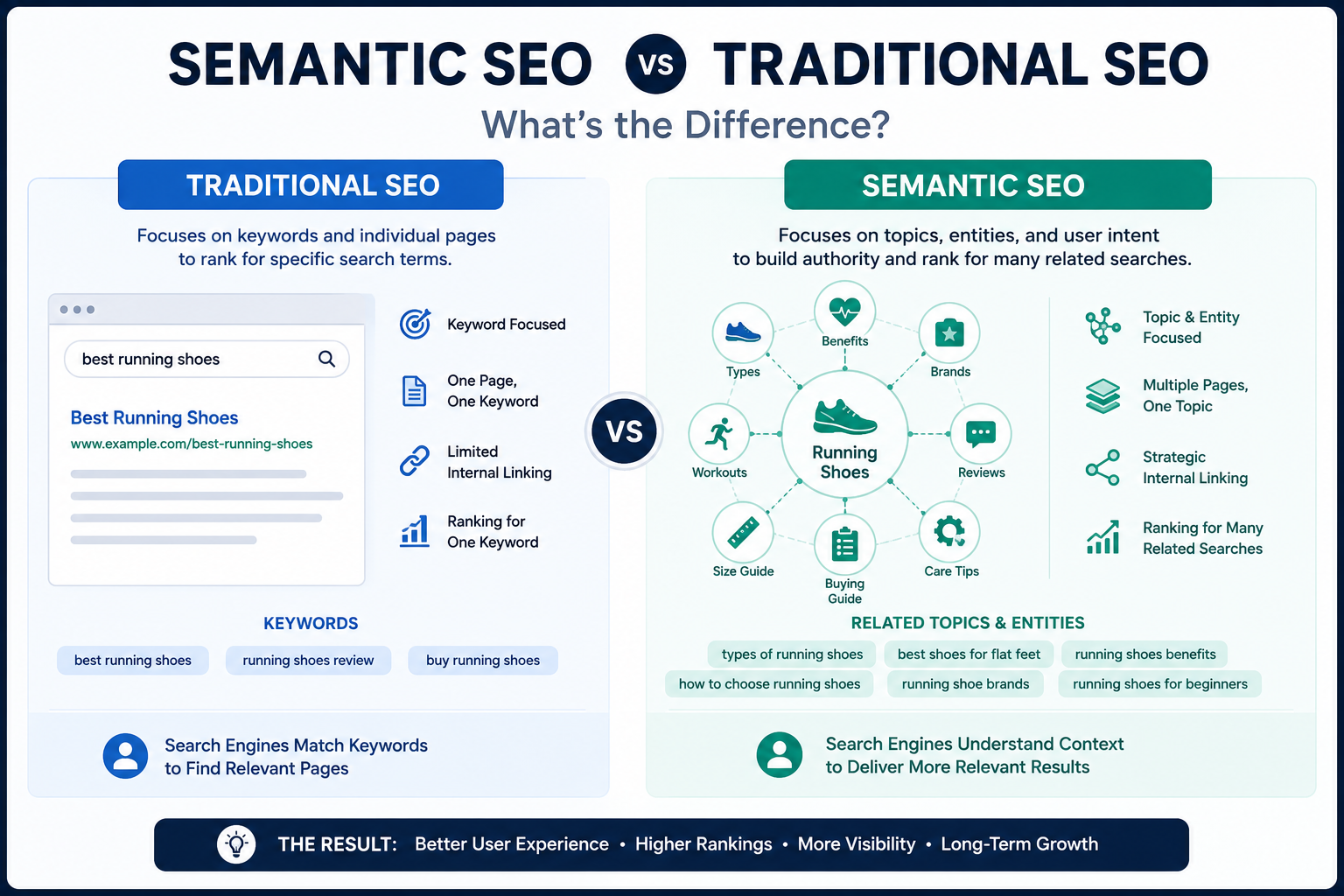
Semantic SEO vs Traditional SEO
The distinction is often exaggerated.
Semantic SEO is not a completely separate replacement for traditional SEO.
Consider the difference as one of emphasis.
| Traditional keyword-led approach | Semantic SEO approach |
|---|---|
| Starts with keywords | Starts with topics and user needs |
| Focuses on individual queries | Connects related queries |
| Measures rankings | Considers broader visibility and coverage |
| May optimise individual pages | Considers relationships between pages |
| Uses keyword variations | Uses concepts and entities naturally |
| Focuses heavily on target terms | Focuses on meaning and intent |
| Can be page-centric | Can be topic and architecture-centric |
| Often begins with keyword research | Begins with topic, intent and entity research |
A good SEO strategy can use both.
You still need to understand the language people use.
You still need to target relevant queries.
You still need technically sound pages.
You still need crawlability and indexability.
You still need links and useful information.
The semantic approach simply asks a bigger question:
Does the website demonstrate meaningful understanding of the subject rather than merely matching a phrase?
Semantic SEO and AI Search Visibility
This is where the subject becomes particularly important.
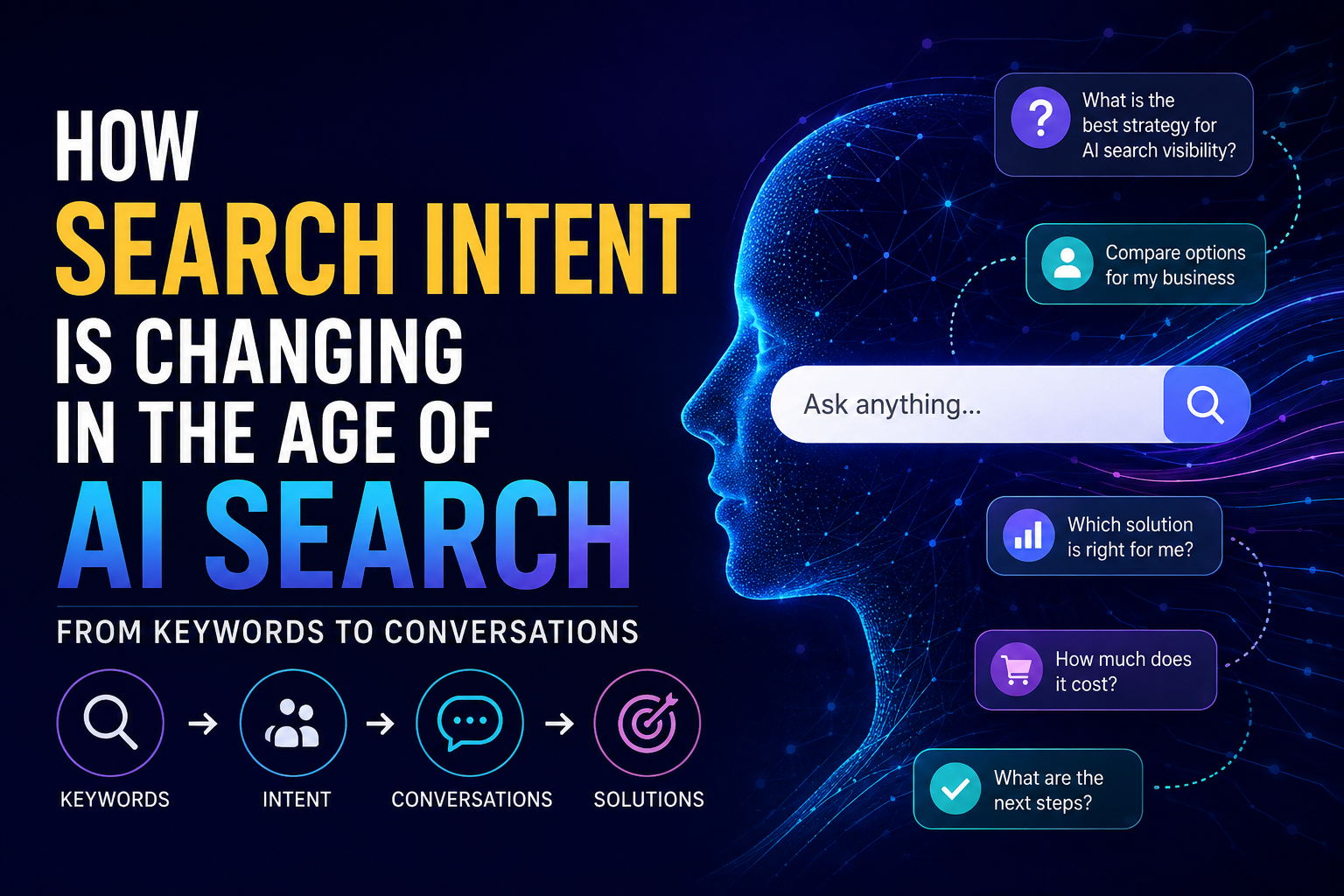
Search behavior is increasingly conversational.
Instead of searching:
semantic SEO services
a person may ask:
What are semantic SEO services and who offers them?
Or:
How can semantic SEO services help my content rank higher?
Or:
What are the core components of semantic SEO services?
Your research contains exactly these kinds of AI prompts.
That changes the content strategy.
A page should not only target a keyword.
It should be capable of answering the underlying question clearly.
Is AEO/GEO Separate From SEO?
Not completely.
This is one of the most important points to understand.
AEO, or Answer Engine Optimization, is generally used to describe optimization aimed at systems that provide direct answers.
GEO, or Generative Engine Optimization, is generally used to describe optimization for generative AI search experiences.
These terms can be useful for describing a workflow.
However, they should not be treated as magical replacement strategies for SEO.
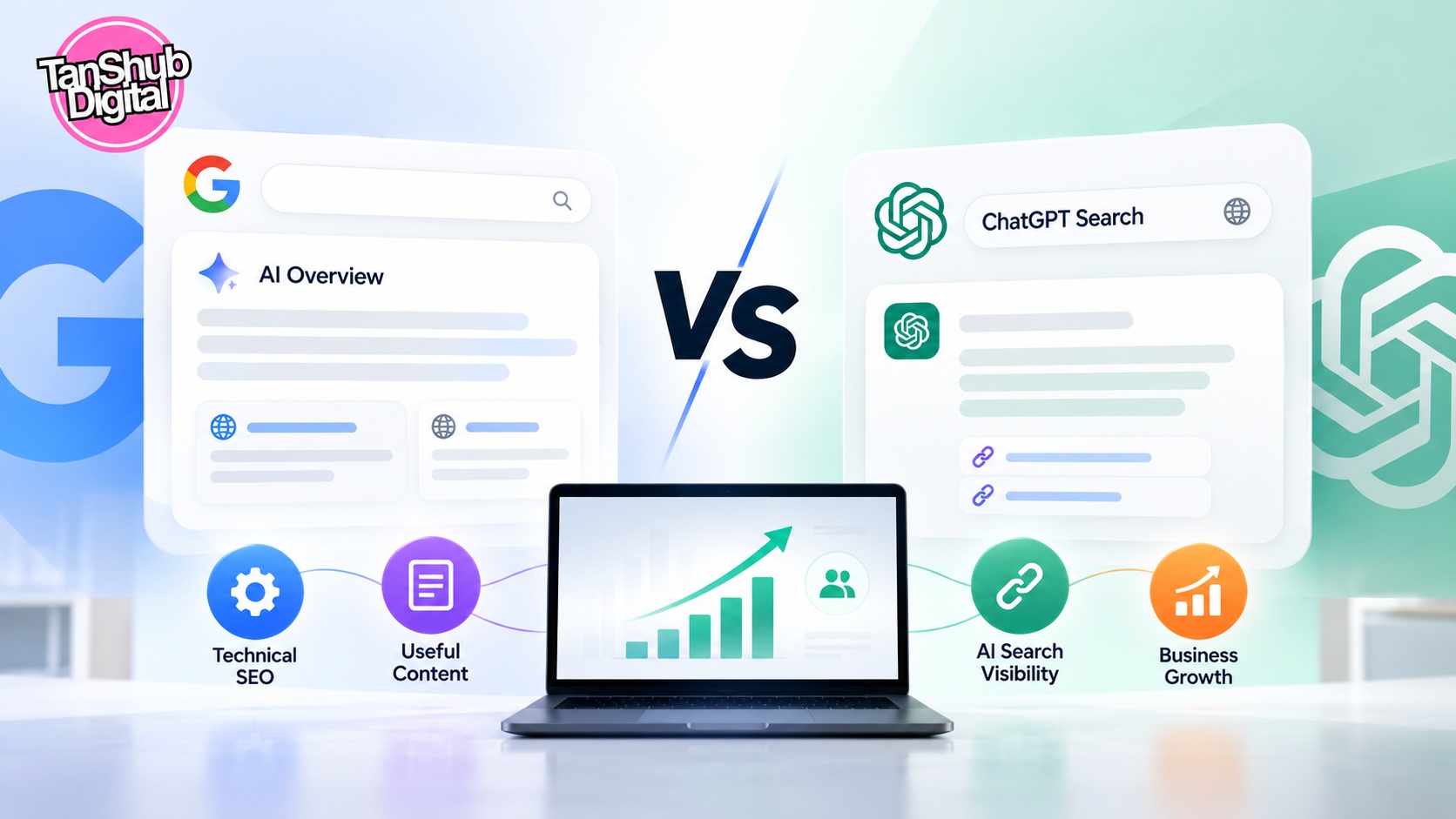
Google’s current guidance is explicit: its AI features continue to rely on foundational SEO practices. There are no additional technical requirements specifically required for inclusion in AI Overviews or AI Mode beyond being indexed and eligible for normal Search.
Google also warns against pursuing “AEO/GEO hacks” such as creating unnecessary pages for every possible query variation or using tactics designed primarily to manipulate generative responses.
Therefore, the better model is:
                SEO
                 │
       ┌─────────┴─────────┐
       │                   │
 Classic Search        AI Search
       │                   │
 Rankings              AI answers
       │                   │
       └─────────┬─────────┘
                 │
       Shared content foundation
                 │
      Helpful + authoritative +
      accessible + structured +
         genuinely valuable
This is why semantic SEO can act as a bridge.
How Semantic SEO Can Support Both Google and AI Search
The goal should not be:
Create one article for Google.
Then:
Create another article for ChatGPT.
That creates unnecessary duplication.
Instead, create a strong source page that can satisfy users regardless of where the discovery happens.
For example, this pillar page can answer:
- What is semantic SEO?
- How does semantic SEO work?
- What are semantic SEO techniques?
- Can semantic SEO improve content?
- What is topical authority?
- What is a semantic content audit?
- What do semantic SEO services include?
- How does semantic SEO differ from traditional SEO?
- How does semantic SEO relate to AI search?
The same page can therefore serve multiple discovery pathways.
Google can crawl and index it.
A user can find it through conventional search.
An AI search system can potentially retrieve and cite it when it is relevant to a user’s question.
OpenAI’s description of ChatGPT Search explains that the system can provide answers with links to relevant web sources and that search connects users with original web content.
That does not mean publishing a semantically rich article guarantees citation by ChatGPT or another AI system.
It means the strategic objective should be to create useful source material worth retrieving and citing.
The Four Case Studies Every Semantic SEO Strategy Should Aim to Demonstrate
If you sell semantic SEO services, theory alone is not enough.
You need evidence.
Case Study 1: How Semantic Restructuring Improved Organic Visibility
A realistic case study could begin with an existing website whose content is fragmented across many pages.
For example:
Page 1: SEO Services
Page 2: Semantic SEO
Page 3: Content SEO
Page 4: Keyword Research
Page 5: SEO Audit
Page 6: Topical Authority
The audit identifies overlapping subjects and weak relationships.
The restructuring could involve:
- consolidating overlapping pages
- defining a central pillar
- creating supporting pages
- improving internal linking
- aligning each page with a distinct intent
- improving content depth
- updating outdated information
The results should then be measured using actual data such as:
- organic clicks
- impressions
- indexed pages
- query coverage
- non-brand clicks
- rankings
- conversions
Do not claim that restructuring caused an improvement unless the data supports the conclusion.
Case Study 2: How Topical Clustering Expanded Non-Brand Search Visibility
Suppose a B2B website receives most of its organic traffic from branded searches.
The website has strong product pages but weak informational coverage.
A topical strategy could create clusters around the customer’s problems.
For example:
Core Product
│
├── Problem
│   ├── What is the problem?
│   ├── Why does it happen?
│   └── How can businesses solve it?
│
├── Solution
│   ├── Methods
│   ├── Best practices
│   └── Implementation
│
├── Evaluation
│   ├── Cost
│   ├── Comparison
│   └── Alternatives
│
└── Commercial
    ├── Product
    ├── Services
    └── Case Studies
The objective is to expand visibility beyond searches for the company’s name.
Again, actual performance should be measured rather than assumed.
Case Study 3: How Entity Optimization Improved Content Coverage
Imagine a technology company has dozens of articles discussing its platform.
However, the content inconsistently refers to:
- the company
- the product
- product features
- integrations
- industries
- use cases
- customers
- technologies
An entity audit can identify inconsistencies and missing relationships.
The content can then establish clearer connections.
For example:
Product X is a payroll platform used by Indian businesses to manage salary processing, statutory deductions and employee payroll workflows.
That sentence identifies relationships between:
Product X → payroll platform → Indian businesses → salary processing → statutory deductions → payroll workflows
The purpose is not to insert entities mechanically.
It is to make the information clearer.
Case Study 4: How Semantic Content Improved AI Search Visibility
This requires particularly careful measurement.
Suppose a company wants to understand how often AI systems mention it for relevant questions.
Start with a fixed prompt set:
- What are the leading providers of X?
- What is X?
- How does X work?
- What are the best solutions for X?
- What are alternatives to X?
- Which companies provide X services?
Record:
- whether the brand is mentioned
- whether competitors are mentioned
- whether the brand is cited
- which pages are referenced
- what claims are made
- whether the answer is accurate
- how visibility changes over time
Then improve the website’s underlying information:
- strengthen authoritative pages
- publish original research
- improve service descriptions
- create useful comparison content
- document expertise
- build relevant topic coverage
- improve internal linking
- ensure pages are crawlable and indexable
Then rerun the same prompts.
This is much more defensible than claiming:
“We optimized this page for GEO and ChatGPT started ranking it.”
AI systems can change their responses, retrieval sources and models. Therefore, AI visibility should be treated as a measurement problem, not a guaranteed ranking position.
How to Build a Semantic SEO Content Strategy
A practical strategy can follow this framework.
Step 1: Identify the business topic
Example:
Semantic SEO Services
Step 2: Identify the audience
For example:
- SaaS companies
- B2B companies
- e-commerce brands
- professional services
- technology companies
- agencies
Step 3: Identify user problems
For example:
- poor organic visibility
- fragmented content
- keyword cannibalization
- weak topical coverage
- outdated content
- poor internal linking
- weak content architecture
- declining non-brand traffic
- low AI search visibility
Step 4: Identify questions
Use actual questions such as:
What is semantic SEO?
How do you do semantic SEO?
Can semantic SEO help content?
What are semantic SEO techniques?
These questions are directly represented in your research.
Step 5: Map intent
Assign each question to an appropriate content type.
Step 6: Build the pillar
Create the central comprehensive resource.
Step 7: Build supporting pages
Create specialized pages only when they provide substantial additional value.
Step 8: Connect the pages
Use logical internal linking.
Step 9: Add evidence
Include:
- original research
- examples
- case studies
- screenshots
- data
- expert commentary
- documented methodology
Step 10: Measure
Track:
Traditional SEO
- impressions
- clicks
- rankings
- indexed pages
- organic conversions
- non-brand traffic
Content performance
- engagement
- assisted conversions
- page-level conversions
- internal-link clicks
AI visibility
Where measurable:
- brand mentions
- citations
- source inclusion
- competitor mentions
- prompt-level visibility
- accuracy of AI-generated descriptions
What a Semantic SEO Audit Should Examine
A comprehensive audit should examine six layers.
Layer 1: Topic
What subjects does the website own?
Layer 2: Intent
Does each important page satisfy the reason behind the search?
Layer 3: Entities
Are important concepts and relationships clearly represented?
Layer 4: Architecture
Are related pages organized logically?
Layer 5: Content
Does each page provide meaningful value?
Layer 6: Discoverability
Can search engines and users actually access the content?
Google’s technical requirements remain fundamental. A page needs to be accessible to Google’s systems and eligible to appear in Search before it can potentially appear as a supporting link in AI Search features.
Common Semantic SEO Mistakes
Mistake 1: Treating semantic SEO as keyword stuffing
Adding related keywords without improving the content does not create semantic depth.
Mistake 2: Creating hundreds of pages
More pages do not automatically create authority.
Google specifically warns against producing large quantities of content primarily for search engines and against creating pages for every possible query variation merely to manipulate visibility.
Mistake 3: Writing generic AI content
AI can help with research, organization and drafting.
But generic AI output is not automatically authoritative.
Google’s guidance says AI-generated content does not receive a special ranking advantage and that content should still be useful, original and aligned with quality expectations.
Mistake 4: Confusing topical authority with a ranking score
There is no need to invent a “topical authority score” and present it as an official Google metric.
Use topical authority as a strategic framework.
Mistake 5: Treating GEO as a collection of hacks
There is no reliable shortcut such as writing a certain number of words, adding a particular file or repeating a phrase a fixed number of times.
Google’s current AI-search guidance specifically pushes site owners toward foundational SEO and valuable content rather than “AEO/GEO hacks.”
Mistake 6: Creating separate Google and AI content unnecessarily
A well-researched, useful source can serve multiple discovery environments.
The better question is:
Would this page be useful to a human who arrives from Google, an AI answer or a direct referral?
If the answer is yes, the content has a stronger foundation.
The Future of Semantic SEO
Search is becoming more conversational.
Users increasingly ask complete questions rather than entering isolated keywords.
AI systems can interpret longer questions and retrieve information from multiple sources.
Google’s current guidance recognizes that users are asking longer and more specific questions in AI search experiences.
That makes semantic understanding increasingly relevant.
But the future is not:
Keywords are dead.
Nor is it:
SEO is dead.
The more realistic development is:
Search systems are becoming better at understanding meaning, context and intent, so websites need to become better sources of useful, structured and trustworthy information.
That is the strategic role of semantic SEO.
Semantic SEO, SEO and AI Search: One Integrated Strategy
The strongest model is not:
SEO
+
AEO
+
GEO
as three completely separate services.
A more useful model is:
                 SEARCH VISIBILITY
                        │
        ┌───────────────┼───────────────┐
        │               │               │
   Google Search    AI Search       Direct Users
        │               │               │
        └───────────────┼───────────────┘
                        │
               CONTENT FOUNDATION
                        │
       ┌────────────────┼────────────────┐
       │                │                │
   Search Intent   Semantic Coverage   Expertise
       │                │                │
       ├────────────────┼────────────────┤
       │                │                │
  Topic Clusters     Entities       Internal Links
       │                │                │
       └────────────────┼────────────────┘
                        │
              Valuable Original Content
This is the key idea.
Semantic SEO can become the connective layer between traditional SEO and AI-search visibility.
You research what people want.
You understand the concepts behind those questions.
You organize the website around those concepts.
You create useful content.
You connect related resources.
You demonstrate expertise.
You make the information technically accessible.
Then the same underlying content can potentially serve multiple search environments.
Frequently Asked Questions About Semantic SEO
What is semantic SEO?
Semantic SEO is an approach to search optimization that focuses on topics, meaning, relationships, entities and search intent rather than treating individual keywords as isolated ranking targets.
How do you do semantic SEO?
Start with a core topic, research related questions and concepts, analyze search intent, create topic clusters, develop useful content, establish logical internal links, clarify entities and relationships, audit existing content and improve the site’s overall information architecture.
Can semantic SEO help content?
It can help make content more comprehensive, relevant, structured and aligned with user needs. However, semantic SEO is not a guaranteed ranking factor or shortcut. Search performance depends on many factors.
What are semantic SEO techniques?
Common techniques include search-intent analysis, topic clustering, content-gap analysis, entity optimization, semantic content optimization, internal linking, content consolidation, topical content planning and structured information architecture.
What is a semantic SEO tutorial?
A semantic SEO tutorial explains how to apply these principles in practice, from topic research and intent mapping through content creation, internal linking and performance measurement.
What is a semantic SEO course?
A semantic SEO course typically teaches the concepts and workflows used to research topics, analyze search intent, develop content clusters, optimize pages and build topical coverage. The quality of a course depends on its methodology, evidence and how current its material is.
What is SEO topical authority?
Topical authority is an industry concept describing the depth and breadth of useful coverage a website demonstrates around a subject. It should not be treated as a single official Google ranking score.
What is an SEO content audit?
An SEO content audit evaluates existing pages for relevance, quality, search intent, performance, duplication, internal linking, topical coverage, freshness and opportunities for improvement.
What are semantic SEO services and who offers them?
Semantic SEO services are professional SEO services that focus on topic coverage, search intent, entities, content architecture, internal linking, content optimization and related areas. Providers range from specialist SEO consultants to agencies offering broader organic-search services.
How can semantic SEO services help my content rank higher?
They can improve content relevance, completeness, information architecture and alignment with search intent. These improvements may support search performance, but no responsible provider should guarantee rankings solely from semantic optimization.
How do semantic SEO services address content quality issues?
They can identify thin, outdated, repetitive or overlapping content, uncover missing topics, improve structure, consolidate competing pages and introduce more useful information, evidence and expert context.
What are the core components of semantic SEO services?
A robust service can include topic research, search-intent analysis, semantic keyword research, topic clustering, entity analysis, content audits, content optimization, internal linking, information architecture, structured data review, content-gap analysis and measurement.
Final Takeaway
Semantic SEO is not about finding a secret list of keywords.
It is about making a website meaningfully useful for a subject.
The research around “semantic SEO services” shows a clear progression:
What is it?
↓
How does it work?
↓
How do I implement it?
↓
What techniques are involved?
↓
Can it improve my content?
↓
How does it compare with traditional SEO?
↓
Who provides it?
↓
What does it cost?
↓
Can it improve my search visibility?
And now another question increasingly matters:
Can my content become a useful source when people ask AI systems the same questions?
That is where semantic SEO becomes strategically interesting.
The answer is not to create one version of your content for Google and another for AI.
Instead, build a strong information foundation that serves both.
Create content around real user needs.
Cover important concepts comprehensively.
Connect related subjects logically.
Use entities naturally.
Strengthen internal linking.
Demonstrate expertise.
Add original information and experience.
Keep content accurate and current.
Make pages technically accessible.
Then measure both traditional organic performance and, where reliable measurement is available, visibility across AI search experiences.
Google’s current guidance reinforces this direction: its AI search features continue to rely on foundational SEO, while valuable, unique, non-commodity and people-first content remains central.
The future of semantic SEO is therefore not “SEO versus AI search.”
It is the development of content and websites that can be understood, discovered and useful across both traditional search and increasingly conversational AI-driven discovery.