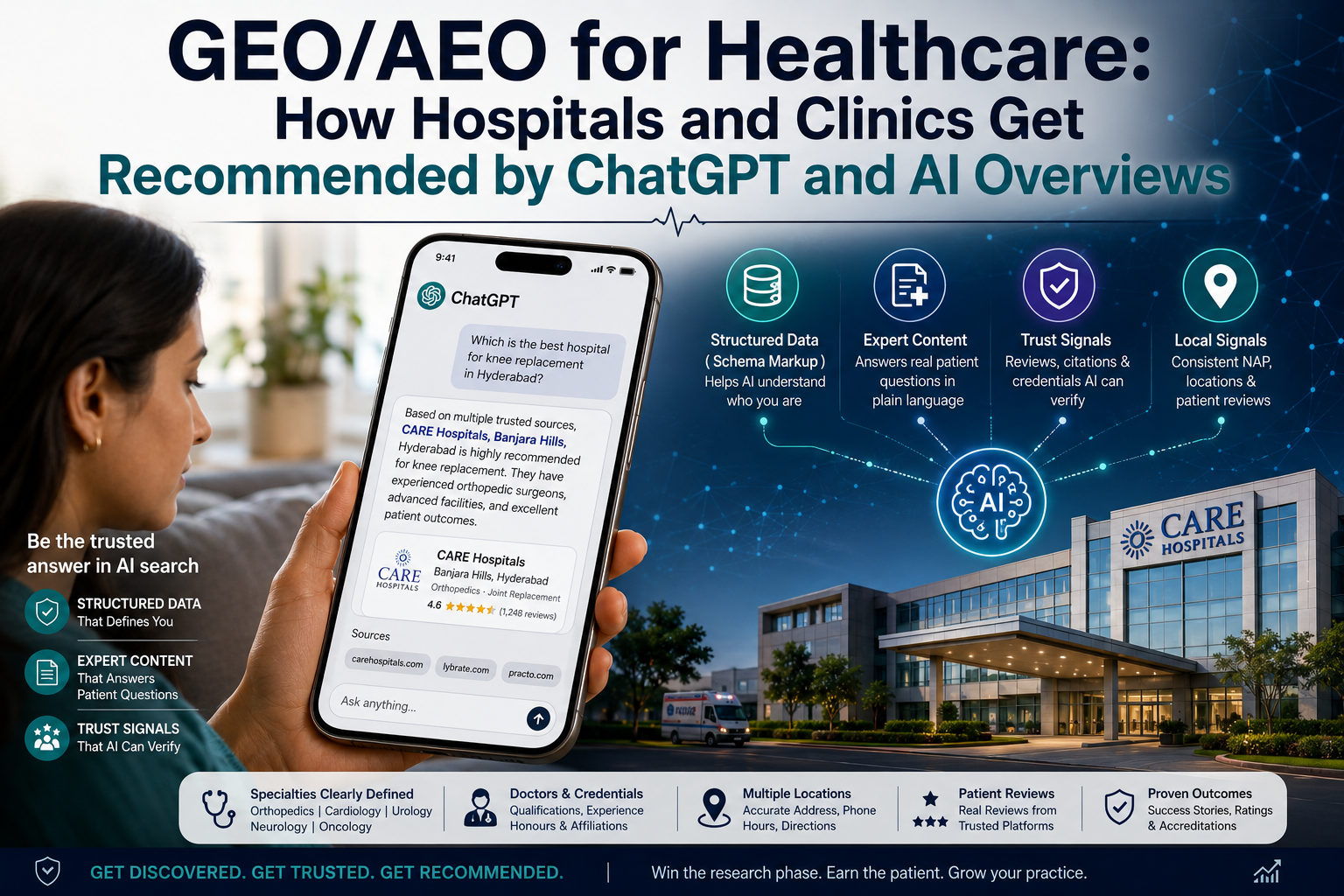
Quick answer: Hospitals and clinics get recommended by ChatGPT and Google AI Overviews the same way they get trusted by patients — by being clearly defined (structured data that names your specialties, doctors, and locations), clearly written (content that answers real patient questions in plain language), and independently verified (reviews, citations, and credentials AI systems can check). That means combining healthcare schema markup, condition-and-treatment content built for extraction, and consistent local signals — not just a Google Business Profile and a hope.
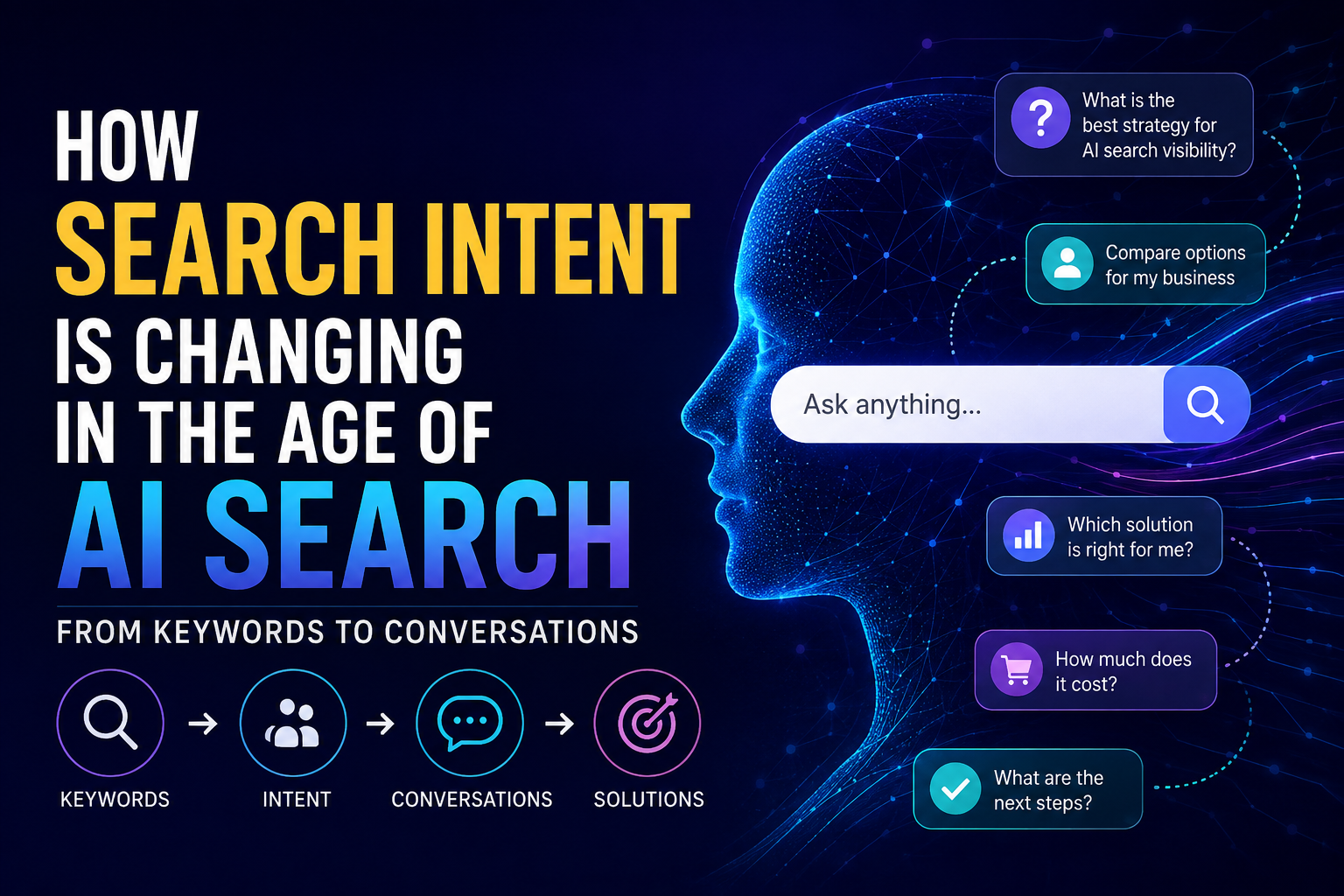
Patients are already asking AI platforms things like “best cardiologist for a second opinion” or “which hospital near me treats kidney stones without surgery.” If your hospital or clinic isn’t structured for AI to find and trust, you’re invisible in that conversation — even if you rank on page one of Google.
This guide breaks down exactly how AI recommendation works for healthcare, and what a hospital, multi-specialty clinic, or individual practitioner needs to do about it in 2026.
Why This Matters Right Now for Healthcare Providers
Search behavior for health information has shifted faster than most hospital marketing teams have caught up with.
- ChatGPT now handles hundreds of millions of health and wellness questions every week globally, and that volume keeps climbing.
- The large majority of Google health searches now trigger an AI Overview before a single blue link appears, which means many patients never scroll to the traditional results at all.
- Research comparing patient behavior across platforms found a clear pattern: ChatGPT wins the research phase (patients use it to understand symptoms, compare treatment options, and decide what kind of specialist they need), while Google still wins the booking phase (patients search for a specific name near them once they’ve decided). A hospital that only optimizes for the booking-phase search and ignores the research-phase conversation is losing patients before they ever type a location-based query.
For any hospital competing against larger, better-funded health systems, this is either a serious threat or a serious opportunity — depending on who moves first.
Why AI Tends to Recommend Hospitals Over Independent Clinics (And What Smaller Practices Can Do)
Recent research auditing thousands of AI health queries found a consistent pattern: when patients ask AI platforms for a doctor or specialist recommendation, the names that come back are disproportionately attached to larger hospital systems rather than independent practices — because AI can only cite a source it has structured, verifiable information about. If a hospital has organized schema, published condition-specific content, and a visible citation trail, and an independent clinic has none of that, the AI defaults to what it can verify.
The same research also found something reassuring for independent clinics and single-specialty centers: patients still read reviews and site content before booking, even after AI gives them a shortlist. That means a well-optimized independent clinic can absolutely compete with large hospital chains for AI citations — it just has to do deliberately what the big systems do by scale: define itself clearly, publish depth on its specialties, and make its credibility verifiable.
The Three Layers of Healthcare GEO/AEO
GEO for healthcare isn’t one tactic — it’s three layers working together. Skipping any one of them caps how far the other two can take you.
1. Entity Clarity (Structured Data)
AI systems don’t “read” your website the way a person does. They extract entities — your hospital, your doctors, your specialties, your locations — from structured data. Without it, an AI system is guessing at who you are from unstructured text, and guessing sources rarely get cited.
Minimum schema stack for a hospital or clinic:
| Schema Type | Where to Use It | What It Signals |
|---|---|---|
MedicalOrganization or MedicalClinic | Homepage, About page | Establishes you as a verified healthcare entity, not just a generic business |
Physician | Every doctor’s individual profile page | Credentials, specialty, medical school, registration/license number, affiliations |
MedicalProcedure / MedicalCondition | Every treatment and condition page | Connects what you treat to how you treat it — the entity graph AI relies on |
MedicalWebPage with reviewedBy + lastReviewed | Every clinical blog post or condition page | The single strongest E-E-A-T signal for AI citation eligibility — shows medical review, not just marketing copy |
FAQPage | Any page with 4+ genuine patient questions | Lets AI extract your exact Q&A wording directly into its answer |
LocalBusiness properties (nested in MedicalOrganization) | Every location page | Address, phone, hours, geo-coordinates — must match your Google Business Profile exactly |
The two most commonly skipped — and highest-impact — are Physician schema on individual doctor pages and reviewedBy/lastReviewed on clinical content. Most hospital websites have neither, which is a fast way for a smaller, better-structured competitor to out-cite them.
2. Content Built for Extraction, Not Just Ranking
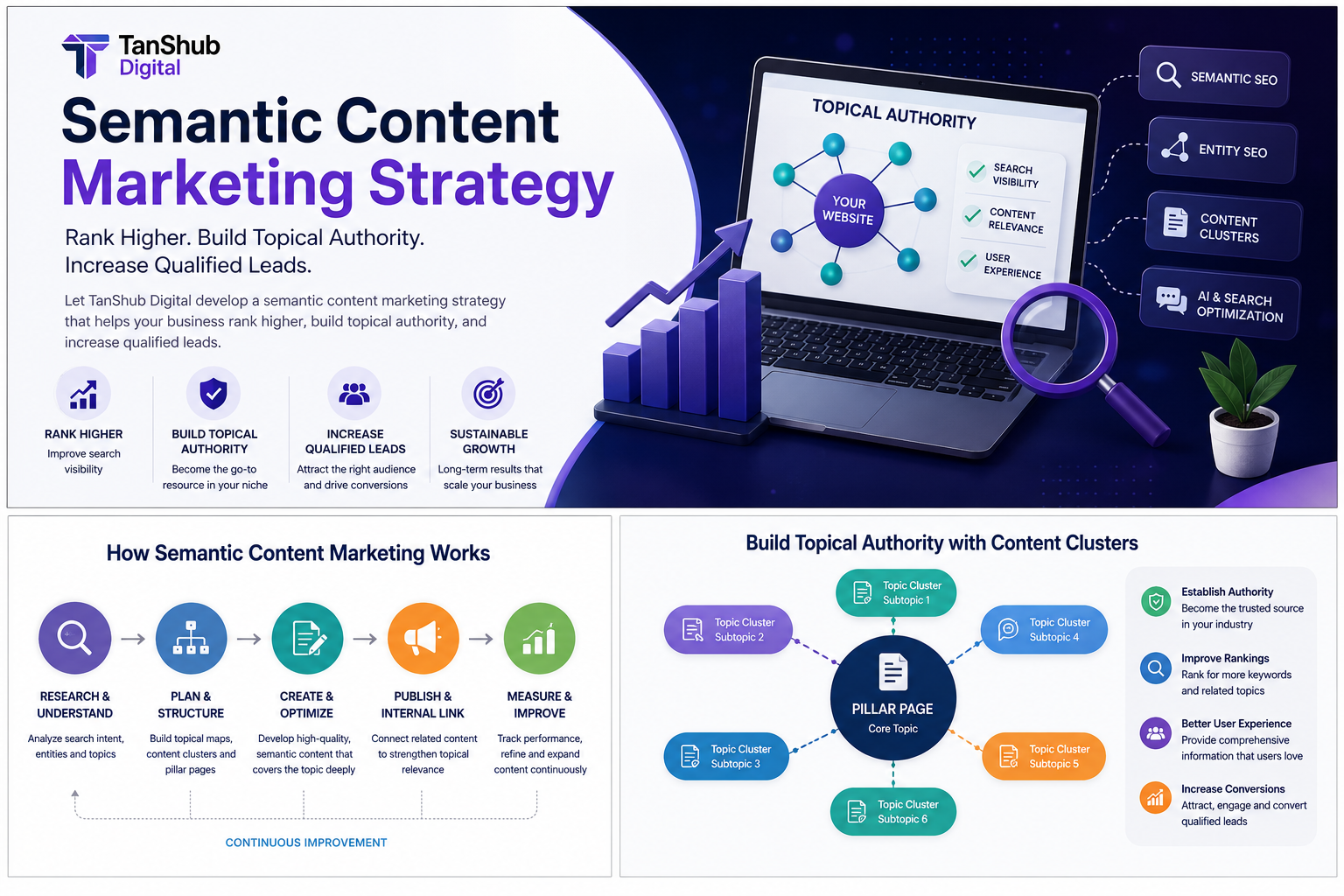
Generative engines increasingly reward topic comprehensiveness over keyword density — they’re synthesizing an answer, not matching a phrase. That changes how healthcare content needs to be written:
- Lead with the direct answer. If the page is about kidney stone treatment, the first two sentences should state what it is and what the options are — not three paragraphs of hospital history before getting there.
- Structure around real patient questions, not just service names. “Is a hysterectomy the only option for fibroids?” gets extracted into an AI answer far more often than a page titled only “Gynecology Services.”
- Write one comprehensive page per condition or treatment, not a dozen thin ones. AI systems favor sources that cover a topic thoroughly enough to be cited as the answer, not just linked as further reading.
- Name your doctors and their credentials inside the content itself, not only in schema. “Dr. [Name], MD (Cardiology), 14 years in practice, board-certified, Registration No. [X]” reads as a trust signal to both patients and AI systems.
3. Verifiable Authority (Citations, Reviews, and Consistency)
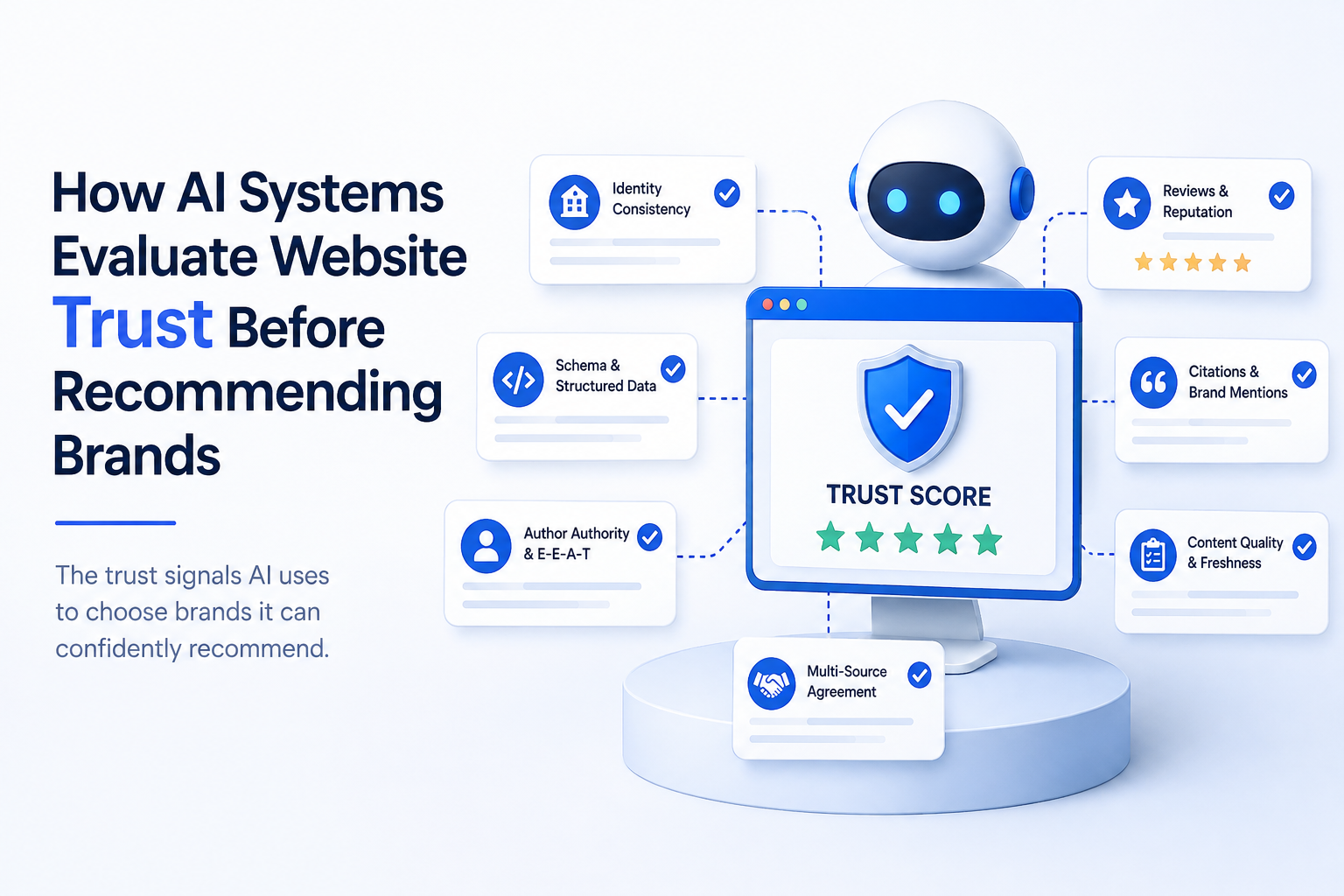
AI systems weigh whether other sources agree with what you say about yourself. That means:
- NAP consistency (Name, Address, Phone) across your website, Google Business Profile, and every major health directory you’re listed on — a mismatched address or phone number between your site and a directory listing actively undermines your AI trust signals.
- Genuine patient reviews, actively requested post-visit, not just displayed as a widget. Review volume and recency are both trust inputs.
- Accreditation and registration details stated clearly: hospital accreditation, medical council or licensing board registration numbers, insurer empanelment — these are exactly the kind of verifiable facts AI systems look for before recommending a healthcare provider, given how cautious they’re built to be around medical claims.
Local and Hyperlocal GEO Tactics
Generic “best hospital” content competes with every hospital in the country. Hyperlocal content competes with a handful of providers in your actual service radius — and it’s exactly the kind of specific, well-covered topic AI systems prefer to cite.
Practical moves:
- Build locality-specific service pages where genuinely relevant — a cardiac care page for one branch is different content from another branch, not a duplicate with the area name swapped.
- Target the way patients actually search: “orthopedic hospital near [neighborhood],” “maternity hospital [area] cost,” “24-hour emergency near [landmark].” These hyperlocal, high-intent phrases have a fraction of the competition of “best hospital in [city].”
- Keep every location’s geo-coordinates, opening hours, and emergency contact in schema and on-page, matched exactly to Google Business Profile.
- If you serve a multilingual patient base, consider local-language FAQ content alongside your primary language — AI systems increasingly serve answers in the query’s language, and structured local-language healthcare content is still rare in most markets.
- Publish cost-transparency content (“What does [procedure] cost”) where you can do so accurately and compliantly — this is a heavily AI-queried topic in healthcare search and one most providers leave to random forums and aggregator sites to answer for them.
A Compliance Note
Healthcare is treated as YMYL (Your Money or Your Life) content by both Google and AI systems, which means the trust bar is deliberately high. A few non-negotiables:
- Every clinical claim should be attributable to a named, credentialed reviewer — not just “our team.”
- Never publish patient-identifiable information or case details that could constitute a privacy breach.
- Keep pricing and outcome claims factual and current; AI systems are cautious about citing sources that make unverifiable medical claims, and outdated pricing erodes trust fast.
- Align all content with your relevant medical council, licensing board, and advertising-standards guidelines (these vary by country and state/region).
A 30-Day GEO/AEO Action Plan for a Hospital or Clinic
- Week 1: Audit — self-test 15-20 patient-style prompts in ChatGPT and Google AI Overviews (“best [specialty] hospital near [your area]”) and record whether and how you’re mentioned.
- Week 1-2: Implement
MedicalOrganization/MedicalClinicschema on your homepage and location pages; align NAP across your site, Google Business Profile, and top health directories. - Week 2-3: Add
Physicianschema to every doctor profile with full credentials; addFAQPageschema to your top five most-visited service pages. - Week 3-4: Rewrite or build one comprehensive, medically-reviewed page per core specialty, leading with direct answers and structured for extraction, with
MedicalWebPage+reviewedBy+lastReviewedschema. - Ongoing: Request reviews systematically post-visit, publish one new condition/treatment page per month, and re-run your AI citation audit quarterly to track movement.
Frequently Asked Questions
How do I know if ChatGPT or Google AI Overviews already mentions my hospital? Run a set of realistic patient prompts — specialty plus locality, symptom plus “which hospital” — through ChatGPT, Perplexity, and Google directly, and record whether your hospital, a competitor, or neither is named. This costs nothing and takes under an hour, and it’s the starting point for any GEO strategy.
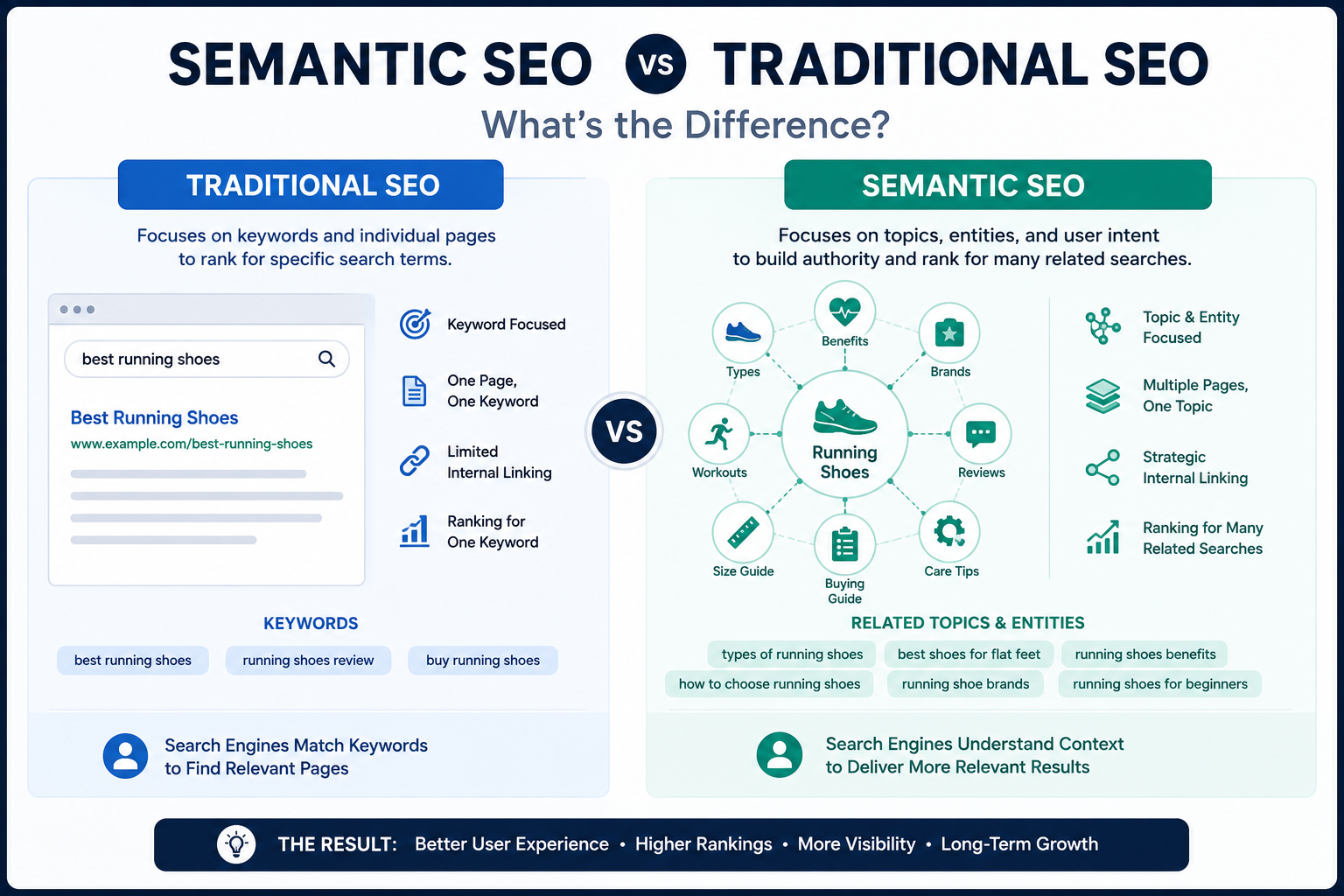
Is GEO/AEO different from regular SEO for hospitals? They overlap heavily but aren’t identical. Traditional SEO optimizes to rank a page in a list of links. GEO/AEO optimizes to be the source an AI system extracts and cites inside a synthesized answer — which puts far more weight on structured data, direct-answer content, and verifiable credentials than on keyword placement alone.
Do small clinics and individual doctors have a real chance against large hospital chains for AI visibility? Yes. AI citation research shows the deciding factor is structured, verifiable information, not size. A single-specialty clinic with complete schema, medically-reviewed content, and consistent local listings can out-cite a large hospital that has neither.
What’s the single highest-impact fix for a hospital website right now? For most sites, it’s adding Physician schema to individual doctor pages and MedicalWebPage schema with reviewedBy/lastReviewed to clinical content — these two are the most commonly missing and the most directly tied to E-E-A-T-based citation eligibility.
Does this replace the need for Google Business Profile and local SEO? No — it builds on it. Your Google Business Profile, NAP consistency, and review volume remain foundational. GEO/AEO adds the structured-data and content layer that determines whether AI systems can confidently extract and cite you on top of that local foundation.