Introduction
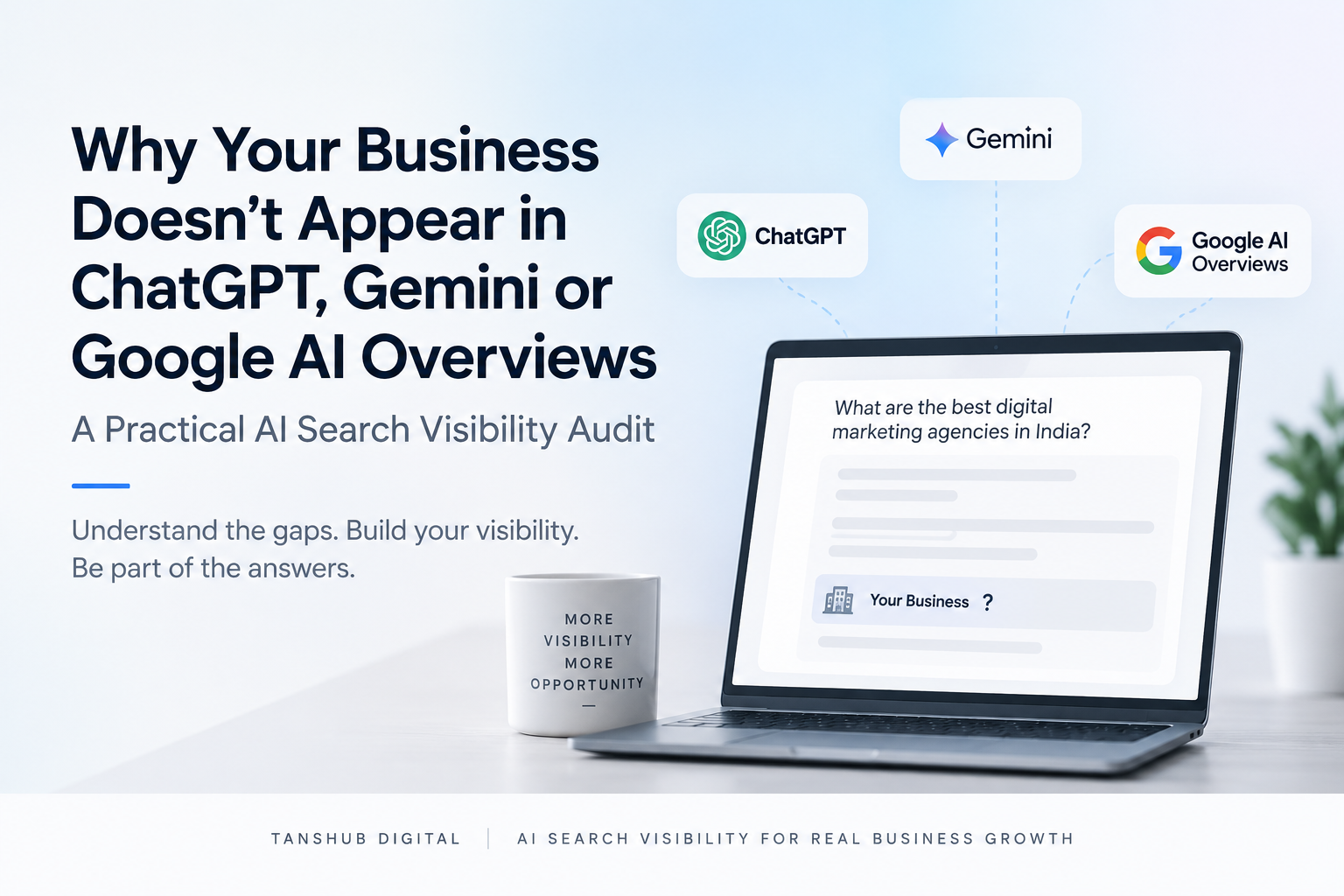
Your website can rank in Google Search without appearing in a Google AI Overview. It can also contain useful information without being cited by ChatGPT Search when potential customers ask questions about your industry.
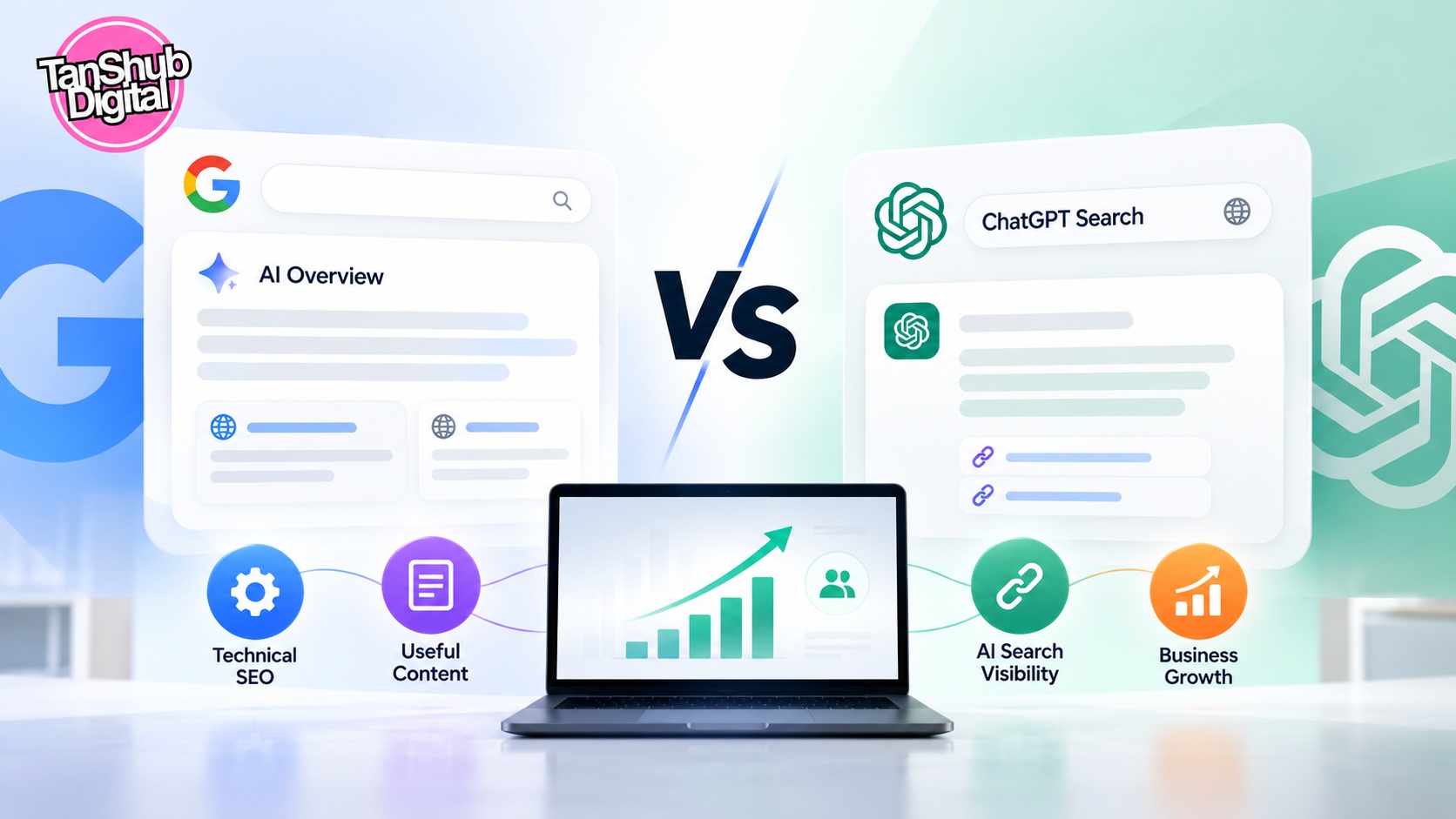
For businesses investing in SEO, this raises an important question: should you optimize for Google AI Overviews and ChatGPT Search differently, or can the same strategy improve visibility across both?
The answer is to build on strong SEO fundamentals while addressing the technical requirements, content gaps and measurement opportunities of each platform.
Google AI Overviews integrates AI-generated summaries into Google Search. ChatGPT Search combines conversational answers with web search and source links. Both can help potential customers discover your business, but their technical access requirements, search experiences and reporting options differ.
Consequently, ranking in traditional search, earning an AI citation and attracting qualified website traffic are related outcomes, but they are not interchangeable.
This guide explains how Google AI Overviews and ChatGPT Search differ, which optimization practices apply to both, what businesses should check separately and how to prioritize improvements based on commercial value.
The goal is not to chase an AI ranking trick. It is to make your website accessible, useful, credible and relevant when potential customers search for the products or services you offer.
1. Google AI Overviews vs ChatGPT Search: Key Differences
Google AI Overviews provides AI-generated summaries within Google Search when Google’s systems determine that they can help answer a query. These summaries can include links to supporting websites.
ChatGPT Search lets users ask questions conversationally and receive answers that may include links to relevant web sources. Users can refine their questions through follow-up interactions.
Although both experiences help people discover information, businesses should understand their differences before deciding how to optimize their websites.
| Comparison factor | Google AI Overviews | ChatGPT Search |
|---|---|---|
| Search environment | Integrated into Google Search | Integrated into the ChatGPT experience |
| Discovery foundation | Google’s Search index, crawling, indexing and ranking systems | Web search and retrieval, including OpenAI’s documented search crawler |
| Technical starting point | Pages must be indexed and eligible to appear in Google Search with a snippet | Relevant pages must be accessible to OAI-SearchBot to be eligible for inclusion in ChatGPT Search answers |
| Content priority | Helpful, original content that satisfies the query and follows Google’s Search policies | Relevant, useful content that can be retrieved and cited for the user’s question |
| Measurement | Google’s generative AI performance reporting in Search Console | Observed citations, brand mentions and identifiable referral traffic |
| Key limitation | Eligibility does not guarantee an appearance | Crawler access does not guarantee a citation |
Sources: Google Search Central: AI features and your website and OpenAI: Overview of OpenAI crawlers.
These differences do not mean that businesses need two separate websites or duplicate content strategies. Instead, evaluate the same website against the discovery requirements and measurement opportunities of each platform.
For example, a product page may be indexed in Google but lack the details needed to answer a particular buying question. The appropriate response is to investigate the content gap, not assume that an AI-specific markup tag will solve the problem.
Similarly, a page may contain excellent information but be inaccessible to a crawler required for a particular search experience. That calls for a technical investigation rather than another round of content rewriting.
2. How Google AI Overviews and ChatGPT Search Discover Website Content
Understanding the discovery process helps businesses identify the right optimization priorities.
How Google AI Overviews work
Google’s AI search features build on its established Search infrastructure. A page generally needs to be indexed and eligible to appear in Google Search with a snippet before it can be considered as a supporting link in AI Overviews or AI Mode.
Google also documents query fan-out, in which AI search experiences can issue multiple related searches across subtopics and sources to help develop a response.
Consider someone researching payroll software for a growing company. Their questions may extend beyond the main product category to statutory reporting, implementation, integrations, pricing and security.
A useful website should provide accurate information about the requirements its product actually supports. Separate pages may be appropriate when they answer distinct questions, but publishing near-identical pages for minor keyword variations does not automatically improve visibility.
What to check on your website
- Open Google Search Console and inspect the URL you want to appear in search.
- Check its indexing status and resolve relevant technical issues.
- Review
robots.txt, canonical tags andnoindexdirectives. - Confirm that important content is available in a form Google can process.
- Check that the page is discoverable through relevant internal links.
- Ensure that its title, visible content and structured data accurately describe the same subject.
Google’s official guidance states that no additional technical requirements or special schema types are required specifically for inclusion in AI Overviews or AI Mode.
Reference: Google Search Central: AI features and your website.
How ChatGPT Search discovers website content
OpenAI documents OAI-SearchBot as the crawler used to help surface websites in ChatGPT Search.
GPTBot serves a different purpose, associated with crawling content that may be used to improve OpenAI’s generative AI foundation models. OpenAI allows website owners to manage these crawler settings independently.
This distinction matters because a business may want its pages to be discoverable in ChatGPT Search while making a separate decision about model-training access.
What to check on your website
- Open
https://yourdomain.com/robots.txt. - Check whether OAI-SearchBot is explicitly blocked by the applicable rules.
- Review CDN, firewall and bot-protection settings that could prevent legitimate crawler access.
- Check server logs, where available, for crawler requests and HTTP responses.
- Confirm that important service pages return successful HTTP responses and contain the intended content.
- Investigate access failures before rewriting otherwise useful content.
A simplified robots.txt example that allows OAI-SearchBot is:
User-agent: OAI-SearchBot
Allow: /
This is an illustrative rule, not a complete replacement for your existing file. Review how it interacts with other directives before making changes.
Allowing OAI-SearchBot does not guarantee that ChatGPT will cite your website. It makes the website accessible for consideration in ChatGPT Search, subject to the platform’s other systems.
Reference: OpenAI: Overview of OpenAI crawlers.
Diagnose the problem before choosing a solution
Suppose a service page appears in Google Search but does not appear in the ChatGPT answers you inspect.
There are three broad possibilities:
- Technical access problem: The page is blocked, unavailable or inaccessible to the appropriate crawler.
- Content relevance problem: The page does not adequately answer the question or provide the information a prospective customer needs.
- Source-selection problem: Other sources provide more relevant or useful information for that particular query.
These problems require different solutions. A technical fix will not necessarily resolve a content gap, and rewriting a page will not fix a blocked crawler.
A structured diagnosis prevents businesses from spending time on changes that do not address the actual problem.
3. What Should Businesses Optimize Differently?
The most effective AI Search Optimization strategy combines shared SEO foundations with platform-specific checks.
Optimize the foundations that support both platforms
Technical accessibility
Ensure that important pages return appropriate HTTP responses, are discoverable through internal links and are not unintentionally blocked by crawler directives or infrastructure settings.
Clear website architecture
Organize your website so visitors can understand the relationship between your services, products, industry expertise and educational content.
Useful, original content
Answer real customer questions with accurate information, relevant examples, evidence and clearly stated limitations. Avoid simply rewriting information already available on competing websites.
Consistent business information
Make sure your company name, services, product capabilities and other important facts are accurate and consistent across key website pages and relevant external profiles.
Accurate structured data
Use applicable schema markup when it helps describe visible page content or supports an eligible search feature. Do not treat structured data as a guaranteed AI citation mechanism.
Relevant internal linking
Link educational content to appropriate service pages and connect related articles when the links help readers understand a topic or take their next step.
Google’s official guidance emphasizes foundational SEO, useful content and technical accessibility for its generative AI search experiences. It does not recommend a separate set of mandatory AI ranking tricks.
Reference: Google’s guide to optimizing for generative AI features.
What to prioritize for Google AI Overviews
Start with your existing Search Console data and the queries that matter commercially.
Review pages receiving impressions but relatively few clicks. Investigate whether the page answers the query, whether its title accurately communicates its value and whether the content provides the detail a reader needs.
Do not assume that a low click-through rate proves an AI Overview is responsible. Standard Web performance reporting does not isolate every AI Overview impression from conventional search activity.
Where available, use Google’s dedicated generative AI performance reporting to evaluate supported AI search visibility. Combine those findings with indexing checks and broader organic search performance.
What to prioritize for ChatGPT Search
Start by confirming that relevant pages can be accessed by OAI-SearchBot.
Then evaluate whether the website provides useful information for the questions your prospective customers actually ask.
For example, a software company should not rely solely on a homepage statement such as “We deliver innovative business solutions.”
Its product pages should explain:
- The problems the product solves.
- The types of customers it serves.
- Its main capabilities and limitations.
- Supported integrations and implementation requirements.
- How it differs from alternatives, where a defensible comparison is possible.
- Supporting evidence, such as documented product capabilities or verified customer results.
These details make the page more useful to potential buyers and easier to evaluate. They do not guarantee selection by ChatGPT Search.
4. Worked Example: Optimizing a B2B SaaS Website
Consider a hypothetical payroll software company targeting businesses with approximately 500 employees.
A prospective customer asks:
“Which payroll software supports statutory compliance reporting and HR system integrations for a company with 500 employees?”
The company’s product page is indexed in Google but contains only a short feature list, a generic introduction and a contact form.
The page does not explain which integrations are supported, which reporting requirements it addresses or what implementation involves.
Adding the phrase “best payroll software for 500 employees” several times would not solve the information gap.
A more useful improvement plan would include the following steps.
Step 1: Clarify product capabilities.
Document the integrations, reporting functions, implementation requirements and limitations the product actually supports. Do not claim support for features that have not been verified.
Step 2: Address buying questions.
Explain which business requirements the software supports, what customers should verify and which requirements depend on configuration or third-party systems.
Step 3: Provide verifiable evidence.
Use current product documentation, relevant case studies or published technical specifications. Clearly distinguish supported capabilities from planned features.
Step 4: Improve internal links.
Connect the product page to relevant integration documentation, compliance resources and implementation guides.
Step 5: Check technical access.
Verify the page’s indexing status, relevant crawler access and HTTP responses.
Step 6: Evaluate the outcome.
Monitor conventional organic search performance, supported Google AI search impressions, observed ChatGPT citations and identifiable referral traffic separately.
This is an illustrative example, not a claim about observed results from a real company. It demonstrates how optimization can start with the customer’s question and the barriers preventing a website from answering it well.
The same work can benefit prospective customers regardless of where they discover the company.
5. How to Measure Visibility Across Both Platforms
AI Search Optimization needs a measurement framework that separates visibility from traffic and business outcomes.
| Metric | Where to measure it | What it tells you |
|---|---|---|
| Organic impressions and clicks | Google Search Console | How pages perform in conventional Web search reporting |
| Generative AI impressions | Google’s generative AI performance report, where available | Visibility in supported Google AI search features |
| Indexing status | Search Console URL Inspection | Whether Google has indexed a specific page |
| AI brand mentions | Documented tests of relevant AI queries | Whether the business is named in observed answers |
| AI citations | Saved AI responses and cited URLs | Whether a platform links to the business’s content |
| AI referral sessions | GA4 or another analytics platform | Visits arriving from identifiable AI sources |
| Qualified leads | CRM and lead reporting | Whether the business receives relevant enquiries |
| Revenue outcomes | CRM and sales reporting | Whether resulting opportunities contribute to revenue |
Do not combine these metrics into a single score without a defined methodology. A brand mention is not equivalent to a citation, and a citation is not equivalent to a qualified lead.
Build a repeatable ChatGPT Search test
Choose a manageable set of commercially important questions based on sales conversations, customer research and the services you offer.
For example:
- Which providers offer a particular service?
- What should a company consider before choosing a solution?
- Which products support a specific requirement?
- How do two credible alternatives compare?
- What implementation risks should buyers evaluate?
For each test, record the exact prompt, date, platform, market context, brand mention, cited URL and competitors shown.
Repeat the same tests periodically under consistent conditions.
For a defined test set, calculate:
Observed citation rate = Tests containing at least one citation to your website ÷ Total valid tests × 100
If your website is cited in 8 out of 40 valid tests, its observed citation rate for that test set is 20%.
That result applies only to the defined test set. It does not mean that your website receives 20% of all ChatGPT citations.
Keep brand mentions and citations separate. Also distinguish citations to your homepage from citations to specific product, service and educational pages.
Track AI referrals and conversions
Use analytics reports to identify visits from AI platforms where the source can be recognized. Keep those visits separate from conventional organic search traffic.
Then examine engagement, enquiry submissions and qualified opportunities.
For a B2B service business, meaningful conversions might include consultation requests, qualified contact form submissions, demo bookings or sales-qualified leads.
Not every AI-assisted discovery journey will appear as a referral. A prospect might encounter the company in an AI answer and return later through direct traffic or another channel.
Consequently, referral data provides useful evidence but cannot reveal every influence on a customer’s decision.
6. How Semantic SEO Supports AI Search Optimization
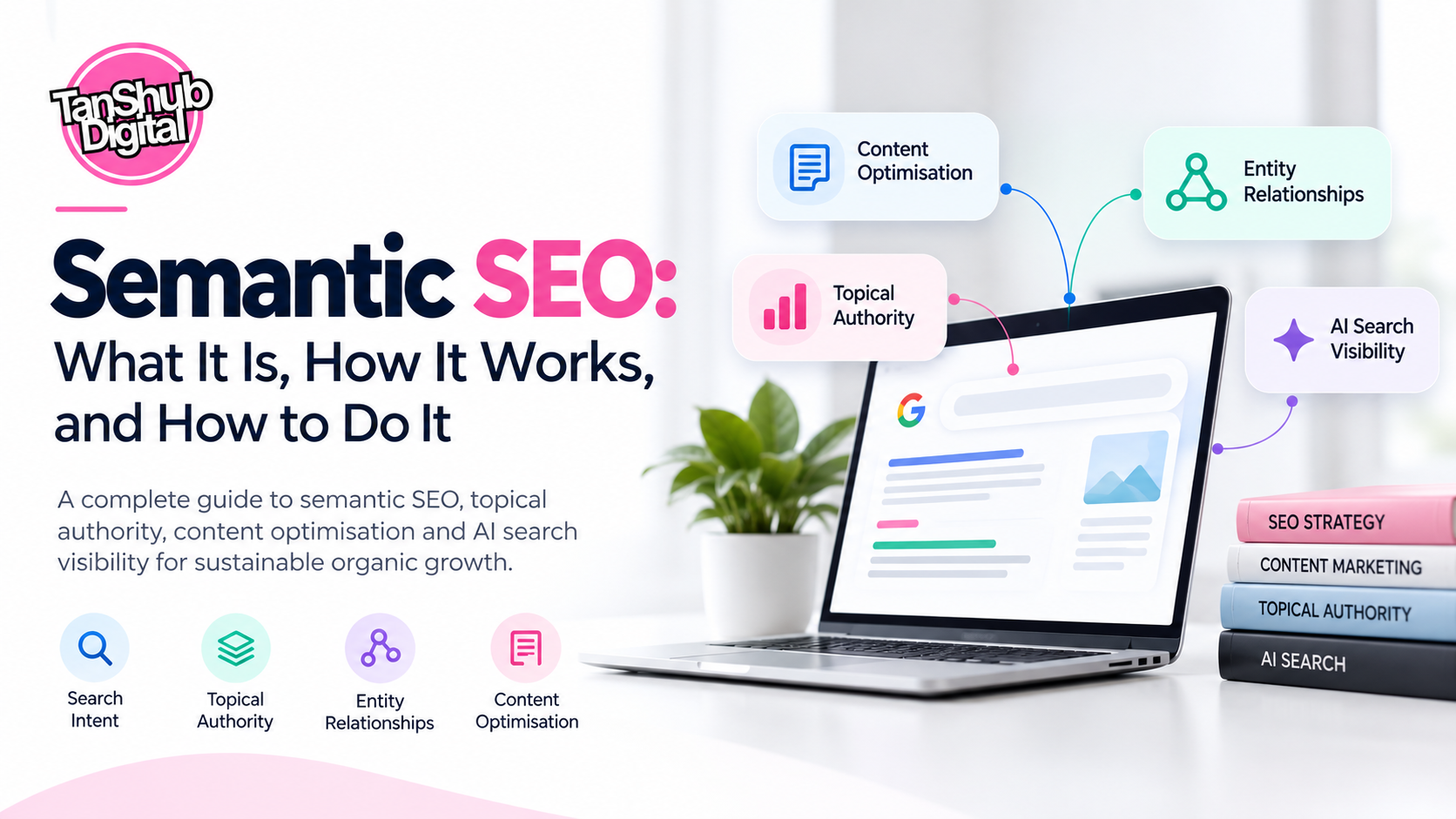
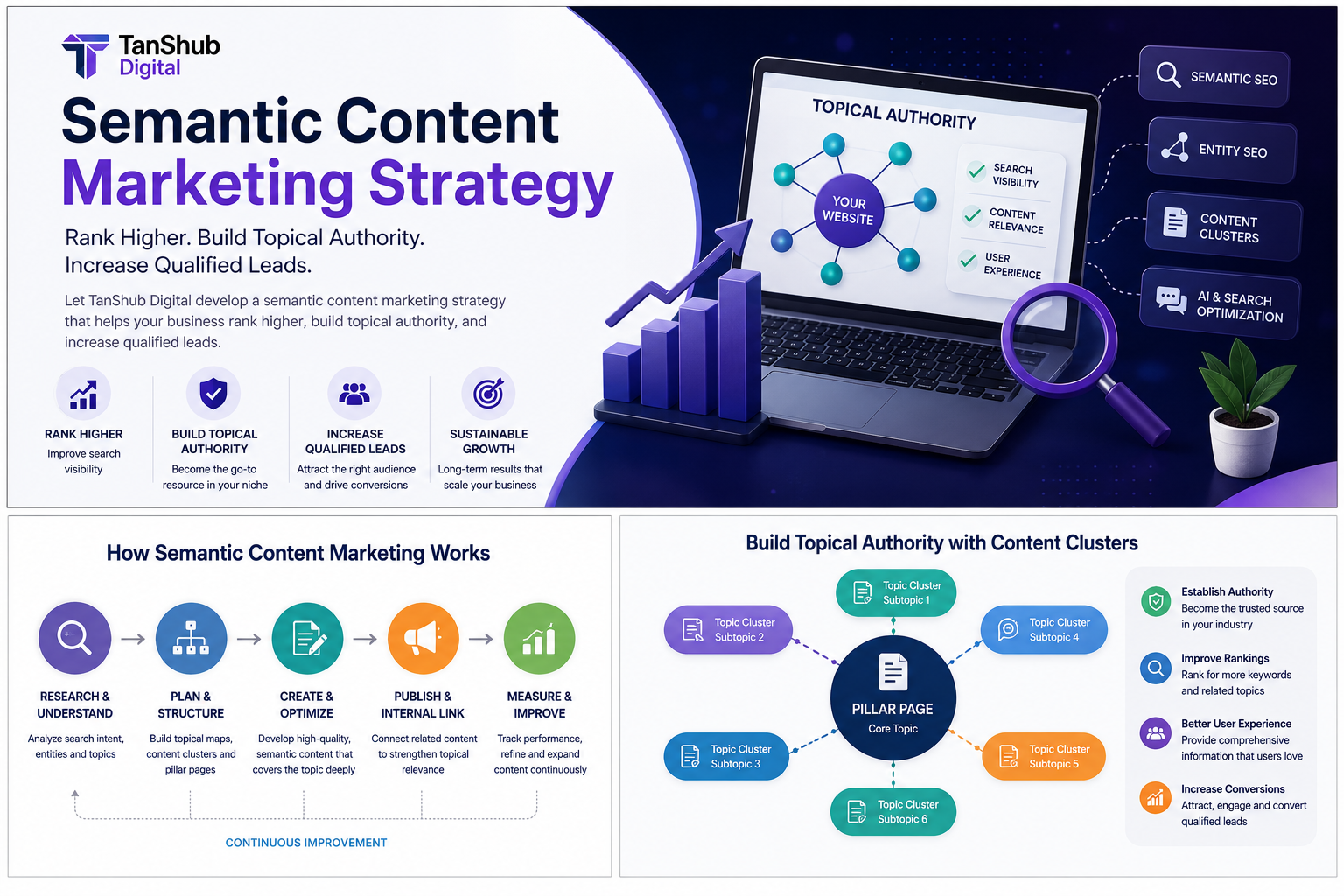
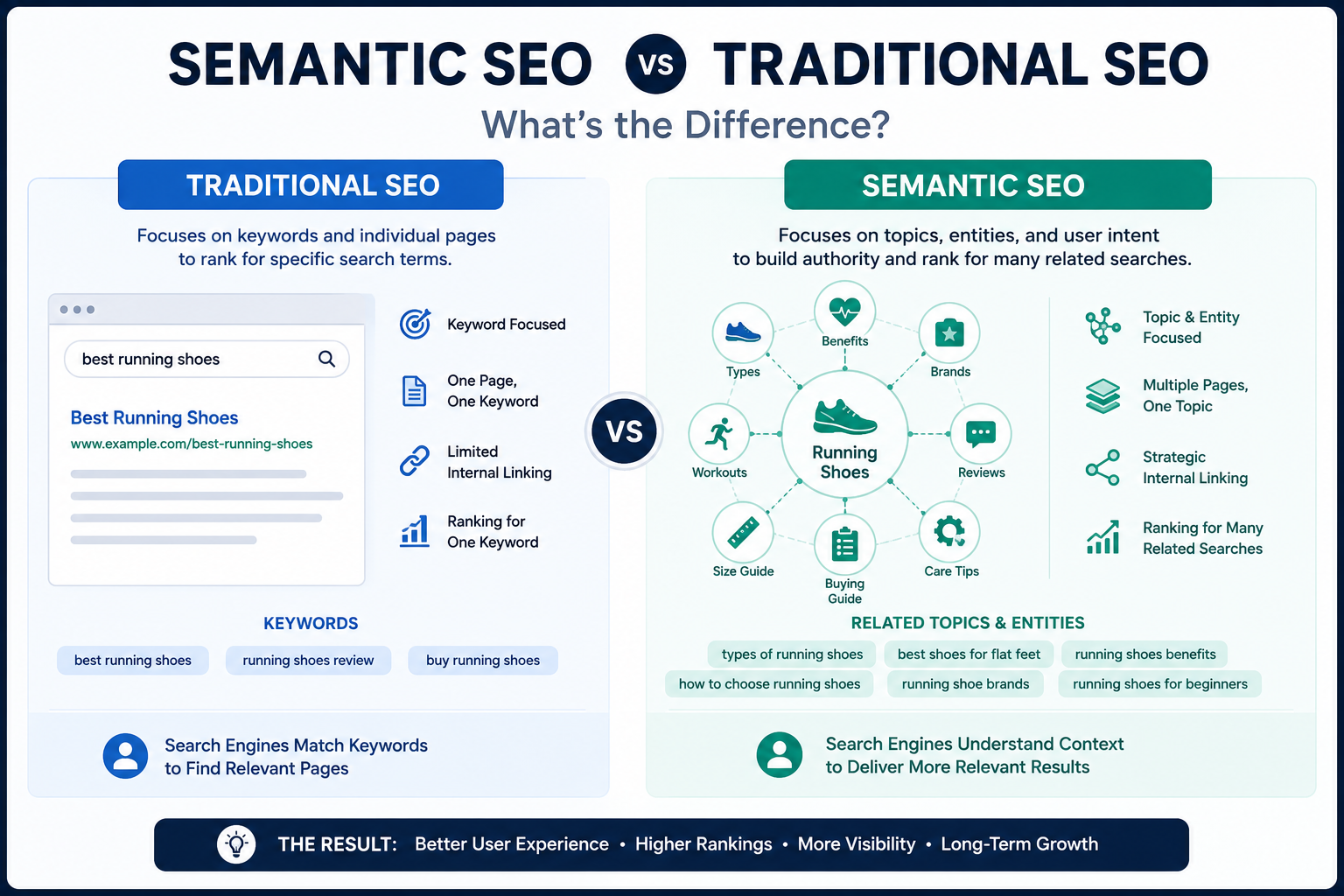
Semantic SEO organizes website content around meaningful topics, entities, relationships and user intent.
It can help businesses create a coherent content architecture that explains what they offer, which audiences they serve and how their products or services relate to relevant customer needs.
However, Semantic SEO is not a separate AI ranking formula. It works alongside technical SEO, useful content and a clear information architecture.
Consider a company offering AI Search Optimization services.
A coherent content structure might include:
- A central AI Search Optimization service page.
- An educational guide comparing Google AI Overviews and ChatGPT Search.
- A practical guide to measuring AI search visibility.
- A supporting article explaining Semantic SEO and topical authority.
- A case study documenting verified findings and outcomes, where evidence is available.
Each page should have a distinct purpose.
The comparison article should explain platform differences and business decisions. The measurement guide should explain reporting and metrics. The service page should describe the engagement, deliverables and commercial value.
Link these pages when doing so helps readers continue their research.
Avoid publishing several near-identical articles that answer the same question simply to target variations of a keyword.
Make business information easy to evaluate
Important pages should accurately explain:
- What the company offers.
- Which customers the service is designed for.
- Which problems it addresses.
- What an engagement includes.
- Which claims are supported by evidence.
- How prospective customers can take the next step.
Use structured data where appropriate and ensure that it reflects the visible page content. Google does not require special AI schema or an llms.txt file for inclusion in AI Overviews or AI Mode.
The objective is to make your website clear, useful, accessible and consistent, not to add technical elements without a demonstrated purpose.
7. Common AI SEO Mistakes Businesses Should Avoid
Mistake 1: Assuming that ranking in Google guarantees an AI citation
Conventional search visibility and AI citations are related but different outcomes. Monitor them separately and investigate the pages and questions where visibility is missing.
Mistake 2: Assuming that a special AI file is mandatory
Google states that llms.txt and other special AI files are not required for inclusion in its AI search features. Do not invest in them on the assumption that they guarantee rankings or citations.
Mistake 3: Blocking crawlers without understanding the consequences
Review crawler settings according to the purpose of each crawler and your business policies. For ChatGPT Search, OAI-SearchBot access is relevant to website discoverability.
Mistake 4: Publishing multiple pages with overlapping search intent
Creating separate pages for minor keyword variations can dilute the site’s information architecture. Consolidate overlapping content where one stronger page better satisfies the intent.
Mistake 5: Treating every AI mention as commercial success
A brand may be named without a link or a visit. Track citations, referral traffic and conversions as separate indicators.
Mistake 6: Promising guaranteed AI rankings
No credible provider should guarantee a particular position in Google AI Overviews or a citation in every ChatGPT answer. These outcomes depend on systems outside a website owner’s control.
Mistake 7: Rewriting content without diagnosing the problem
If a page is blocked, improve access. If it lacks useful information, improve the content. If it attracts irrelevant traffic, revisit the audience and search intent.
The right optimization depends on the actual problem.
8. When Should a Business Invest in AI Search Optimization Services?
Businesses can perform basic checks internally. Professional support becomes valuable when technical problems, content gaps and measurement challenges require coordinated work.
An AI Search Optimization engagement may be appropriate when:
- Important pages are not indexed or discovered as expected.
- Organic visibility has stagnated despite publishing relevant content.
- Competitors repeatedly appear in AI answers for commercially relevant questions.
- Product or service pages do not adequately answer buying questions.
- Several pages compete for the same search intent.
- The website contains inconsistent information about the company’s products or services.
- The marketing team cannot connect search visibility with qualified enquiries.
- The business needs a prioritized roadmap rather than a list of generic SEO recommendations.
What should a professional AI SEO engagement deliver?
A credible service should provide clear outputs and explain how each output supports a business objective.
1. Technical SEO and accessibility assessment
Review crawling, indexing, HTTP responses, robots directives, internal links and relevant platform-specific access requirements.
2. Search intent and content gap analysis
Identify commercially important queries, assess existing pages and determine which content should be improved, consolidated or created.
3. Semantic SEO and content architecture recommendations
Map relevant topics, entities, internal links and supporting pages without creating unnecessary content overlap.
4. AI visibility baseline
Document the relevant platforms, test questions, observed citations, brand mentions and available reporting data.
5. Prioritized implementation roadmap
Specify the recommended changes, their rationale, expected business relevance and implementation dependencies.
6. Measurement and reporting plan
Define the metrics, sources, review frequency and limitations before implementation.
7. Validation and ongoing optimization
Verify completed changes, review observed outcomes and adjust priorities based on evidence.
These deliverables help businesses understand what they are paying for and how progress will be evaluated.
The value of professional AI Search Optimization is not a promise of instant visibility. It is a disciplined process for identifying actual problems, implementing defensible improvements and measuring the results.
Conclusion: Build Search Visibility That Supports Business Growth
Google AI Overviews and ChatGPT Search create different opportunities for businesses to be discovered, but neither offers a guaranteed route to visibility.
Start with the foundations: make important pages accessible, ensure their content is useful and accurate, and organize your website around the questions your customers need answered.
Then investigate the platform-specific gaps. Use Search Console to understand Google Search performance and supported AI search impressions. Check OAI-SearchBot access when evaluating ChatGPT Search discoverability. Record citations for commercially relevant questions and use analytics to understand identifiable referral traffic and conversions.
Finally, prioritize the improvements that make the greatest difference to your audience and business objectives.
The real goal of AI Search Optimization is not simply to appear in an AI-generated answer. It is to help the right customers discover, understand and evaluate your business when they are ready to make a decision.
Want to know where your website stands?
Our Search Optimization Services bring together technical SEO, Semantic SEO and AI Search Optimization to help businesses assess discoverability, identify content gaps and prioritize improvements.
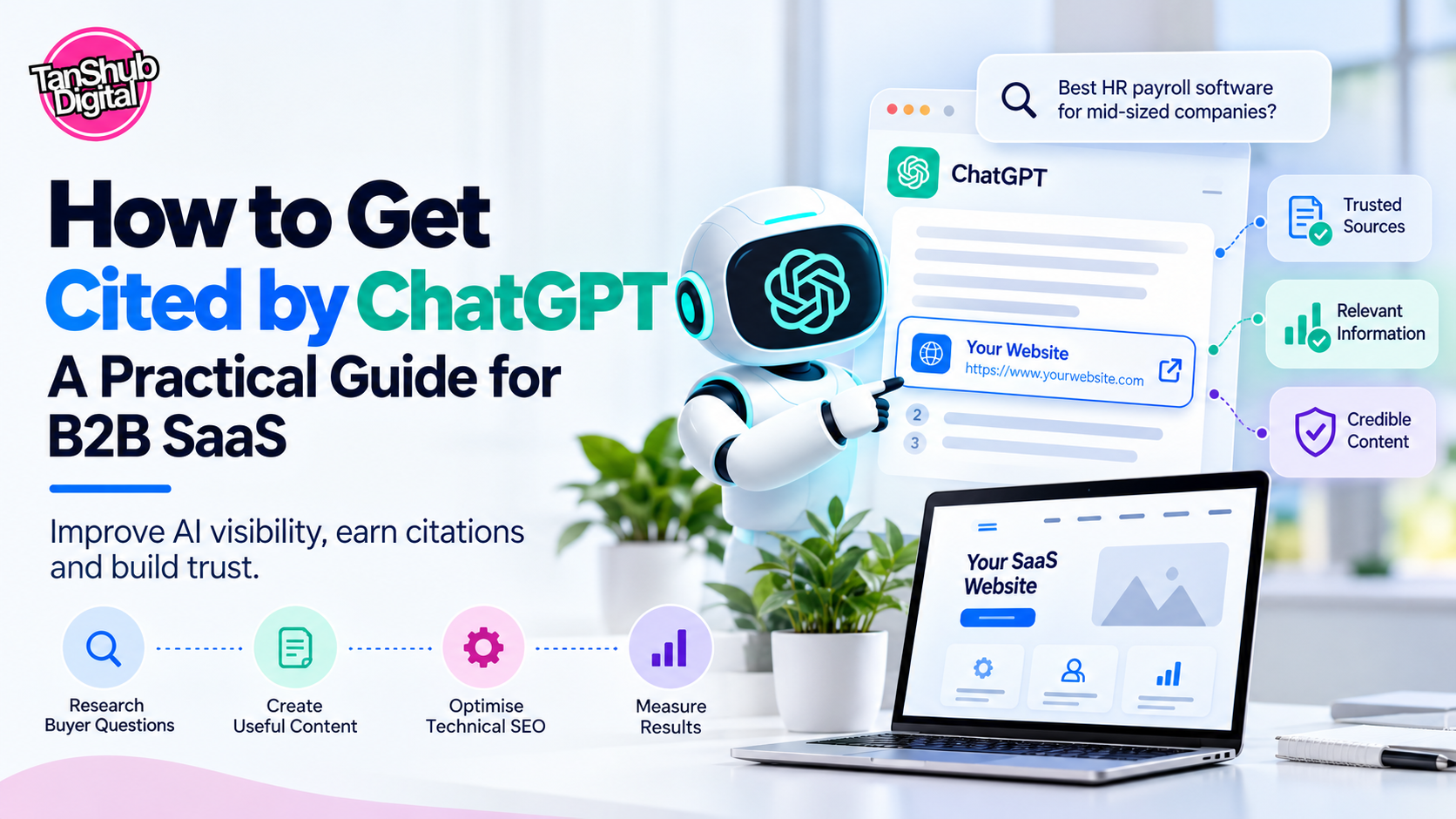
For further reading, explore our practical guide to getting cited by ChatGPT. It covers the broader citation and prompt-testing process, while this article focuses on the differences between Google AI Overviews and ChatGPT Search.
Request an AI search visibility assessment to identify the technical issues, content opportunities and measurement gaps worth addressing first.
The starting point is evidence: what your website can currently achieve, where it falls short and which improvements make the most sense for your business.
Editorial note: Search features, crawler behaviour and measurement options can change. Verify official documentation before implementing technical changes. This article explains evidence-based practices and does not guarantee rankings, citations or leads.