Introduction
Publishing more blog posts does not necessarily mean generating more business.
A B2B company might publish four articles every month, optimise their titles, add internal links and share them on LinkedIn. Yet, after six months, organic traffic remains inconsistent, the sales team receives few relevant enquiries, and nobody can confidently explain which pieces of content influenced a purchase.
The problem may not be the quality of individual articles. It may be the absence of a connected content strategy.
This is where a semantic content marketing agency can make a meaningful difference. Instead of treating every keyword as a separate publishing opportunity, it examines how customers search, which questions influence buying decisions, how topics relate to one another and what evidence prospects need before choosing a provider.
The result should be more than a collection of search-optimized articles. It should be a content system that connects search visibility with customer education, brand credibility and commercial outcomes.
However, not every agency offering semantic content marketing delivers this level of strategic work. Some simply repackage conventional SEO writing with new terminology.
This guide explains what to look for, which deliverables to expect, how to evaluate performance and which warning signs should influence your decision.
What Does a Semantic Content Marketing Agency Actually Do?
A semantic content marketing agency plans, creates and improves content around the relationships between customer needs, business offerings, subject matter and search intent.
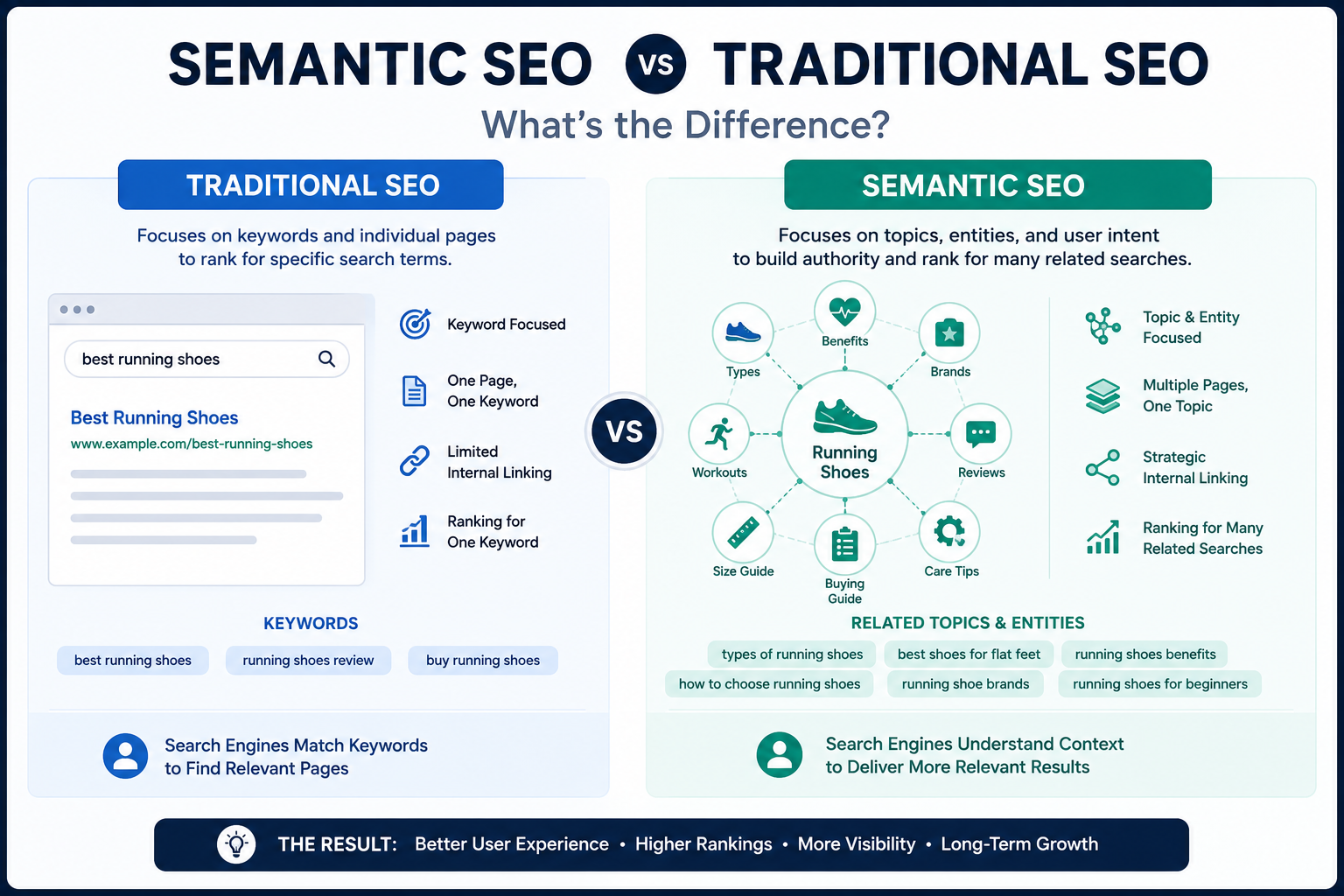
Traditional keyword-led production often begins with a list of search terms. A semantic approach begins by asking a broader set of questions.
- What problem is the customer trying to solve?
- Which concepts must the customer understand before choosing a solution?
- What information distinguishes an informed buyer from someone who is merely researching?
- Which pages should establish expertise, and which should generate enquiries?
- How should those pages connect to support the customer’s decision?
Consider a B2B software company selling payroll automation.
An isolated keyword strategy might produce articles targeting payroll software, payroll automation and payroll compliance.
A semantic content strategy would investigate the wider decision-making process. Prospects might also need information about payroll errors, statutory compliance, employee data security, implementation, integrations, audit trails, reporting and the cost of manual processing.
These subjects are related, but they serve different purposes.
A payroll compliance article might attract an HR manager researching a problem. A payroll software comparison could help that manager evaluate alternatives. An implementation guide could address concerns raised by IT. A detailed service or product page could explain how the software solves the problem.
The agency’s job is to connect these content assets into a coherent journey, rather than publish them as unrelated articles.
The strategy should also establish which information belongs on a service page, which belongs in a supporting article and which requires a case study, comparison page or practical resource.
That distinction matters because search visibility alone does not tell you whether the content is helping customers make a decision.
Why Businesses Need More Than Conventional SEO Content
The commercial case for a stronger content strategy is not that conventional SEO has become obsolete. It is that content production without clear goals, audience understanding and measurement can become an expensive publishing exercise.
The Content Marketing Institute’s B2B Content Marketing Benchmarks, Budgets, and Trends: Outlook for 2025, based on research involving 980 B2B marketers, found that 58% described their content strategy as only moderately effective. The research also reported that 74% said content marketing helped generate demand or leads, while 49% reported sales or revenue benefits.
Source: Content Marketing Institute, B2B Content Marketing Research.
These findings illustrate two important points. Content marketing can contribute to commercial outcomes, but many organisations still struggle to make their strategies consistently effective.
A semantic approach helps address that problem by connecting content decisions to a larger business objective.
1. It reduces disconnected content production
Without a topic strategy, businesses often publish whatever seems relevant at the time. One month, the focus is on industry trends. The next, it shifts to general advice. Important buying questions remain unanswered, while several articles cover nearly identical ground.
A semantic content strategy establishes topic priorities and assigns each page a specific role.
2. It connects informational searches with buying decisions
A prospect searching for a definition is not necessarily ready to purchase. Someone comparing providers, implementation options or pricing is usually evaluating a more concrete decision.
A well-planned content ecosystem addresses both groups and provides relevant paths from education to evaluation.
3. It creates a stronger foundation for evolving search experiences
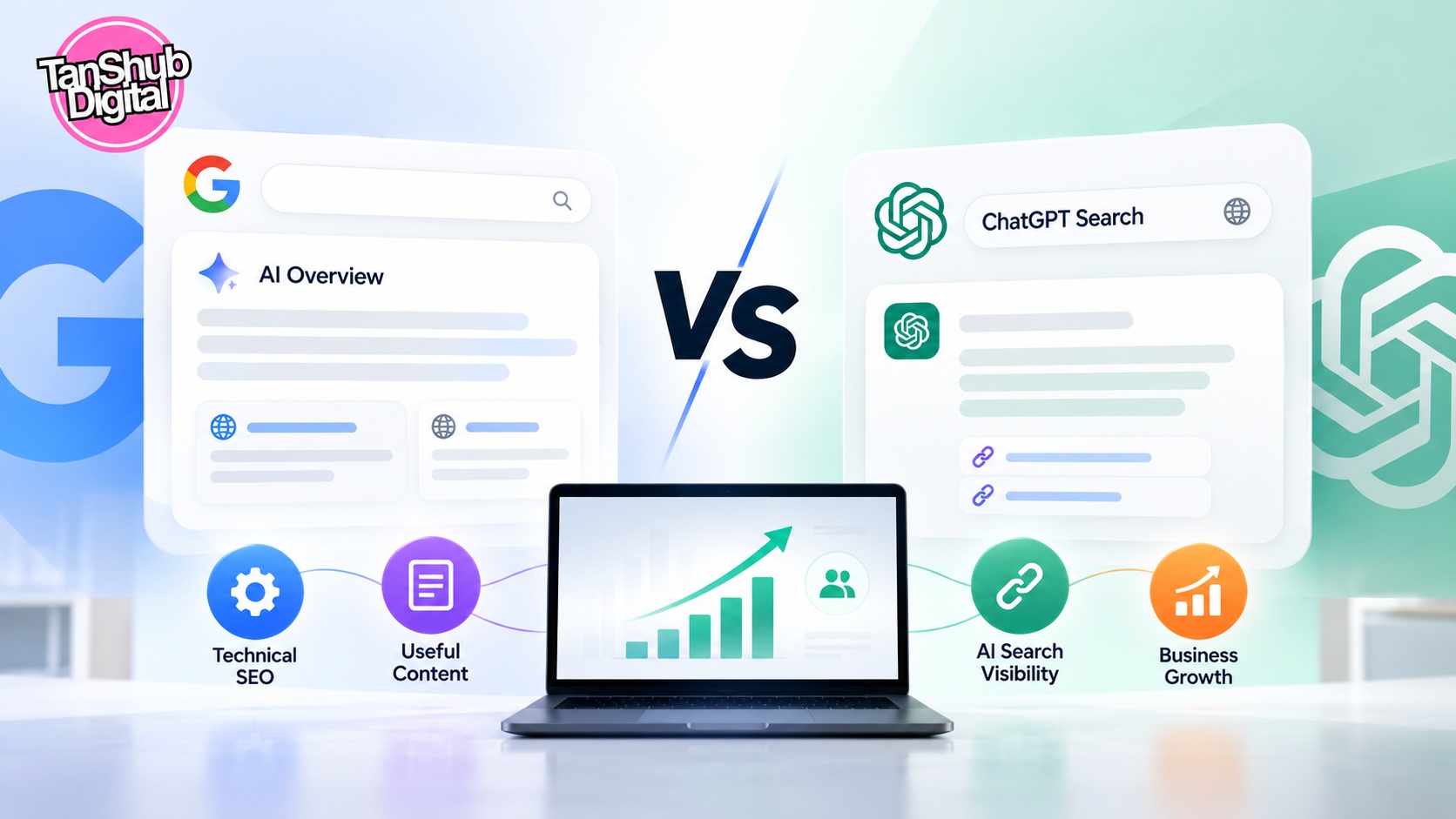
Google’s AI Overviews and AI Mode can surface supporting links for complex queries. Google’s current guidance, published in 2026, emphasizes valuable, distinctive content and established SEO fundamentals rather than special AI-only optimization tricks.
Source: Google Search Central: Optimizing for generative AI features in Google Search.
This is an important distinction. A business cannot guarantee AI citations by inserting a certain number of entities, creating an llms.txt file or rewriting every paragraph into short answers. It needs useful content that search systems can discover, understand and potentially select.
What Should a Semantic Content Marketing Agency Deliver?
Before hiring an agency, examine the actual deliverables. The word semantic is not a substitute for a documented strategy.
A professional engagement should include the following components, adapted to the size of the business, its existing website and its commercial priorities.
1. Search intent and audience research
The first deliverable should establish who the business wants to attract and what those people need to know.
This involves more than exporting keyword volumes from an SEO tool.
The agency should examine:
- Search queries associated with your products and services.
- Questions prospects ask during sales calls.
- Objections that repeatedly delay purchase decisions.
- Competitor pages that address the same needs.
- Search results that reveal whether people want explanations, comparisons, tools or service providers.
For example, a company offering cloud migration services may find that prospects search for migration risks, downtime, data transfer, cloud security, implementation timelines and managed support.
Those queries reveal distinct information needs. They should not automatically become six blog posts. The agency must determine whether each topic deserves a separate page, belongs within a larger guide or is better addressed on the service page.
What to request: An audience and search-intent map that links target queries to customer problems, content formats and business objectives.
2. A topic cluster and content architecture
The next deliverable should show how the proposed content fits together.
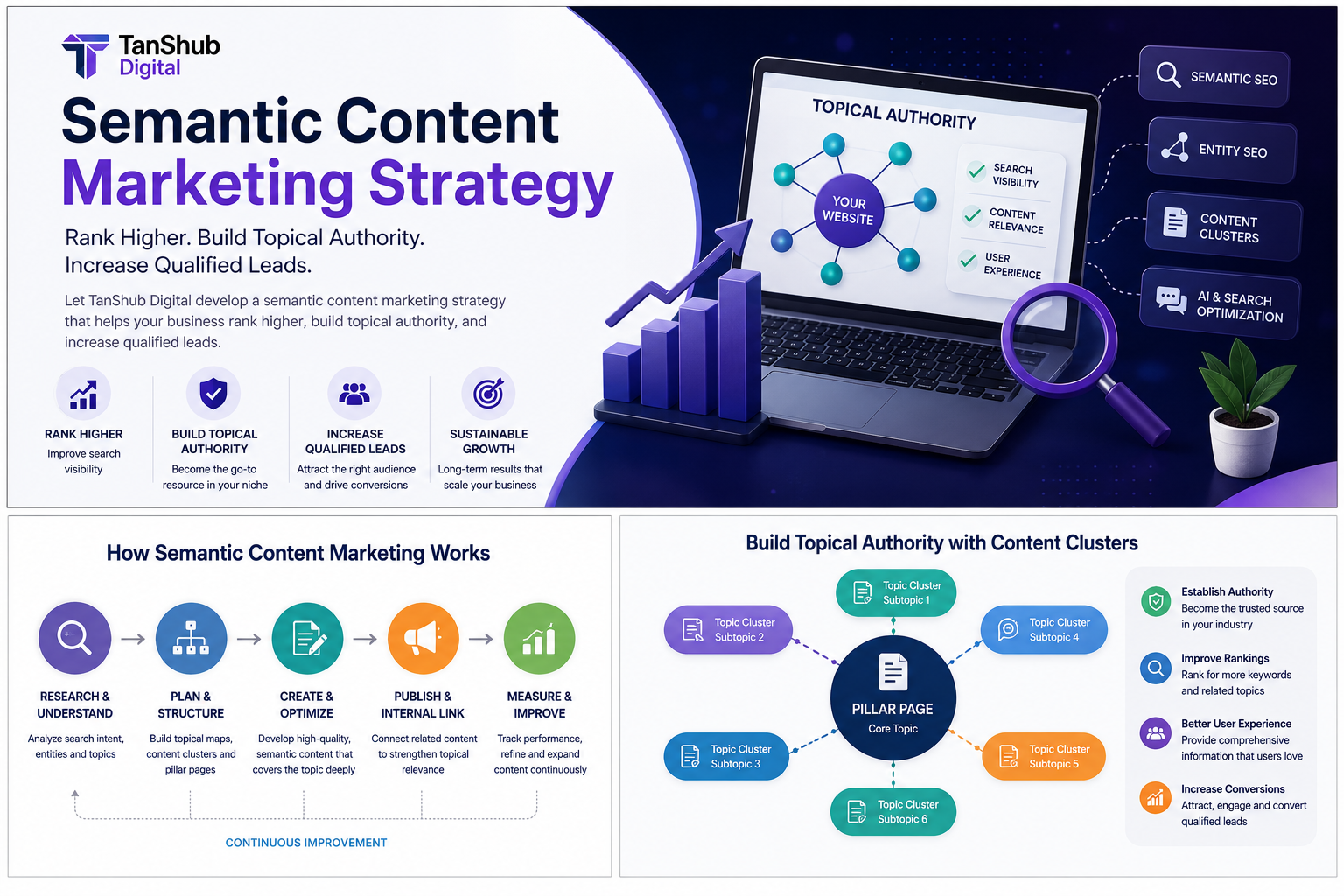
A topic cluster normally consists of a central page covering a broad subject and supporting pages addressing narrower questions. Relevant internal links connect the pages.
For a B2B payroll software provider, the architecture might look like this:
| Content asset | Main purpose | Commercial contribution |
|---|---|---|
| Payroll software service page | Explain the product and its value | Generate product enquiries |
| Payroll compliance guide | Explain compliance requirements | Attract relevant HR and finance audiences |
| Manual vs automated payroll comparison | Evaluate competing approaches | Help prospects assess the need for automation |
| Payroll implementation checklist | Address deployment concerns | Support evaluation and internal approval |
| Payroll error prevention guide | Explain operational risks and controls | Connect a business problem to the product solution |
| Customer implementation case study | Demonstrate a real customer outcome | Reduce uncertainty during evaluation |
The links between these pages should be purposeful. A compliance article can direct readers to the relevant product capabilities, while the service page can link to the implementation guide for prospects who need further detail.
This structure helps readers navigate the subject and gives search engines clearer pathways for discovering related pages. Google’s SEO Starter Guide explains the value of logical site organisation, descriptive links and reducing unnecessary duplicate content.
What to request: A visual topic map, a list of existing URLs to retain or improve, proposed new content assets and an internal linking plan.
3. Content gap and competitor analysis
A useful content gap analysis identifies missing information that matters to the target customer. It should not simply copy the headings used by competing websites.
Suppose three competing agencies explain what semantic SEO means, but none provides a practical framework for calculating content performance or evaluating the cost of a content engagement.
That gap may represent a valuable opportunity because it addresses a decision that prospective buyers actually face.
An agency should examine competitor content for:
- Questions answered well and questions left unresolved.
- Product and service comparisons.
- Original examples, data and expert contributions.
- Evidence of customer outcomes.
- Gaps between informational content and commercial landing pages.
It should then recommend content that adds a distinct perspective, better evidence or a more useful solution.
What to request: A prioritized gap analysis that explains why each proposed page matters, who it serves and how it differs from existing content.
4. Entity and subject-matter optimization
Entities are identifiable people, organisations, products, concepts and other things that can be distinguished from one another.
In content marketing, the practical task is to explain relevant concepts accurately and establish their relationships.
For a company selling customer relationship management software, related subjects could include lead qualification, contact management, sales pipelines, workflow automation, customer records, reporting and integrations.
A page that explains these relationships clearly is more useful than one that repeatedly inserts the phrase “CRM software” without addressing the reader’s actual questions.
Entity-focused content should therefore include precise terminology, relevant examples, clear definitions and accurate explanations of how concepts relate.
Structured data can provide additional information where appropriate, but it does not replace useful content or guarantee rankings.
What to request: A documented subject-matter map showing core entities, related concepts, terminology and the pages responsible for explaining them.
5. Content production and editorial quality control
A strategy only becomes useful when it produces content that customers can understand and trust.
An agency should have an editorial process for researching topics, checking facts, incorporating subject-matter expertise, reviewing claims and ensuring that every page has a clear purpose.
AI tools can assist with research, outlining and editing. However, generating large quantities of similar articles without adding meaningful value can create quality and spam-policy risks.
Google’s guidance on using generative AI content on websites emphasizes accuracy, quality, relevance and compliance with its Search policies.
Ask how the agency verifies statistics, sources, technical explanations and product claims. Also ask who reviews the content before publication.
What to request: An editorial brief, source list, review workflow and clear responsibilities for subject-matter approval.
6. Internal linking and ongoing optimization
Publishing an article should not be the final step.
The agency should identify relevant existing pages to link to, monitor search performance and update content when evidence shows that improvements are warranted.
For instance, if a supporting article begins receiving impressions for a specific implementation question, the team should check whether the article answers it adequately and whether readers have a relevant next step.
If two pages compete for substantially the same purpose, the agency should investigate whether they need clearer differentiation, consolidation or a different internal linking structure.
What to request: An internal linking map and a recurring optimization report that explains which changes were made and why.
How to Evaluate Whether the Strategy Can Generate Qualified Leads
One of the most common mistakes in content marketing is treating every increase in traffic as a business success.
Traffic matters, but its value depends on who visits, what they are looking for and what happens after they arrive.
A commercial content programme should connect search performance to meaningful business metrics.
Measure performance at three levels
| Measurement level | Metrics to review | What the data tells you |
|---|---|---|
| Search visibility | Impressions, clicks, CTR and query-level position | Whether relevant pages are being discovered |
| Content engagement | Relevant landing-page visits, engagement and next-page actions | Whether visitors are finding useful information |
| Commercial outcomes | Enquiries, qualified leads, sales opportunities and revenue contribution | Whether the content is contributing to business growth |
Use Google Search Console to assess organic search queries, clicks and impressions. Use an analytics platform and CRM to measure what happens after a visitor reaches the site.
Where possible, track conversions by landing page, traffic source and customer journey. Use appropriate attribution methods and remember that a single article may influence a purchase without being the final page a customer visits.
For example, a visitor might discover a company through an educational article, return through a branded search and then submit a service inquiry. Looking only at the final landing page would miss part of that journey.
Calculate content ROI using business data
A practical starting point is:
Content marketing ROI = (attributable gross profit − content investment) ÷ content investment × 100
Consider an illustrative example.
A business invests ₹1,20,000 in a content programme. Over an agreed measurement period, the programme is associated with ₹3,00,000 in gross profit from attributable sales.
The calculation is:
(₹3,00,000 − ₹1,20,000) ÷ ₹1,20,000 × 100 = 150% ROI
This is an illustration, not a benchmark or a promise of results. Actual ROI depends on the attribution model, sales cycle, delivery costs, margins and the extent to which content contributed to those sales.
If the programme generates enquiries but no sales have closed yet, report qualified opportunities and pipeline separately. Do not present projected pipeline as realized revenue.
Establish a baseline before setting targets
A credible agency should first review the website’s current performance, existing content, ranking distribution and conversion tracking.
Only then should it propose targets.
A new website with limited organic visibility has different starting conditions from an established B2B website with thousands of relevant visitors. Targets should reflect those differences, as well as competition, resources and sales-cycle length.
What Recent AI Search Developments Mean for Content Buyers
AI search is changing how people discover information, but businesses should be careful about paying for unsupported promises.
Two recent developments are particularly relevant.
Google continues to emphasise distinctive, useful content
In May 2026, Google published an updated guide to optimising for generative AI features in Search. It highlighted the importance of valuable, unique content and clarified misconceptions around practices sometimes promoted as special AEO or GEO requirements.
Source: Google Search Central’s AI optimization guide.
For a business evaluating an agency, the implication is practical: ask how the agency will create content that is genuinely useful and distinctive, rather than merely restructuring existing articles for AI systems.
Google introduced dedicated reporting for generative AI search visibility
Google announced Search Console’s generative AI performance reports in June 2026 and stated that the reports had rolled out worldwide by 31 August 2026.
Source: Google Search Central: Search Generative AI performance reports.
This is useful because it gives website owners additional reporting for visibility in Google’s generative AI search experiences.
However, visibility in Google’s AI features is not the same as citations in ChatGPT, Gemini or Perplexity. Each platform has different interfaces, retrieval mechanisms and reporting limitations.
A credible agency should distinguish measurable outcomes from estimates. It should explain what it can track, how it will track it and which results cannot be reliably attributed.
AI visibility does not eliminate the need for conventional SEO
Research from Pew Research Center, published in July 2025, examined browsing activity from 900 US adults during March 2025. It found that users clicked a traditional search result in 8% of visits where a Google AI summary appeared, compared with 15% where no summary appeared. Clicks on links within the AI summaries themselves occurred in just 1% of visits in the study.
Source: Pew Research Center: Google users are less likely to click on links when an AI summary appears.
These figures describe a particular US study and should not be treated as universal CTR forecasts for every market or query.
Nevertheless, they illustrate why businesses should measure more than rankings. A content strategy must consider brand discovery, relevant clicks, trust, enquiries and the commercial value of the visitors it attracts.
How Much Should Semantic Content Marketing Services Cost?
There is no single reliable price for a semantic content marketing engagement. Costs depend on the amount of strategic work, the condition of the website, the number of subject areas involved and the expertise required to produce accurate content.
A programme focused on auditing an existing content library will have different requirements from one that involves market research, a new content architecture, expert interviews, extensive production and ongoing optimization.
When comparing proposals, examine the scope rather than the headline price.
| Cost component | Questions to ask |
|---|---|
| Research and strategy | Does the fee include audience research, search-intent mapping and prioritisation? |
| Content architecture | Will the agency deliver a topic cluster map and URL-level recommendations? |
| Content production | How many assets are included, and what level of research and review do they receive? |
| Technical and on-page work | Are internal links, metadata, canonical checks and implementation recommendations included? |
| Performance measurement | Will the agency configure or review conversion tracking and provide meaningful reporting? |
| Ongoing optimisation | Are updates and performance-based recommendations included, or billed separately? |
Request a written scope that identifies deliverables, responsibilities, approval processes, reporting frequency and exclusions.
Be cautious of proposals that promise a fixed number of articles without explaining how those articles will support the business’s goals.
Likewise, avoid choosing a provider solely because it promises rankings or AI citations within a fixed period. Search outcomes depend on factors that no agency fully controls.
Seven Questions to Ask Before Hiring an Agency
Use these questions when evaluating proposals or conducting an initial consultation.
1. How will you decide which topics deserve investment?
Look for a process that combines business priorities, customer needs, search evidence, competition and existing content performance.
2. How will you prevent overlapping pages?
The agency should explain how it assigns a purpose to each URL and identifies opportunities to consolidate or differentiate content.
3. What will I receive besides the articles?
Ask for examples of a content strategy, topic map, editorial brief, internal linking plan and performance report.
4. How do you establish subject-matter accuracy?
The answer should cover source verification, expert input, editorial review and responsibility for technical or regulated claims.
5. How will you measure qualified leads?
The agency should connect organic landing pages to conversion events and, where possible, CRM outcomes.
6. What can you realistically promise about AI search visibility?
A credible provider should explain its approach and measurement limitations without guaranteeing inclusion in an AI-generated answer.
7. What happens after publication?
Look for a defined process for reviewing performance, updating content, addressing technical issues and prioritising the next set of improvements.
The quality of these answers often tells you more about the proposed engagement than the number of keywords included in the contract.
Red Flags to Watch for When Selecting a Provider
Not every provider using semantic content marketing terminology offers a substantive service.
Be cautious if an agency:
- Promises guaranteed rankings or guaranteed AI citations.
- Treats keyword density as the main measure of semantic optimization.
- Proposes dozens of near-identical pages for minor keyword variations.
- Cannot explain why a proposed article matters to your customers.
- Reports traffic without discussing lead quality or commercial outcomes.
- Uses statistics without credible sources or cannot explain how claims were verified.
- Offers a fixed content package without reviewing the existing website.
- Cannot show how it will measure progress against an agreed baseline.
A good agency should be willing to explain its decisions, acknowledge uncertainty and prioritise work according to the evidence available.
How TanShub Digital Approaches Semantic Content Marketing
For businesses that need a more connected content strategy, the objective should be to align content production with search intent, customer understanding and commercial priorities.
TanShub Digital‘s semantic content marketing approach can bring together the following workstreams:
Content strategy and planning: Identify priority audiences, search opportunities, content gaps and the pages most closely connected to business objectives.
Topic cluster strategy: Organise pillar pages and supporting articles around meaningful relationships between subjects and customer questions.
Search-intent alignment: Match each page to the information a prospect needs at that stage of the buying journey.
Semantic optimization: Improve topic coverage, contextual relevance, terminology and internal links without forcing unnecessary keyword variations into the copy.
Answer Engine Optimisation: Structure useful explanations and evidence so that readers can understand the content easily and the site remains eligible for relevant search experiences.
Content performance analysis: Review search visibility, landing-page engagement, conversions and opportunities for improvement.
The exact scope should be tailored to the website, its current content assets and the business’s growth priorities.
For a company with an established blog, the best starting point may be a content audit and a more deliberate internal linking strategy. For a newer website, it may be a topic architecture built around its core services and the questions prospects ask before buying.
The purpose is not to publish more for the sake of publishing. It is to create the right content, connect it logically and measure whether it contributes to the business.
Frequently Asked Questions
Is semantic content marketing the same as semantic SEO?
They overlap, but they are not identical. Semantic SEO focuses on helping search engines understand the meaning, context and relationships within a website’s content. Semantic content marketing applies related principles to a broader content programme that also considers audience needs, editorial planning, distribution and commercial objectives.
How long does a semantic content marketing strategy take to produce results?
There is no universal timeline. Results depend on the website’s existing authority, technical condition, competition, content quality, implementation speed and demand for the target topics. An agency should establish a baseline, define measurable milestones and review progress regularly rather than promise a fixed ranking date.
Does semantic content marketing help with Google AI Overviews?
It can support the underlying content quality and search eligibility needed for consideration in Google’s AI search experiences. However, no content strategy guarantees inclusion. Google continues to emphasise established SEO fundamentals and helpful, distinctive content.
Does every topic need a separate blog post?
No. Separate pages are appropriate when they serve meaningfully different needs. Closely related questions may be better addressed in one comprehensive page, while distinct commercial intents may justify separate landing pages. The decision should reflect search results, audience needs and the purpose of each URL.
How is success measured?
Measure search impressions, clicks, relevant landing-page traffic, engagement, enquiries, qualified leads and sales outcomes where attribution is possible. The right mix depends on the business model and sales cycle.
Can semantic content marketing work for a small business?
Yes, provided the scope matches its resources. A small business may benefit more from a carefully planned set of core service pages and supporting articles than from an extensive publishing programme it cannot maintain.
Conclusion: Choose a Content Strategy Built Around Business Outcomes
Choosing a semantic content marketing agency should involve more than comparing article counts, keyword lists or monthly fees.
The right partner should understand the business, identify the questions that influence customer decisions, organise content around those needs and explain how the work will be measured.
That requires research, editorial judgement, thoughtful content architecture and a clear connection between search visibility and commercial outcomes.
It also requires realistic expectations. No agency can guarantee organic rankings, AI citations or revenue simply by adopting semantic terminology. What it can do is establish a disciplined process, improve the quality and relevance of the content ecosystem, and use performance data to guide future decisions.
If your current content programme generates publications but does not provide a clear path from discovery to inquiry, it may be time to review the strategy behind it.
Ready to make your content work harder?
Explore TanShub Digital‘s Semantic Content Marketing Services to discuss a content strategy aligned with your audience, search opportunities and business goals.
Request a consultation to identify the most valuable next steps for your website.