A website can have hundreds of pages, thousands of keywords and a technically healthy foundation and still struggle to build meaningful search visibility.
The problem is often not a lack of content. It is a lack of semantic structure.
Search engines and AI-powered search systems need to understand what a website is about, which entities it represents, how those entities relate to one another, what questions its content answers and which pages are responsible for different user needs.
That is where a semantic SEO audit becomes useful.
Unlike a conventional SEO audit that primarily examines technical health, keywords, backlinks and on-page elements, a semantic SEO audit examines the deeper information structure of a website. It looks at entities, relationships, search intent, topical coverage, content architecture, internal linking, evidence and the role each page plays in the overall website.
More importantly, a good audit should not simply tell you that something is missing.
It should tell you why it matters, which page should own it and what should happen next.
This guide explains how to perform a semantic SEO audit and introduces a practical framework for identifying and prioritising semantic gaps.
What Is a Semantic SEO Audit?
A semantic SEO audit is a structured analysis of how effectively a website represents its subject matter through topics, entities, relationships, search intent, content and website architecture.
Instead of asking only:
Which keywords are we ranking for?
a semantic audit asks:
- What does this website actually represent?
- Is its main entity clear?
- Which topics does it comprehensively cover?
- Which important topics are missing?
- Which entities are missing or ambiguous?
- Which relationships between entities are unclear?
- Does every important search intent have an appropriate destination?
- Are pages competing with each other?
- Does internal linking reinforce meaningful relationships?
- Does the content provide evidence for important claims?
- Does every page have a distinct responsibility?
- Can the website be understood consistently across different markets and search environments?
The objective is not to produce a mysterious “semantic SEO score”.
The objective is to find weaknesses and determine the right repair.
A missing topic may require a new page. A weak topic may only need expansion. Two overlapping pages may need consolidation. A poorly connected page may need better internal links. An important claim may need stronger evidence.
That distinction is what makes a semantic SEO audit useful.
Why Does a Semantic SEO Audit Matter?
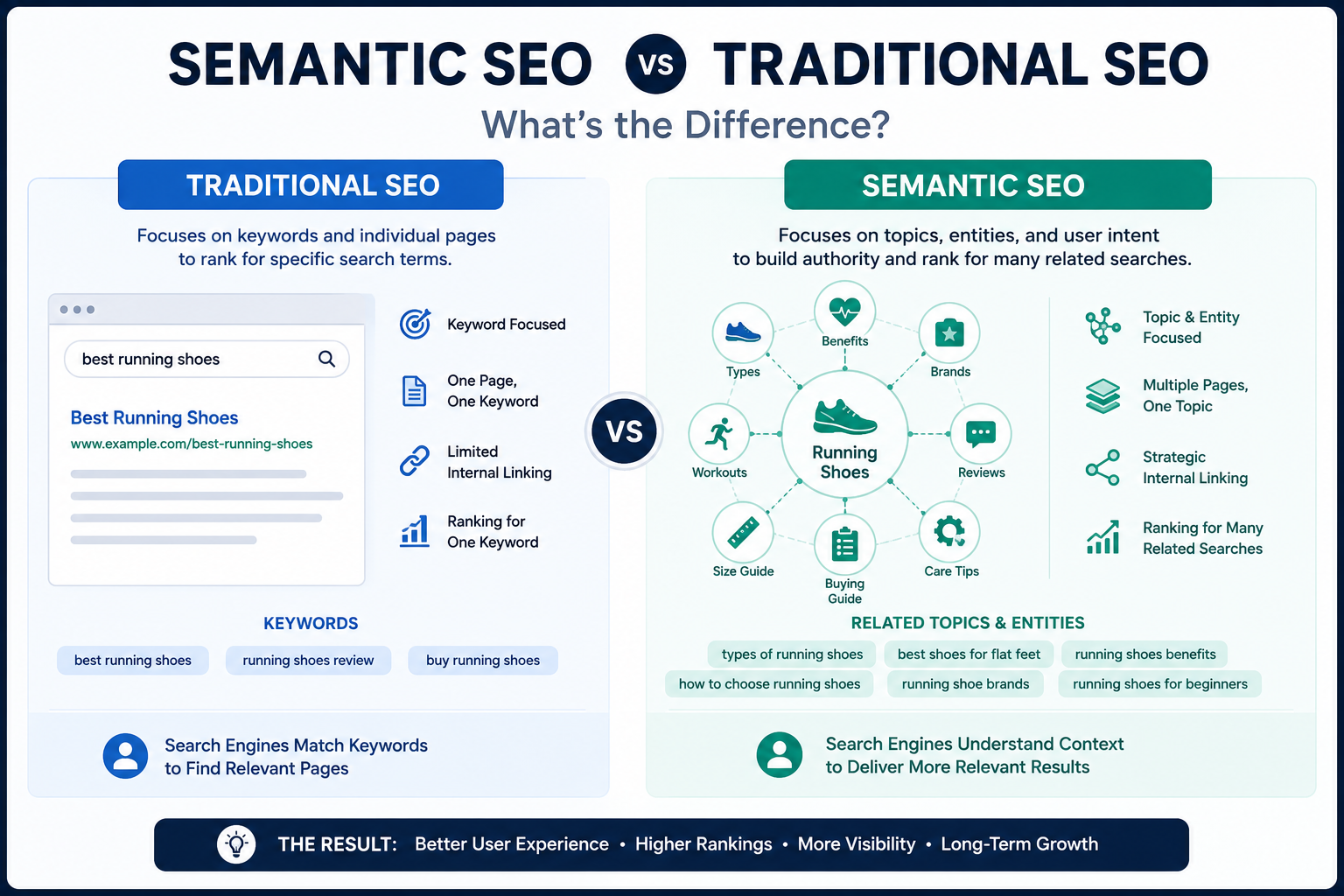
Traditional SEO has often treated a webpage as a collection of keywords.
Modern search is better understood as a system of meaning, entities, intent and relationships.
Consider a page about payroll software.
A keyword-focused approach may concentrate on:
- payroll software
- payroll system
- payroll software India
- online payroll software
- payroll management system
A semantic approach goes deeper.
It considers entities such as:
- employees
- salary processing
- payslips
- payroll compliance
- provident fund
- ESI
- TDS
- attendance
- leave management
- HRMS
- payroll automation
It also considers relationships:
Payroll software → calculates → employee salary
Payroll software → supports → statutory compliance
Payroll software → generates → payslips
The difference is important.
The objective is not to insert every related term into a page. It is to ensure that the website represents the subject accurately and comprehensively.
Semantic SEO Audit vs Traditional SEO Audit
A traditional SEO audit and a semantic SEO audit are not mutually exclusive.
Technical SEO still matters. Crawlability, indexing, performance, structured data and other technical foundations can affect search visibility.
However, they answer different questions.
| Traditional SEO Audit | Semantic SEO Audit |
|---|---|
| Can search engines crawl the website? | Can they understand the website’s subject? |
| Which keywords are missing? | Which concepts and entities are missing? |
| Which pages rank? | Which page should own each intent? |
| Are pages technically optimised? | Do pages have clear semantic responsibilities? |
| Are internal links present? | Do internal links communicate meaningful relationships? |
| Is schema implemented? | Does structured data reinforce the actual content? |
| What do competitors rank for? | What semantic responsibilities do competitors fulfil? |
| Is content thin? | Is the required meaning adequately represented? |
| Which pages receive traffic? | Which parts of the user journey are uncovered? |
A semantic audit therefore sits on top of the technical foundation rather than replacing it.
The 10 Layers of a Semantic SEO Audit
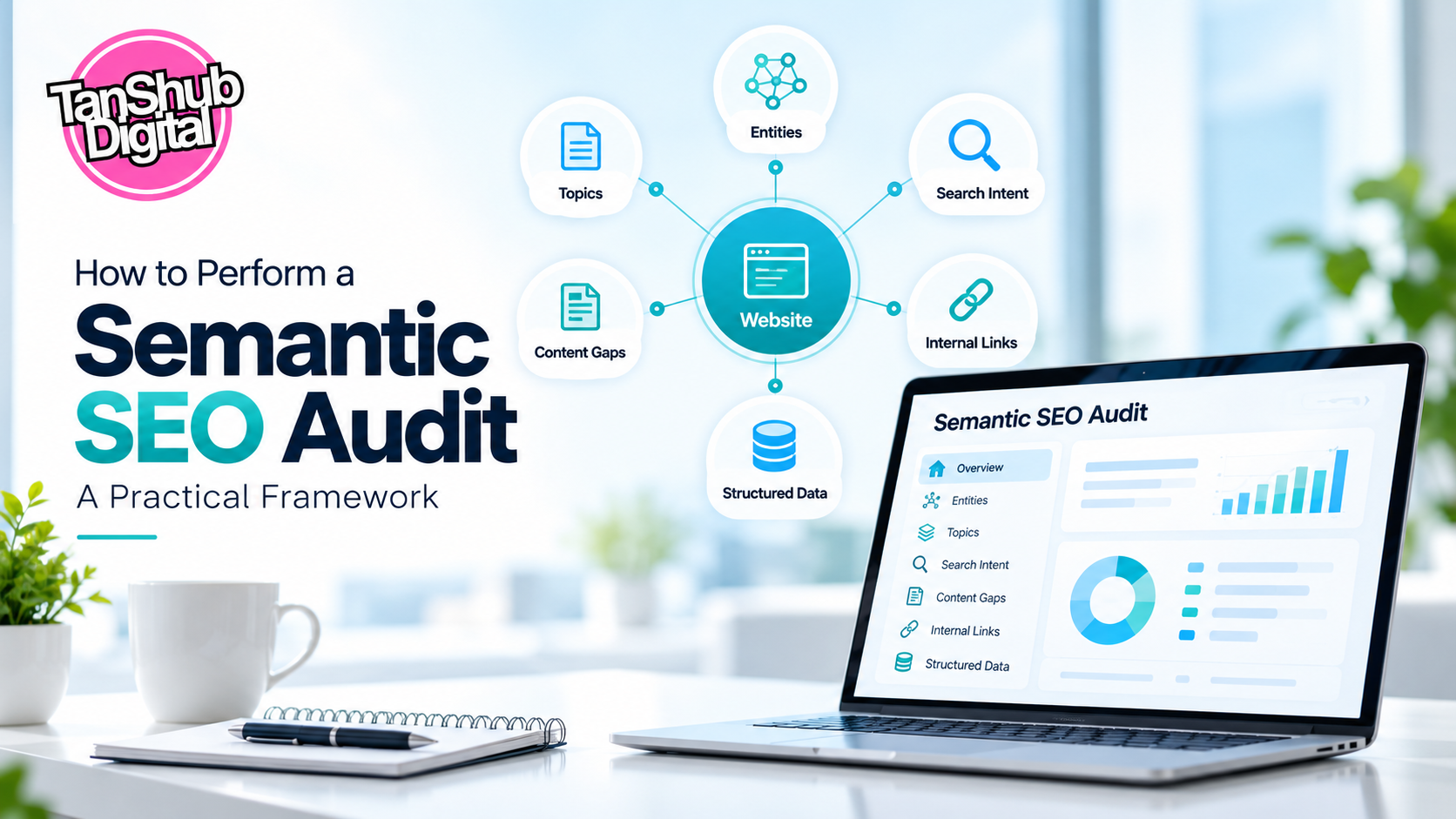
A useful semantic audit can be organised into ten interconnected layers.
1. Business and Search Objective
Start with the business.
Before analysing content, establish what the website is actually trying to accomplish.
Ask:
- What does the business sell?
- Who are its customers?
- Which markets does it target?
- Which services or products matter most commercially?
- Which topics demonstrate expertise?
- Which topics influence purchasing decisions?
- Which searches should ultimately lead to enquiries, purchases or another business outcome?
This prevents one of the most common SEO mistakes: creating content simply because a competitor has created it.
A topic may have search demand but little relevance to the business.
Semantic relevance must therefore be evaluated against business relevance.
2. Entity Integrity
Entities are identifiable people, organisations, places, products, services, concepts and other distinct things.
An entity audit should identify the website’s:
Primary entity
What is the central subject of the website?
Supporting entities
Which entities explain or surround that subject?
Attributes
What characteristics define those entities?
Relationships
How are the entities connected?
For example, a digital marketing agency may have:
Organisation → provides → Semantic SEO
Semantic SEO → supports → Search visibility
Semantic SEO → uses → Entity optimisation
Semantic SEO → involves → Topic clusters
The audit should determine whether those relationships are actually explained by the website.
Entity ambiguity
There is another question that is often overlooked:
Could a search engine or AI system confuse this entity with another entity?
Check:
- brand name consistency
- organisation description
- founder information
- location
- social profiles
- business directories
- service descriptions
- author information
- third-party mentions
- structured data
A brand that describes itself differently across important sources can create unnecessary ambiguity.
3. Search Intent and Intent Ownership
Search intent is more than assigning labels such as informational, commercial or transactional.
A better semantic audit asks:
Which page owns this user mission?
For example:
| Search need | Appropriate page |
|---|---|
| What is semantic SEO? | Educational guide |
| How does semantic SEO work? | Detailed guide |
| Semantic SEO audit | Audit guide |
| Semantic SEO services | Service page |
| Semantic SEO agency | Commercial/service page |
| Semantic SEO pricing | Pricing or commercial page |
| Semantic SEO case study | Case study |
This is intent ownership.
Without it, several pages may attempt to answer the same underlying question.
That leads to semantic cannibalisation.
4. Semantic and Topical Coverage
A semantic content gap is not simply a keyword your competitor ranks for.
A genuine gap exists when an important concept, entity, relationship, process, attribute or user need is missing or inadequately represented.
Consider four different types of gaps.
Keyword gap
A competitor ranks for a query you do not target.
Content gap
An important subject has not been adequately covered.
Entity gap
An important entity is missing or underdeveloped.
Semantic gap
The entities exist, but their important relationships, attributes or context are missing.
For example, mentioning “payroll compliance” is not the same as explaining its relationship with:
- payroll processing
- employee classification
- statutory deductions
- filing obligations
- deadlines
- compliance risks
This distinction prevents the common mistake of treating mentions as coverage.
5. Page Responsibility and Content Architecture
Every important page should have a clear semantic responsibility.
For example:
| Page type | Primary responsibility |
|---|---|
| Pillar page | Establish broad subject understanding |
| Supporting guide | Explain a specific subtopic |
| Comparison | Help users evaluate alternatives |
| Service page | Explain the commercial solution |
| Case study | Provide evidence |
| FAQ | Resolve focused questions |
| Location page | Establish geographic relevance |
| Product page | Explain product/entity attributes |
Now ask:
Does each page have a unique job?
If two pages have essentially the same responsibility, you may have semantic cannibalisation.
If an important responsibility has no page, you have an architecture gap.
This leads to a powerful rule:
Do not create a new page until you know what unique responsibility that page will own.
6. Semantic Internal Linking
Internal links should do more than distribute authority.
They should communicate relationships.
For example:
Semantic SEO
→ Entity SEO
communicates one relationship.
Semantic SEO
→ Semantic Content Marketing
communicates another.
Semantic SEO
→ Semantic SEO Services
creates a commercial relationship.
The audit should therefore examine:
- source page
- destination page
- anchor text
- contextual relevance
- relationship between the two pages
- whether the destination is the correct owner
- whether important pages are isolated
- whether supporting content connects to pillar content
Think of internal linking as semantic routing.
A good internal link helps both users and search systems move from one concept to a related concept.
7. Evidence and Information Gain
This is where a semantic audit becomes much more sophisticated.
Ask:
What does this page contribute that competing pages do not?
If ten websites explain the same concept in almost identical ways, simply producing an eleventh version may not create much additional value.
Look for:
- original research
- first-hand observations
- examples
- case studies
- expert analysis
- original frameworks
- unique data
- demonstrations
- useful comparisons
- practical decision-making information
Evidence architecture
Important claims should have appropriate support.
Think of the relationship as:
Entity → Claim → Evidence
For example:
AI search → changes discovery behaviour → supported by current search research and observed search results
This is stronger than making broad claims without qualification.
The goal is not to add citations everywhere for appearance.
The goal is to make consequential claims defensible and useful.
8. Technical and Structured Data Alignment
Semantic SEO does not eliminate technical SEO.
A semantic audit should still review:
- crawlability
- indexability
- canonicalisation
- URL structure
- headings
- structured data
- rendering
- page experience
- duplicate pages
- XML sitemap
- orphan pages
However, structured data deserves special attention.
Ask:
Does the structured data accurately reinforce what the visible page communicates?
Schema should not be treated as a shortcut for semantic relevance.
A page cannot become authoritative simply because JSON-LD has been added to it.
The visible content, entity relationships and site architecture still need to make sense.
9. AI Search and Retrieval Visibility
A modern semantic SEO audit should also examine how clearly a website can be understood in AI-assisted search environments.
Do not reduce this to:
“Is the website optimised for ChatGPT?”
Instead, test the underlying information.
Ask:
Can AI systems identify the organisation?
Can they accurately describe its services?
Can they associate the brand with the correct location?
Can they identify its expertise?
Can they distinguish it from similarly named entities?
Which competitors are mentioned instead?
What information is missing from the AI-generated description?
Does the website provide strong source material for important claims?
This creates an AI retrieval audit layer.
It should be treated as an observational test, not a guaranteed ranking or citation mechanism.
10. Geographic Semantic Architecture
Location should not be treated as a keyword that is simply added to a page.
For businesses targeting multiple markets, geography becomes part of the semantic architecture.
Suppose a company serves:
- USA
- India
- Hyderabad
- Singapore
The audit should ask:
- Is the organisation’s identity consistent?
- Are its locations clearly established?
- Are its services associated with relevant markets?
- Are market-specific needs represented?
- Are location pages genuinely differentiated?
- Are pages merely reproducing the same content with different city names?
- Is the business actually demonstrating relevance to the market?
USA
Consider industry expectations, B2B buying journeys, SaaS, technology, professional services and commercial search behaviour.
India
Consider local intent, Indian businesses, regional audiences, multilingual considerations and market-specific business needs.
Hyderabad
Establish genuine local relevance through the organisation, service area, business information and locally meaningful content.
Singapore
Consider the needs of businesses operating in a highly international, technology-oriented and multicultural market.
The principle is simple:
Geographic relevance should come from genuine context, not location keyword repetition.
The Semantic SEO Audit Checklist
Use this checklist when auditing a website.
Business
- Business objective defined
- Target audiences identified
- Priority services/products identified
- Priority markets identified
Entities
- Primary entity identified
- Supporting entities mapped
- Important attributes identified
- Entity relationships documented
- Brand identity consistent
- Entity ambiguity checked
Intent
- Major search intents identified
- User missions mapped
- Page ownership established
- Commercial intent represented
- Informational intent represented
- Transactional intent represented where relevant
Content
- Core topics covered
- Supporting topics covered
- Entity gaps identified
- Semantic gaps identified
- Content gaps identified
- Important processes explained
- Important attributes explained
- Important relationships explained
Architecture
- Pillar pages identified
- Supporting pages identified
- Page responsibilities defined
- Duplicate responsibilities identified
- Orphan pages identified
- Topic clusters connected
Internal linking
- Contextual links reviewed
- Anchor text reviewed
- Important pages receive relevant links
- Supporting content links to core pages
- Semantic relationships are reinforced
Evidence
- Important claims supported
- Sources are appropriate
- First-hand information included where possible
- Original insights identified
- Content provides information gain
- Outdated claims identified
Technical
- Crawlability checked
- Indexability checked
- Canonicals checked
- Structured data checked
- Sitemap checked
- Duplicate URLs checked
- Orphan URLs checked
AI visibility
- Brand recognition tested
- Service recognition tested
- Entity associations tested
- Competitor associations tested
- Important claims tested
- AI interpretation compared with website messaging
Geography
- Target markets identified
- Location entities consistent
- Local pages differentiated
- International pages differentiated
- Market-specific context established
Not Every Gap Requires a New Page
This is one of the most important principles in a semantic SEO audit.
Finding a gap does not automatically mean publishing another article.
A gap can require several different actions.
Create
The topic or user mission genuinely needs a new page.
Expand
The existing page is responsible for the topic but lacks sufficient depth.
Merge
Two pages have overlapping semantic responsibilities.
Differentiate
Two pages need clearer purposes.
Link
The information exists but isn’t properly connected.
Restructure
The information is present but the architecture is confusing.
Update
The information is outdated.
Add evidence
The claim is important but insufficiently supported.
Qualify
The content makes a claim that requires clearer boundaries or context.
Retire
A page provides little unique value and has no strategic responsibility.
This prevents URL inflation, where every perceived content gap becomes another page.
A New Concept: Semantic Debt
A website can accumulate what I call semantic debt.
Semantic debt is the collection of inconsistencies and structural weaknesses that accumulate as a website grows.
Examples include:
- outdated service descriptions
- inconsistent brand information
- duplicate topics
- overlapping pages
- orphan content
- weak internal links
- missing relationships
- outdated structured data
- unsupported claims
- fragmented topic clusters
- duplicated location pages
- outdated terminology
A website may publish excellent new content while its older semantic debt continues to make the overall information architecture harder to understand.
That is why a semantic SEO strategy should not only focus on creating more content.
It should also repair the content that already exists.
Another Important Concept: Semantic Cannibalisation
Traditional SEO often talks about keyword cannibalisation.
Semantic SEO requires a broader view.
Two pages can target different keywords while satisfying essentially the same underlying search mission.
For example:
- What Is Semantic SEO?
- How Does Semantic SEO Work?
- Semantic SEO Guide
- Complete Semantic SEO Guide
These pages may use different keyword variations but still compete for the same conceptual territory.
Therefore:
Keyword uniqueness does not guarantee semantic uniqueness.
A semantic audit should identify pages that overlap in:
- subject
- intent
- entities
- user mission
- information responsibility
The solution may be consolidation, differentiation or clearer page ownership.
How to Prioritise Semantic SEO Audit Findings
Not every finding deserves immediate attention.
A useful prioritisation model should consider:
Business impact + user impact + semantic importance + search opportunity + repair effort
For example:
| Finding | Impact | Effort | Recommended action |
|---|---|---|---|
| Missing core service page | High | Medium | Create |
| Duplicate pillar pages | High | Medium | Merge |
| Weak internal link | Medium | Low | Link |
| Missing supporting topic | Medium | Medium | Create |
| Outdated statistic | Medium | Low | Update |
| Peripheral competitor topic | Low | High | Defer |
| Unsupported major claim | High | Low | Add evidence |
| Duplicate city pages | High | Medium | Differentiate/merge |
This changes the question from:
“What content should we publish?”
to:
“What change will create the greatest improvement in the website’s information system?”
The Complete Semantic SEO Audit Workflow
A practical audit can follow ten stages.
Step 1: Define the scope
Identify the subject, business objective, audience and markets.
Step 2: Inventory the website
Map pages, URLs, topics, entities and page types.
Step 3: Identify the primary entity
Determine what the website fundamentally represents.
Step 4: Map user missions
Identify the major questions, problems and buying stages.
Step 5: Analyse semantic coverage
Map entities, attributes, relationships, processes and supporting topics.
Step 6: Audit page responsibilities
Determine which URL owns each major topic and intent.
Step 7: Analyse architecture and internal routing
Identify disconnected, duplicated or poorly connected information.
Step 8: Analyse evidence and differentiation
Determine whether the content contributes useful information beyond existing resources.
Step 9: Prioritise repairs
Choose between creation, expansion, consolidation, differentiation, linking, restructuring, updating or removal.
Step 10: Re-audit
After implementation, repeat the same assessment.
A semantic audit should therefore be a closed loop:
Audit → Diagnose → Prioritise → Repair → Measure → Re-audit
How to Know Whether Your Semantic SEO Audit Worked
Do not rely on one metric.
Monitor a combination of:
- organic impressions
- clicks
- ranking breadth
- queries
- relevant landing pages
- non-brand visibility
- conversions
- engagement
- internal-link performance
- indexed content
- AI search observations
- brand/entity recognition
- topical coverage
Most importantly, connect the metrics to the original problem.
If the audit identified a missing commercial topic, measure commercial visibility.
If it identified an entity problem, test entity recognition.
If it identified an internal architecture problem, examine crawling, discovery and user navigation.
The audit should have a finding → repair → measurement relationship.
When Should You Conduct a Semantic SEO Audit?
A semantic audit is particularly useful when:
- organic traffic has plateaued
- content production is increasing but results aren’t
- multiple pages target similar subjects
- competitors dominate entire topic areas
- rankings exist but qualified leads remain low
- the website is expanding into a new market
- the business is launching new services
- content has accumulated over several years
- AI systems misunderstand the brand
- the website has many articles but weak topical structure
- an international SEO strategy is being introduced
- a website migration has changed the content architecture
It is also useful before creating a large content programme.
A poor semantic structure can cause a business to spend months producing content that adds volume without adding meaningful authority.
Semantic SEO Audit for USA, India, Hyderabad and Singapore
A global website should not create four versions of the same article simply to target four markets.
Instead, build one coherent semantic system and introduce genuine market-specific context.
For a US-focused SaaS company, the audit may emphasise product use cases, integrations, industry applications, buyer concerns and commercial comparison content.
For an Indian technology company, it may need to account for Indian business requirements, local search behaviour, regional audiences and international expansion.
For a Hyderabad-based company, local relevance may depend on the relationship between the organisation, services, location, business profiles and locally meaningful content.
For Singapore, the audit may need to account for international business audiences, technology, professional services and the specific context in which customers search for solutions.
The underlying principle remains the same:
The semantic structure should reflect the real business, audience and market rather than simply adding geographic keywords.
Frequently Asked Questions
What is a semantic SEO audit?
A semantic SEO audit evaluates how effectively a website communicates topics, entities, relationships, search intent and contextual meaning across its content and architecture.
How is a semantic SEO audit different from a technical SEO audit?
A technical audit primarily evaluates technical accessibility and search-engine delivery. A semantic audit examines whether the information itself is logically represented, connected, comprehensive and aligned with user intent.
What is a semantic content gap?
A semantic content gap occurs when an important concept, entity, relationship, process, attribute or user need is missing or inadequately represented.
Is a semantic gap the same as a keyword gap?
No. A keyword gap identifies a missing search term. A semantic gap identifies missing meaning or context. One semantic gap can potentially affect many related queries.
Does every semantic gap require a new page?
No. The correct solution could be to expand an existing page, merge two pages, improve internal links, add evidence, restructure content, update information or remove redundant material.
What is entity gap analysis?
Entity gap analysis compares the important entities represented by your website with those relevant to the subject and competitive search landscape.
What is semantic cannibalisation?
Semantic cannibalisation occurs when multiple pages overlap substantially in subject, intent, entities or user mission, even when their target keywords differ.
Can semantic SEO improve AI search visibility?
A clear semantic structure can make information easier for search and retrieval systems to interpret. However, no semantic SEO technique guarantees inclusion, ranking or citation in an AI-generated answer.
How often should a semantic SEO audit be performed?
There is no universal schedule. Re-audit when the website, market, services, content architecture or search environment changes significantly, and use the same criteria to evaluate whether identified problems have actually been resolved.
Final Takeaway
A semantic SEO audit should not be another checklist of keywords, headings and related terms.
It should answer five fundamental questions:
What does this website represent?
What does it need to represent more clearly?
Which page should own each important topic and user mission?
What evidence and relationships strengthen that representation?
What is the most valuable repair to make next?
The strongest semantic SEO strategy is therefore not:
Find keywords → publish pages → add links.
It is:
Define → Map → Diagnose → Prioritise → Repair → Measure → Re-audit.
That approach turns Semantic SEO from a collection of optimisation techniques into a structured way of improving how a website represents its expertise, services, entities and information.
And that is ultimately what a good semantic SEO audit should deliver: not a score, but a clearer, more coherent and more useful information system.