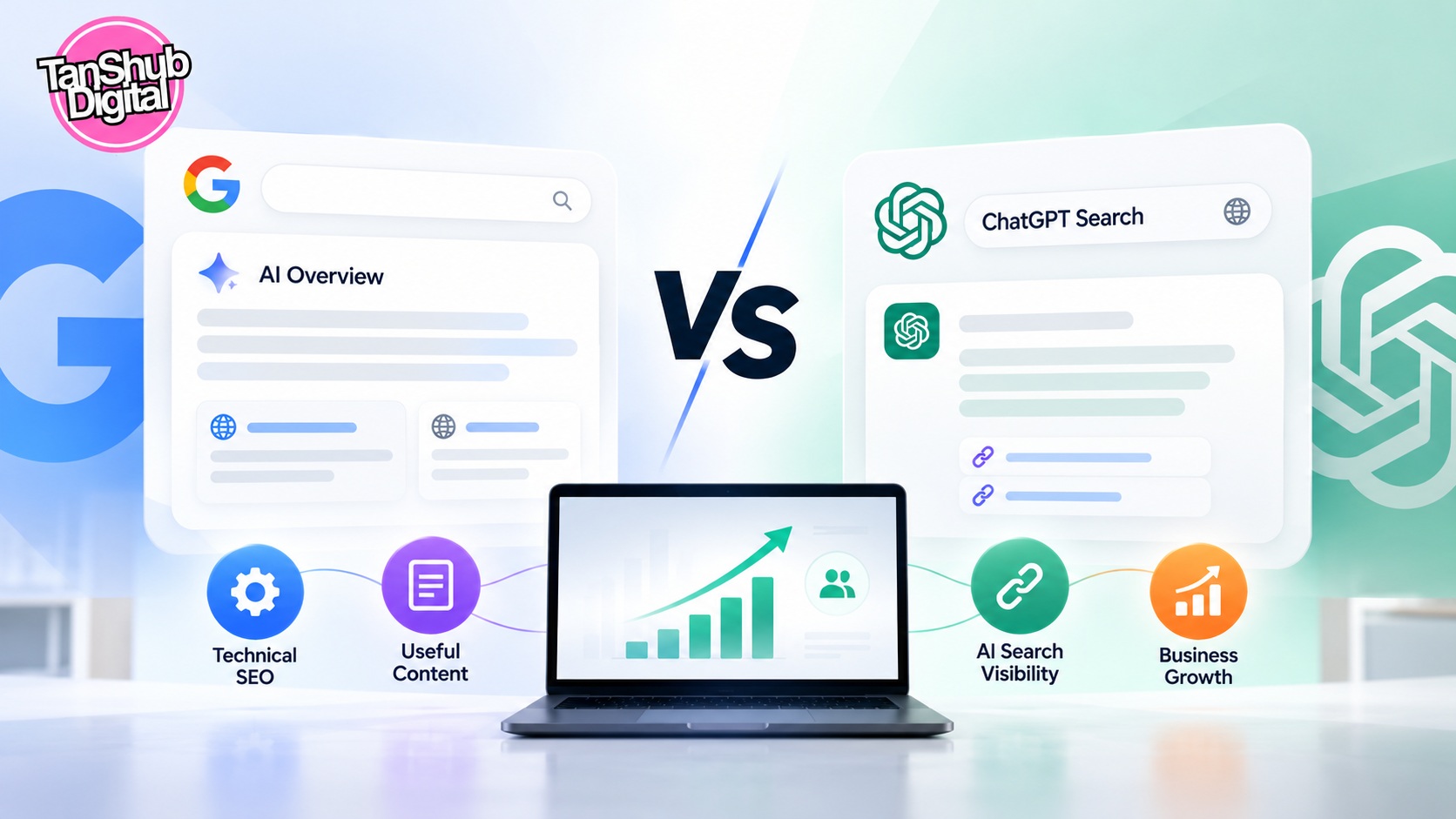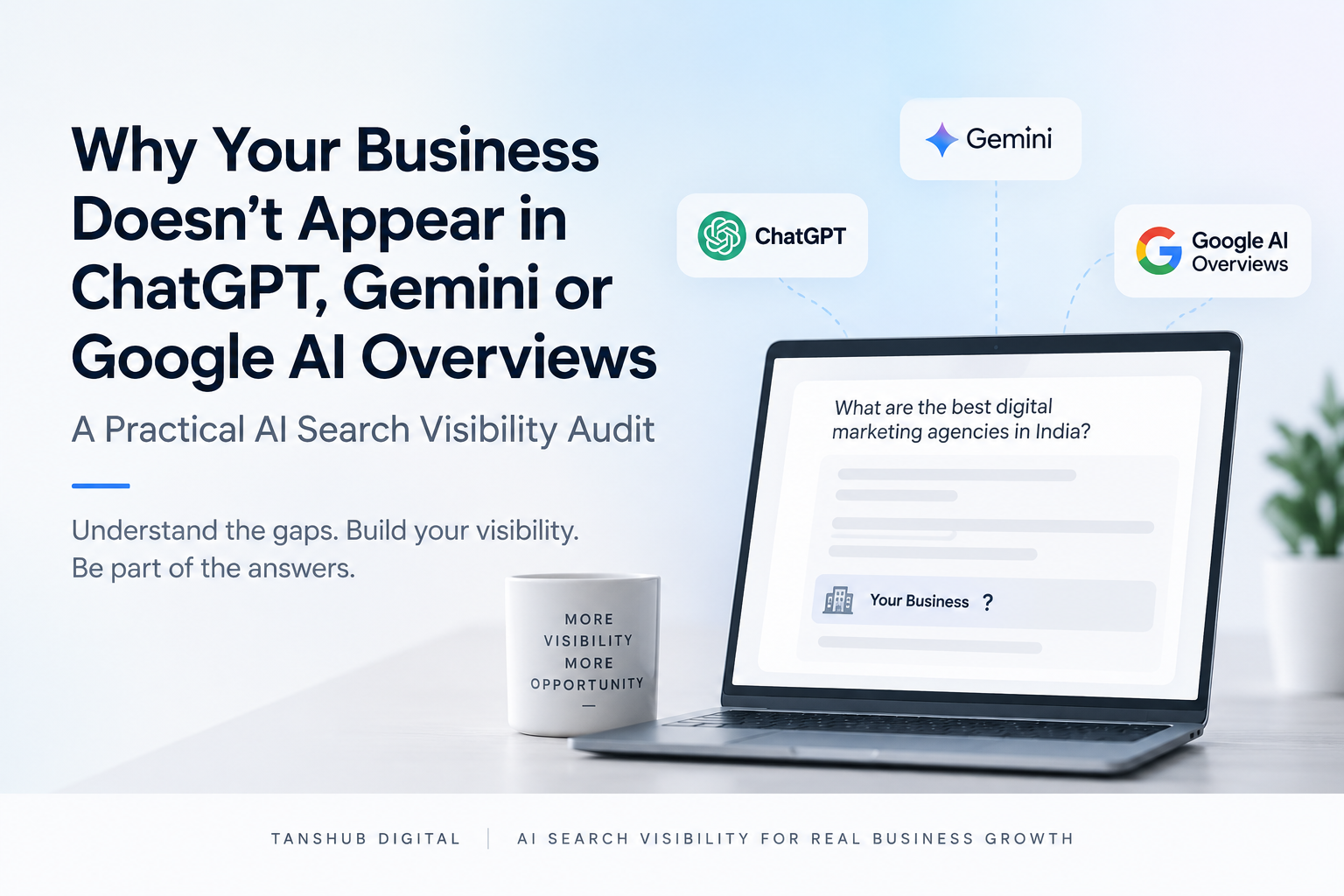
Search has changed.
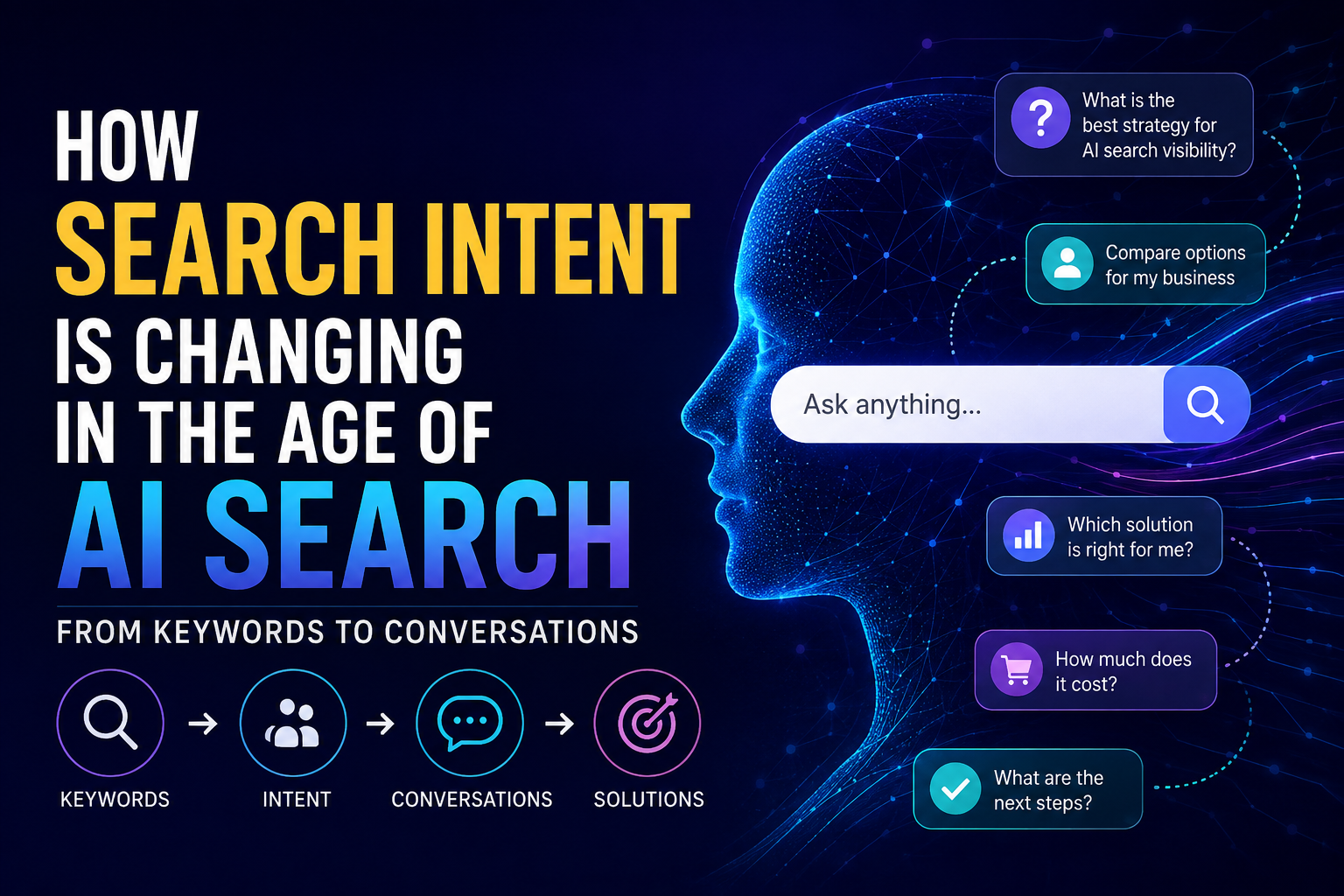
A potential customer can now ask ChatGPT, Gemini, Perplexity, or Google AI Mode a question such as:
“What are the best digital marketing agencies for a SaaS company in India?”
Instead of receiving ten blue links, they may receive a synthesized answer with a shortlist of businesses, explanations, and links to supporting sources.
That creates a new problem for businesses.
You may rank on Google and still not appear when someone asks an AI platform to recommend a business like yours.
But there is an important misconception here.
AI search visibility is not simply about adding an “AI SEO” layer to your website. Google itself says the same foundational SEO practices remain relevant for AI Overviews and AI Mode, and there are no additional technical requirements specifically for appearing in those experiences.
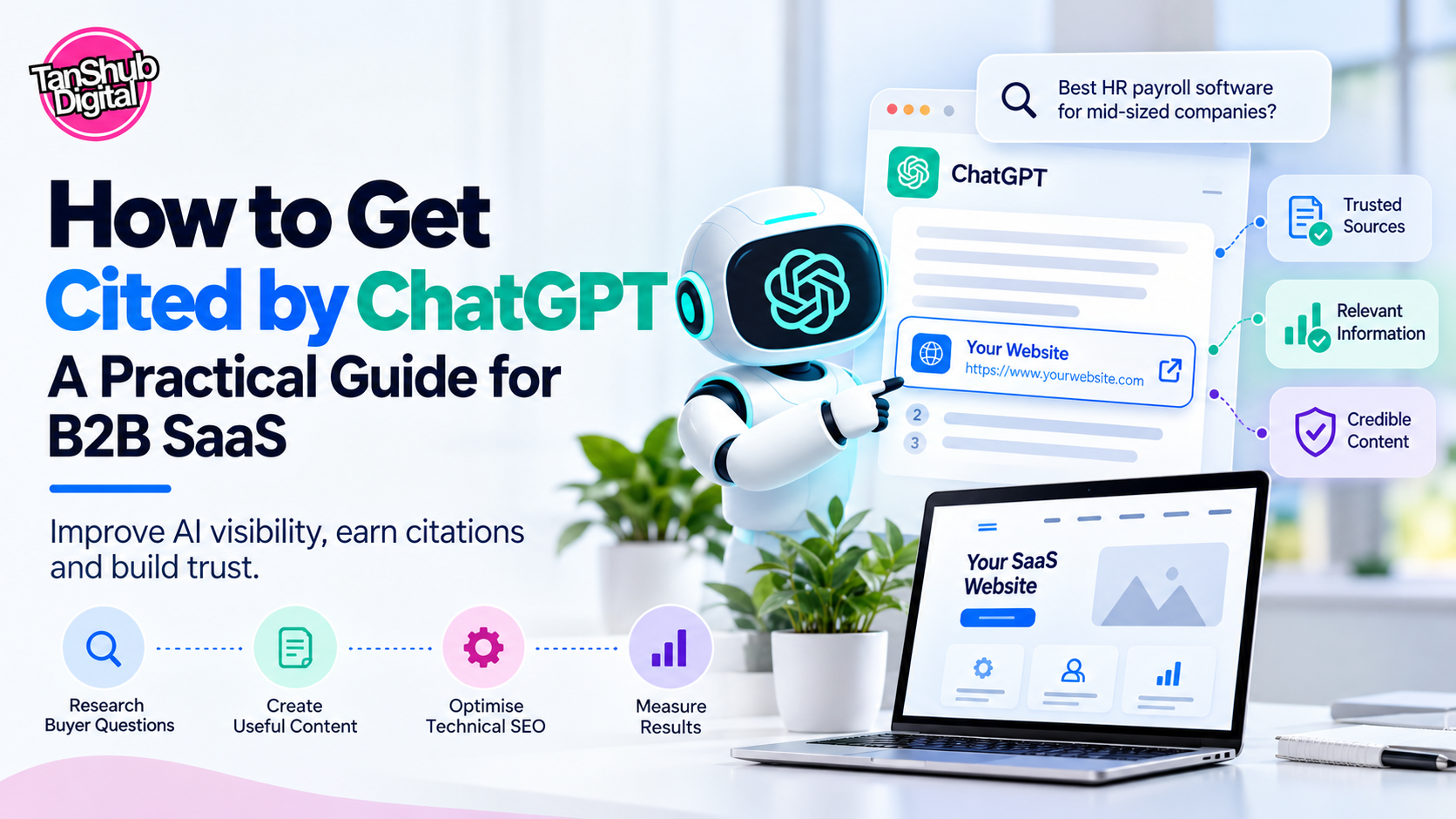
ChatGPT Search works differently from traditional Google Search, but even OpenAI does not describe a secret optimization formula. It says ChatGPT Search ranking uses multiple factors designed to surface relevant and reliable information, with no guarantee of top placement. Websites also need to allow OAI-SearchBot to crawl them if they want their content to be eligible for inclusion.
So if your business isn’t appearing in AI search, the better question is not:
“How do I trick ChatGPT into mentioning my business?”
It is:
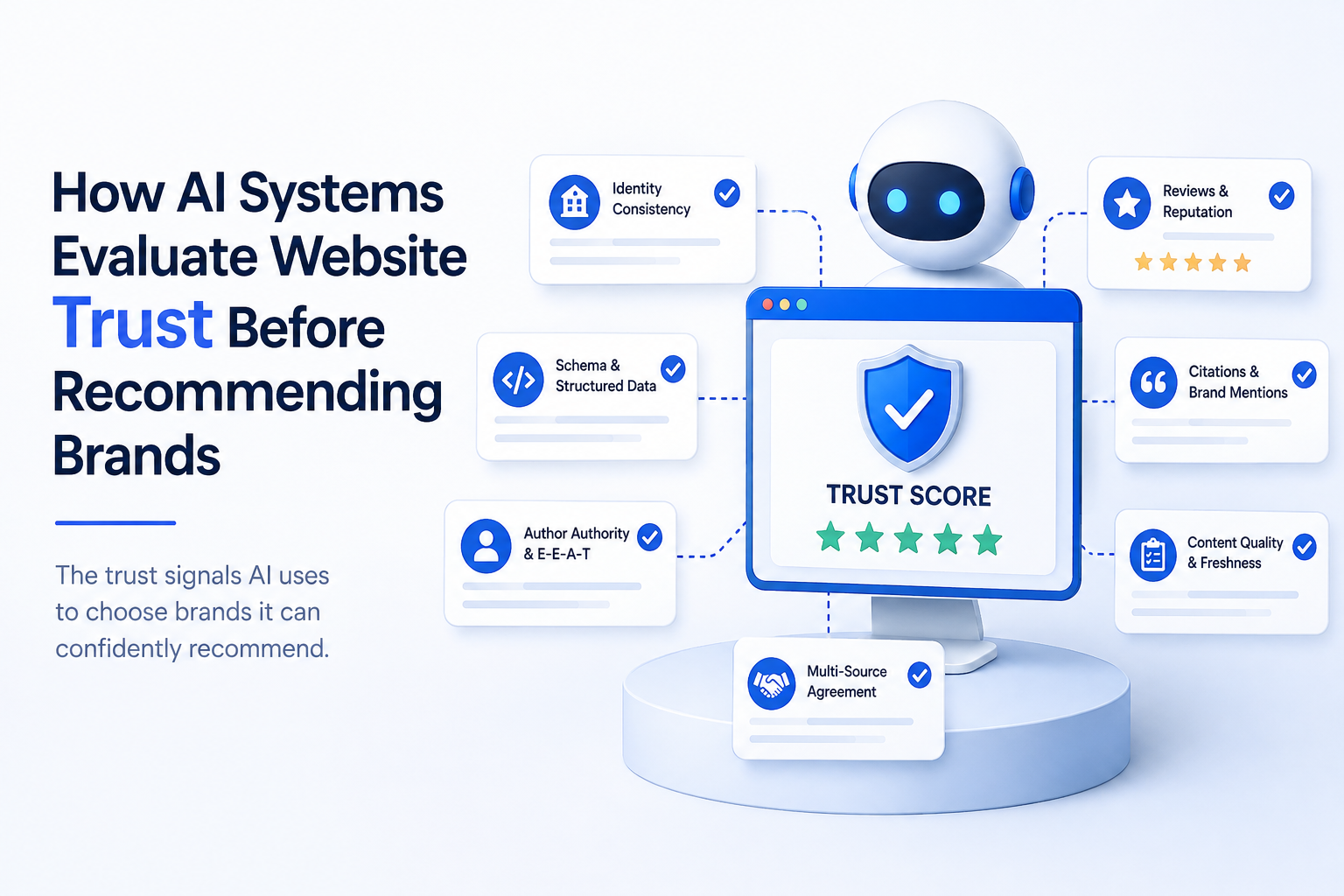
“Does the web contain enough clear, credible, relevant and connected information for an AI system to understand my business and confidently surface it?”
That is what an AI search visibility audit should investigate.
What Does AI Search Visibility Actually Mean?
Before diagnosing the problem, it helps to separate several things that are often treated as one.
A business can have different levels of visibility in AI search.
1. Discoverability
Can an AI-powered search system discover your website and other information about your business?
If your important pages cannot be crawled or indexed, there is a fundamental visibility problem.
For Google AI features, a page needs to be indexed and eligible to appear in normal Google Search. Google also recommends making important content accessible, internally linked, crawlable and available in textual form.
For ChatGPT Search, OpenAI specifically recommends allowing OAI-SearchBot to crawl the website.
2. Understanding
Can the system clearly determine:
- what your company does
- who you serve
- what products or services you offer
- where you operate
- which industries you specialize in
- what makes you different
- who the people behind the business are
A website can contain a lot of information and still communicate very little clearly.
3. Mentionability
Does your business appear when people ask relevant questions?
For example:
“What are the best AI SEO agencies in India?”
Being mentioned is different from simply having a website indexed.
4. Citation
Does the AI response actually link to your website or another credible source about your business?
This is stronger evidence that the system found your information useful for the particular answer.
5. Recommendation
Does the system recommend your company when a user asks for options?
This is where commercial intent becomes important.
A business doesn’t necessarily need to be mentioned for every query. It needs to be visible for the right queries.
Why Your Business May Not Appear in ChatGPT or AI Search
There isn’t one universal reason.
In practice, an AI search visibility audit should examine several layers.
1. Your Website Is Not Crawlable
This is the most basic issue.
If search systems cannot access your content, there is little reason to expect that content to be used in an answer.
For Google AI features, Google says the same technical requirements that apply to Search apply to AI Overviews and AI Mode. It specifically recommends checking crawling, indexing, internal links and the availability of important content in textual form.
For ChatGPT Search, OpenAI says websites should allow OAI-SearchBot to crawl the site.
Audit this first
Check:
- robots.txt
- noindex directives
- canonical tags
- XML sitemap
- server accessibility
- CDN and firewall restrictions
- important pages in Google’s index
- internal linking
- OAI-SearchBot access
- important content rendered in accessible text
Don’t start with advanced GEO tactics if the basic discovery layer is broken.
2. Your Business Is Difficult to Understand
Consider these two descriptions.
Company A:
“We provide innovative, scalable, next-generation solutions that help businesses unlock digital transformation.”
Company B:
“We provide AI SEO, semantic SEO and content marketing services for SaaS, technology, healthcare and professional-services companies.”
The second description gives a search system much more usable information.
It identifies:
- the company category
- services
- target customers
- industries
- subject area
This matters because AI search involves interpreting relationships between entities, topics, questions and sources.
Your website should make those relationships explicit.
3. Your Content Talks About Keywords Instead of Problems
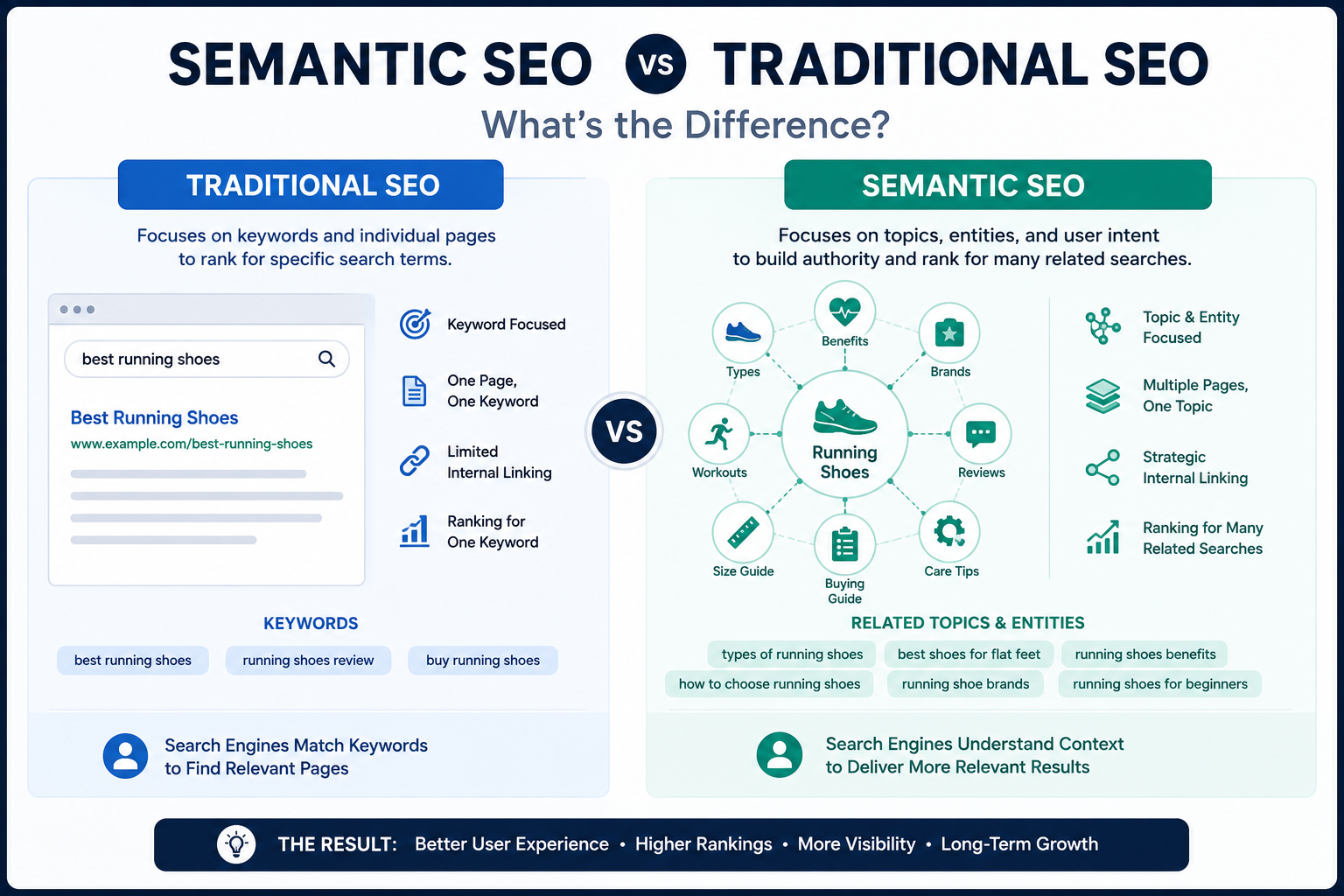
Traditional SEO often encourages businesses to think in terms of keywords.
But customers don’t necessarily think in keywords.
A business owner might not search:
“AI search optimization services.”
They may ask:
“Why doesn’t my company appear in ChatGPT recommendations?”
Or:
“How can I get my business mentioned in AI search results?”
Or:
“Why does ChatGPT recommend my competitors but not me?”
These are different expressions of the same underlying problem.
A strong content strategy therefore needs to cover the problem space, not simply repeat a target keyword.
Google’s current guidance emphasizes useful, unique and non-commodity content rather than producing content simply to target search systems.
4. Your Website Has Content, But Not Enough Topical Depth
Publishing 100 unrelated blog posts does not automatically create authority.
Imagine a company publishes:
- 10 SEO articles
- 8 social media articles
- 12 email marketing articles
- 5 PPC articles
- 7 AI articles
The website may have plenty of content.
But it may not have a clear area of expertise.
Compare that with a company that develops a connected body of content around:
AI search visibility
→ AI search optimization
→ ChatGPT visibility
→ Google AI Overviews
→ AI search citations
→ entity optimization
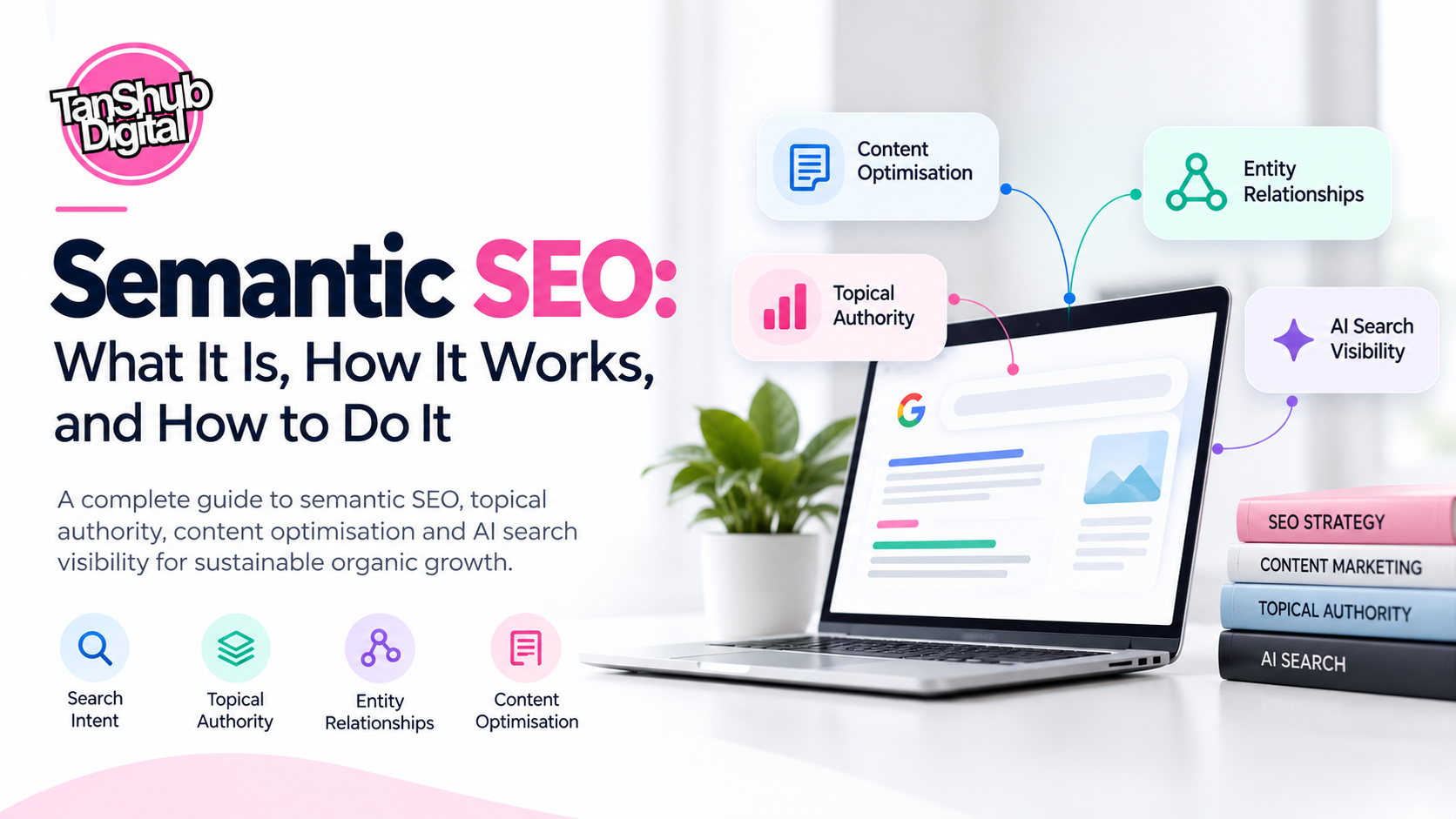
→ semantic SEO
→ AI search measurement
→ brand mentions
→ content retrieval
→ digital authority
→ AI recommendations
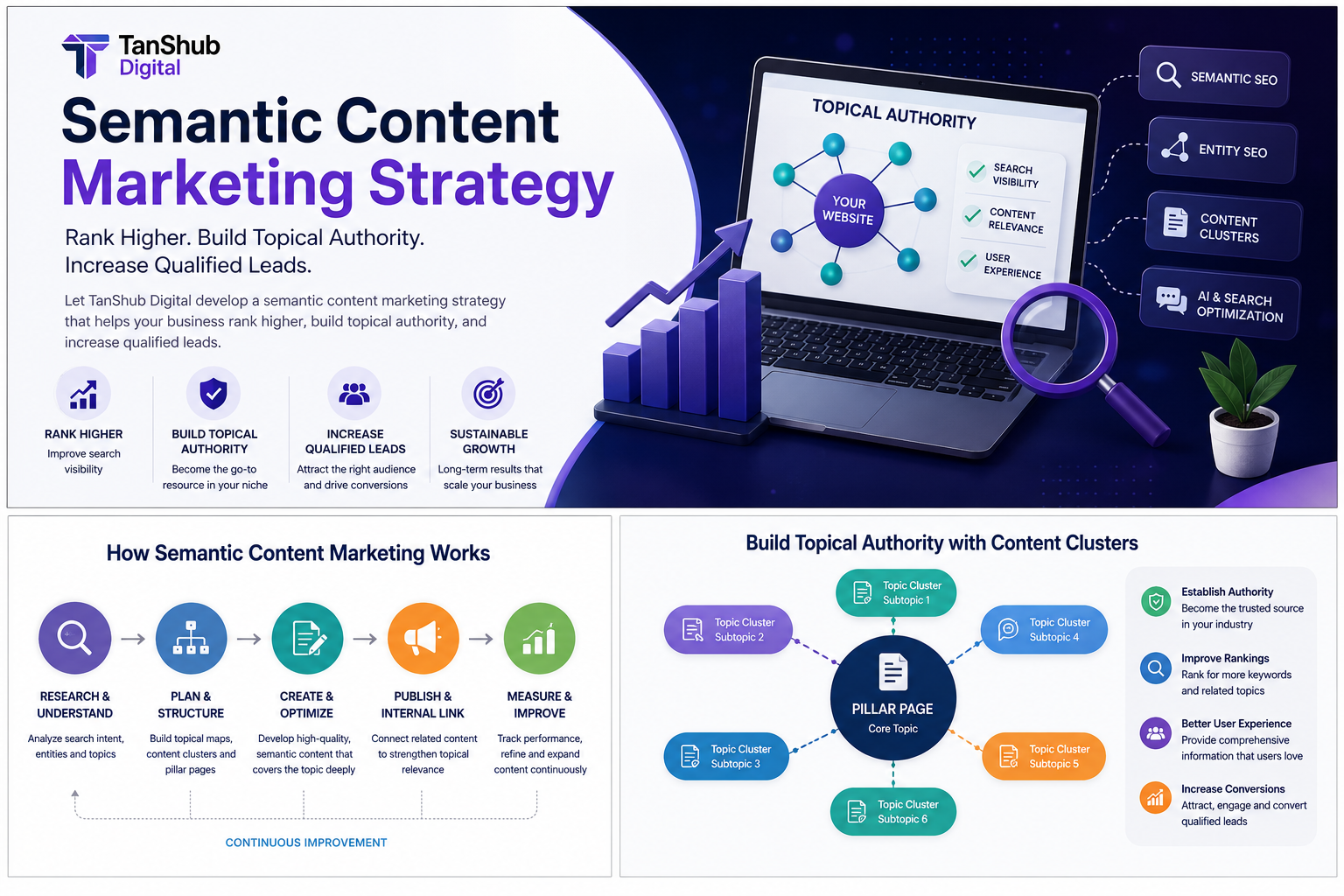
The second structure creates a much clearer topical relationship.
This is one reason Tanshub’s current positioning around AI SEO, Semantic SEO, Entity Optimization, Knowledge Graphs and Brand Authority can become more powerful when those concepts are connected rather than published as isolated topics.
5. Your Business Exists Online, But Its Information Is Fragmented
This is an overlooked problem.
Your website may say one thing.
Your LinkedIn profile may say another.
A directory may use an old company description.
A review platform may categorize your business differently.
Your Google Business Profile may contain incomplete information.
Your founder may describe the company using different terminology.
None of these problems automatically means AI systems will ignore your business.
But they create a more complicated information environment.
A practical AI search visibility audit should therefore examine the wider digital presence:
- website
- Google Business Profile
- business directories
- social profiles
- industry publications
- review platforms
- interviews
- press coverage
- third-party articles
- founder profiles
- customer references
Tanshub’s own Digital Presence Management service follows a similar logic by combining reputation management, Google Business Profile optimization, business listings, personal branding, brand monitoring and authority development.
6. Nobody Else Talks About Your Business
Your website controls what you say about yourself.
It does not control what the rest of the web says about you.
This distinction matters.
Suppose a company claims:
“We are one of India’s leading AI SEO agencies.”
That is a self-description.
Now suppose independent sources also describe the company as:
an AI SEO agency
a semantic SEO specialist
a digital marketing agency for SaaS companies
Those are different types of evidence.
The second situation gives an AI system more external context to work with.
This does not mean you should manufacture mentions or publish hundreds of low-quality guest posts.
It means businesses need to think about digital authority beyond their own domain.
That can include legitimate:
- industry coverage
- expert contributions
- interviews
- partnerships
- professional profiles
- customer stories
- independent reviews
- useful resources
- original research
- credible mentions
7. Your Content Has Nothing Distinctive to Cite
This is one of the biggest problems with generic AI-generated content.
Imagine two websites publish:
“AI SEO is the process of optimizing content for AI search engines.”
There is little reason for an AI system to prefer one explanation over another.
Now imagine a company publishes:
- original research
- proprietary datasets
- real experiments
- documented audits
- original frameworks
- industry observations
- expert interviews
- customer findings
- comparative analysis
The information becomes more distinctive.
Google’s own guidance now explicitly emphasizes valuable, unique and non-commodity content for generative AI search experiences.
The implication is important:
Publishing more is not necessarily the answer. Publishing something worth using is.
8. You Are Optimizing for “AI” Instead of the Customer
There is a tendency in the GEO industry to overcomplicate everything.
Businesses are told to create:
- special AI files
- special prompts
- special markup
- AI-only pages
- massive FAQ blocks
- keyword variations
- artificial conversational language
Some of these tactics may have legitimate applications in specific situations.
But they should not replace the fundamentals.
Google explicitly says websites do not need to create new machine-readable files or special schema specifically to appear in AI Overviews or AI Mode.
The better question is:
Does this page make the business easier to understand and the customer’s problem easier to solve?
If the answer is no, adding more AI terminology probably isn’t going to fix it.
The AI Search Visibility Audit
Instead of treating AI visibility as a mysterious metric, you can audit it systematically.
Here is a practical framework.
Step 1: Test Your Brand
Ask several AI platforms the same questions.
For example:
“What are the best [category] companies in [market]?”
“Which companies specialize in [specific service]?”
“Who should I consider if I need [problem solved]?”
“What are the best alternatives to [competitor]?”
“Which agencies work with [industry]?”
Record:
| Test | Result |
|---|---|
| Brand mentioned | Yes / No |
| Brand recommended | Yes / No |
| Website cited | Yes / No |
| Competitors mentioned | Yes / No |
| Sources cited | Yes / No |
| Position/context | Record |
| Reason for recommendation | Record |
Run the same test periodically rather than relying on one prompt.
AI responses can vary by query, context, location and system.
Step 2: Test Your Category
Don’t only search for your brand.
Ask:
“What companies operate in this category?”
Then ask:
“What makes these companies different?”
Now compare the information AI systems associate with your business versus competitors.
You may discover something important:
Your competitors aren’t necessarily more visible because they have better websites. They may simply have a stronger overall digital footprint around the category you want to own.
That distinction changes the strategy.
Step 3: Audit Your Entity
Ask whether a third party could understand your business without reading your entire website.
Can they answer:
- What is the company?
- What does it sell?
- Who does it serve?
- Where does it operate?
- Which industries does it specialize in?
- Who founded it?
- What topics is it associated with?
- What makes it different?
If these answers are unclear, your entity-level positioning needs work.
Step 4: Audit Your Content Architecture
Look beyond individual blog posts.
Map your content into topic clusters.
For example:
AI Search Visibility
→ ChatGPT visibility
→ Google AI Overviews
→ AI Mode
→ Gemini
→ Perplexity
→ AI citations
→ AI recommendations
→ entity SEO
→ semantic SEO
→ digital authority
→ AI search measurement
Then identify missing relationships.
A strong content architecture helps users and search systems understand how individual pages relate to the broader subject.
Step 5: Audit Your Digital Authority
Look outside your website.
Ask:
- Who mentions the company?
- Where is the founder mentioned?
- Which publications reference the company?
- Are reviews consistent?
- Are business profiles accurate?
- Are company descriptions consistent?
- Does the brand appear in relevant industry discussions?
- Are there credible third-party references?
This is not about collecting mentions for the sake of collecting mentions.
It is about building a coherent digital presence.
Step 6: Audit Your Technical Accessibility
Check the basics before attempting advanced optimization.
For Google:
- Is the page indexable?
- Can Google crawl it?
- Does it meet Search technical requirements?
- Is important content available in text?
- Are internal links working?
- Does structured data match visible content?
For ChatGPT:
- Is OAI-SearchBot blocked?
- Does the hosting or CDN block OpenAI’s published crawler IP addresses?
OpenAI specifically identifies OAI-SearchBot access as an important requirement for inclusion in ChatGPT Search.
Step 7: Audit Conversion After Visibility
Visibility alone is not the goal.
Imagine your company suddenly appears in 20 AI-generated answers.
If those visitors land on a confusing website, nothing meaningful has improved.
The journey should be:
AI discovery
↓
Website visit
↓
Understanding
↓
Trust
↓
Action
↓
Lead or sale
That means AI search optimization eventually connects with:
- website UX
- landing pages
- conversion optimization
- lead forms
- calls to action
- CRM
- lead nurturing
- marketing automation
This is why AI search should be treated as part of the wider digital customer journey rather than as an isolated SEO activity.
How to Appear in ChatGPT: Start With the Basics
If your immediate question is “How can I get my business to appear in ChatGPT?”, start with these checks.
1. Make sure your website is accessible
Do not block OAI-SearchBot if you want your content to be available to ChatGPT Search.
2. Make your business easy to understand
Clearly explain:
- who you are
- what you do
- who you serve
- where you operate
- what you specialize in
3. Build useful, specific content
Answer the actual questions your customers ask.
4. Develop topical depth
Cover important aspects of your subject rather than publishing disconnected articles.
5. Strengthen your wider digital presence
Maintain accurate business information and build legitimate authority across relevant platforms.
6. Create information worth referencing
Original research, practical examples, expert insights and proprietary analysis are more useful than another generic definition.
7. Measure actual visibility
Test the queries that matter to your business.
Do not judge AI SEO success solely by whether ChatGPT mentions your company once.
What About Google AI Overviews and AI Mode?
Google’s guidance is particularly useful because it cuts through much of the speculation surrounding GEO.
Google says AI Overviews and AI Mode use the same foundational Search practices that have long mattered for websites. Pages need to be indexed and eligible for Search, and there are no additional technical requirements specifically for AI features.
Google also says its AI features may use a “query fan-out” approach, where the system performs multiple related searches across different subtopics and sources before constructing a response.
That has an important strategic implication.
A page does not necessarily need to answer every possible question on the internet.
Instead, your website should establish clear relationships between:
topics → questions → entities → evidence → supporting pages
This makes the website more useful as a source of information.
Google’s current generative AI guidance also emphasizes non-commodity content and says traditional SEO remains foundational because these AI experiences are rooted in Google’s existing Search systems.
AI Search Visibility Is Not the Same as Google Rankings
This distinction deserves attention.
A business can have:
Strong Google rankings + weak AI visibility
or:
Moderate Google rankings + strong visibility for specific AI questions
Why?
Because the experiences are not identical.
AI systems can synthesize information from multiple sources and answer a more complex question than a single keyword query.
Google says AI Mode is designed for nuanced questions, comparisons and further exploration, and AI features can surface a broader range of supporting links.
That does not mean traditional SEO has become irrelevant.
It means the definition of search visibility is becoming broader.
The 10-Query AI Visibility Test
If you want a simple starting point, create your own ten-query test.
Choose:
3 category queries
“Best [service] companies in [market]”
“Top [service] providers for [industry]”
“Which companies specialize in [service]?”
3 problem queries
“How can I solve [problem]?”
“Who can help with [problem]?”
“What should I look for when choosing a [service provider]?”
2 comparison queries
“Best alternatives to [competitor/category]”
“[Service A] vs [Service B]”
2 high-intent queries
“Which [provider] should I hire for [specific need]?”
“Best [provider] for [industry + location]”
Then test them across the AI search platforms relevant to your market.
Create a simple spreadsheet with:
- query
- platform
- date
- brands mentioned
- brands recommended
- citations
- sources
- your position
- competitors
- observations
This gives you something far more useful than a vague claim that your business is “AI optimized.”
How Should You Measure AI Search Visibility?
Measurement is still evolving.
Google announced dedicated Search Console reporting for visibility from generative AI features such as AI Overviews and AI Mode, giving site owners more specific insight into this traffic and visibility.
For broader AI search, however, you should combine platform testing with normal analytics.
Track:
Visibility
- brand mentions
- recommendation frequency
- citation frequency
- query coverage
- competitor visibility
Website impact
- organic traffic
- AI referral traffic where identifiable
- engaged sessions
- landing pages
- conversions
- leads
- revenue
Brand impact
- branded searches
- direct traffic
- third-party mentions
- review growth
- referral sources
The objective is not to maximize the number of AI mentions.
The objective is to become visible for commercially meaningful questions and convert that visibility into business outcomes.
When Should You Invest in Professional AI Search Optimization?
You probably don’t need an agency simply because AI search exists.
A business should first establish the fundamentals.
Professional support becomes more useful when:
- your competitors consistently appear but you don’t
- your website has substantial content but weak visibility
- your business positioning is unclear
- your digital presence is fragmented
- you operate across multiple locations
- you serve several industries
- your website has technical SEO problems
- you need a scalable content architecture
- you want to build authority around a specific topic
- you need systematic visibility and conversion measurement
The work may involve several disciplines rather than a single “GEO tactic.”
That can include:
- SEO
- AI search optimization
- semantic SEO
- entity optimization
- content strategy
- technical SEO
- digital PR
- reputation management
- local SEO
- landing-page optimization
- conversion tracking
- marketing automation
The right combination depends on the actual visibility gap.
The Bigger Problem: Your Website Is Only One Part of Your Digital Identity
This is perhaps the most important shift businesses need to understand.
Your brand does not exist only on your website.
It exists across a network of information:
Website
↕
Search results
↕
Business profiles
↕
Social platforms
↕
Reviews
↕
Industry publications
↕
Third-party mentions
↕
People and experts
↕
Customer experiences
AI search systems increasingly operate across this broader information environment.
That means improving AI search visibility is not simply a matter of rewriting website content.
It is about making the overall digital presence more coherent, authoritative and useful.
Don’t Chase AI Search Tricks. Build a Business Worth Finding.
The AI search industry will continue to produce new terminology, new tools and new optimization theories.
Some will prove useful.
Others will disappear.
The more durable strategy is simpler.
Make your business:
Easy to discover.
Easy to understand.
Useful to the customer.
Credible beyond its own website.
Consistent across the digital ecosystem.
Worth mentioning.
Worth citing.
And most importantly, worth recommending.
Google’s current guidance reinforces the importance of useful, unique, non-commodity content, while OpenAI emphasizes relevance, reliability and crawler accessibility for ChatGPT Search.
That is a much more sustainable approach than trying to find a shortcut into an AI answer.
Final Takeaway
If your business doesn’t appear in ChatGPT, Gemini, Perplexity or Google AI experiences, don’t immediately conclude that you need more “GEO content.”
Start with an audit.
Ask:
- Can AI search systems discover my business?
- Can they clearly understand what my business does?
- Is my website covering the questions my customers actually ask?
- Does my content provide anything distinctive?
- Do credible third parties reinforce what I say about my business?
- Is my digital presence consistent?
- Do I appear for the questions that matter commercially?
- Can I measure whether that visibility is improving?
- Does my website convert the visitors that visibility creates?
If the answer to several of these is no, you don’t have an AI search problem alone.
You have a digital visibility and authority problem.
And that is where an effective AI search optimization strategy should begin.
How TanShub Digital Approaches AI Search Visibility
TanShub Digital approaches AI search visibility as part of a broader digital growth strategy, combining AI Search Optimization, Semantic SEO, content strategy, entity optimization, digital presence and conversion-focused marketing rather than treating AI visibility as an isolated tactic.
The objective is straightforward:
Make your brand easier to discover, understand, trust and choose across Google, ChatGPT and emerging AI search experiences.
If your business is struggling to understand why competitors appear in AI search while your brand remains invisible, an AI Search Visibility Audit can help identify the specific gaps across technical accessibility, content, entity signals, digital authority and conversion.
Start with the audit. Fix the visibility gaps. Then build from there.
Frequently Asked Questions
Why doesn’t my business appear in ChatGPT?
Your business may not appear because AI search systems cannot easily discover, understand, verify, or confidently associate your business with the query being asked. Technical accessibility, content relevance, topical authority, digital presence, and third-party references can all contribute to how visible a business is in AI search.
How can I get my business to appear in ChatGPT?
Start by making sure your website can be crawled, including allowing OAI-SearchBot if you want your content to be eligible for ChatGPT Search. Then make your business information clear, develop useful content around customer questions, strengthen your digital presence, and build credible references beyond your own website. There is no guaranteed method for securing a particular position in ChatGPT Search.
Does SEO help with AI search visibility?
Yes. Traditional SEO remains an important foundation for AI search visibility. Google states that the same foundational SEO practices used for its normal Search experiences remain relevant to AI Overviews and AI Mode. AI search optimization should therefore complement SEO rather than replace it.
Do I need special GEO or AI SEO techniques to appear in Google AI Overviews?
Google does not require special technical optimizations specifically for AI Overviews or AI Mode. Pages still need to meet Google’s normal Search requirements and provide useful, accessible content. Some AI search optimization practices can improve how clearly information is structured and understood, but they should not replace fundamental SEO.
Does schema markup guarantee ChatGPT or Google AI citations?
No. Structured data can help search engines understand certain information about a page when implemented correctly, but there is no reliable basis for claiming that adding schema guarantees an AI citation or recommendation.
What is the difference between being mentioned and being cited by AI?
A mention means the AI system names your business. A citation generally means the response provides a source or link supporting the information. A citation can be a stronger signal of source visibility, but neither guarantees that the user will choose your business.
How do I measure AI search visibility?
Create a set of commercially relevant questions and test them regularly across the AI search platforms that matter to your business. Record whether your brand is mentioned, recommended or cited, which competitors appear, and which sources are used. Combine this with website analytics, leads, conversions and other business metrics.
Can a business rank well on Google and still have poor AI search visibility?
Yes. Traditional rankings and AI search visibility overlap, but they are not identical. AI systems can synthesize information from multiple sources to answer broader questions, so a strong Google ranking for individual keywords does not automatically mean your business will be recommended for relevant conversational queries.
How long does it take to improve AI search visibility?
There is no universal timeline. Technical issues can sometimes be addressed relatively quickly, while building topical authority, credible third-party references and a stronger digital presence can take considerably longer. AI search visibility should be treated as an ongoing optimization process rather than a one-time campaign.
Should I publish more content to improve AI search visibility?
Not necessarily. More content is useful only when it adds meaningful coverage or information. Publishing large volumes of repetitive or generic articles can create more pages without making your business more authoritative. Focus instead on useful, specific, well-supported content that answers important customer questions.
Is Your Business Invisible in AI Search?
If customers are asking ChatGPT, Gemini, Perplexity or Google AI search about businesses like yours, being absent from those conversations can become a visibility problem.
But the solution isn’t simply to publish more AI-generated content or chase the latest GEO tactic.
You need to understand why your business isn’t being discovered, understood, mentioned or recommended in the first place.
TanShub Digital can help audit the gaps across your SEO, AI search visibility, semantic content, entity presence, digital authority and overall online presence and build a strategy around the areas that actually need improvement.
Find Out Where Your AI Search Visibility Is Breaking Down
Talk to TanShub Digital about an AI Search Visibility Audit.