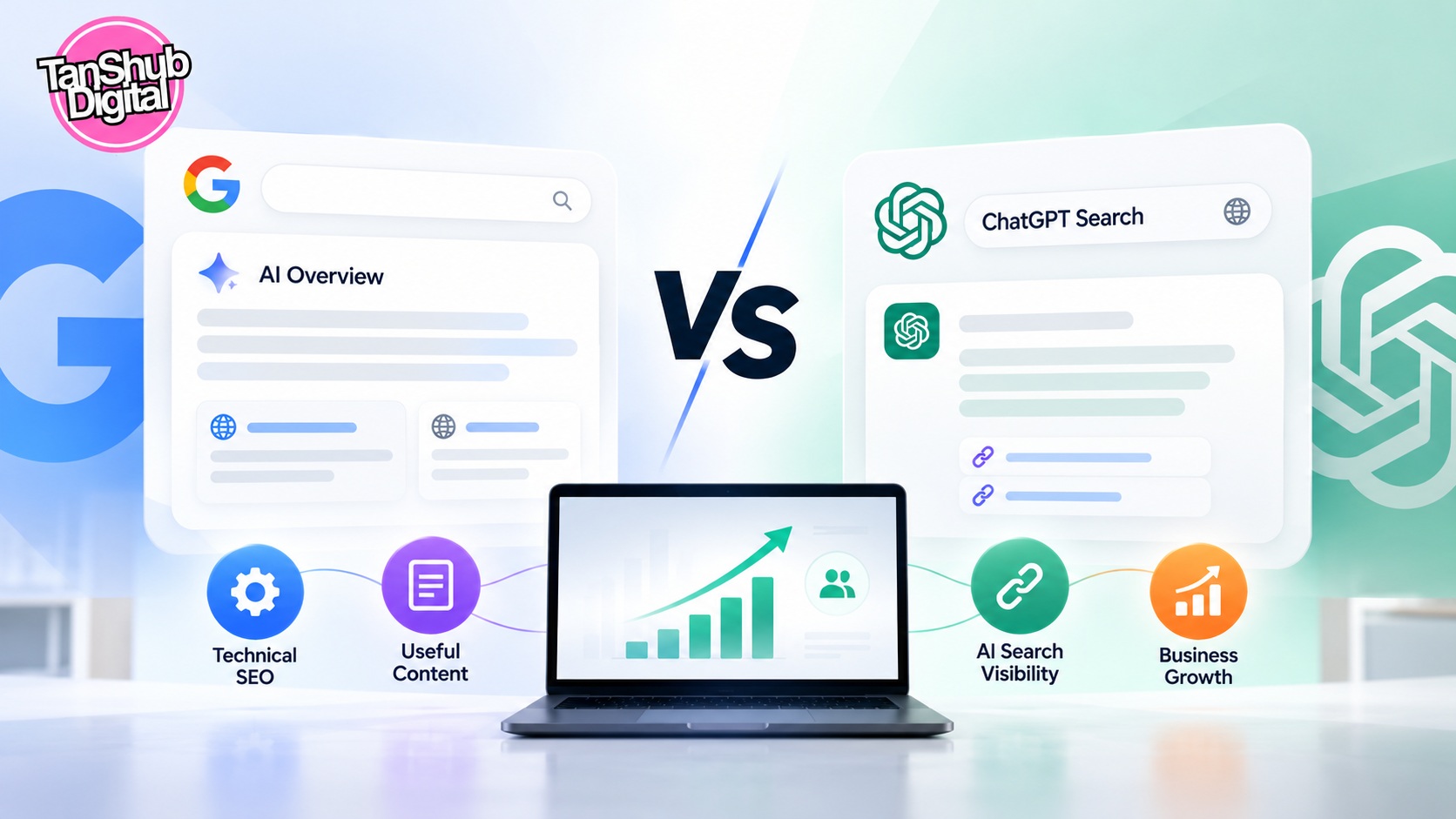
Google AI Overviews vs ChatGPT Search: How Should Businesses Optimize Their Websites?
Introduction Your website can rank in Google Search without appearing in a Google AI Overview. It can also contain useful information without being cited by ChatGPT Search when potential customers ask questions about your industry. For businesses investing in SEO, this raises an important question: should you optimize for Google AI Overviews and ChatGPT Search differently, or can the same strategy improve visibility across both? The answer is to build on strong SEO fundamentals while addressing the technical requirements, content gaps and measurement opportunities of each platform. Google AI Overviews integrates AI-generated summaries into Google Search. ChatGPT Search combines conversational answers with web search and source links. Both can help potential customers discover your business, but their technical access requirements, search experiences and reporting options differ. Consequently, ranking in traditional search, earning an AI citation and attracting qualified website traffic are related outcomes, but they are not interchangeable. This guide explains how Google AI Overviews and ChatGPT Search differ, which optimization practices apply to both, what businesses should check separately and how to prioritize improvements based on commercial value. The goal is not to chase an AI ranking trick. It is to make your website accessible, useful, credible and relevant when potential customers search for the products or services you offer. 1. Google AI Overviews vs ChatGPT Search: Key Differences Google AI Overviews provides AI-generated summaries within Google Search when Google’s systems determine that they can help answer a query. These summaries can include links to supporting websites. ChatGPT Search lets users ask questions conversationally and receive answers that may include links to relevant web sources. Users can refine their questions through follow-up interactions. Although both experiences help people discover information, businesses should understand their differences before deciding how to optimize their websites. Comparison factor Google AI Overviews ChatGPT Search Search environment Integrated into Google Search Integrated into the ChatGPT experience Discovery foundation Google’s Search index, crawling, indexing and ranking systems Web search and retrieval, including OpenAI’s documented search crawler Technical starting point Pages must be indexed and eligible to appear in Google Search with a snippet Relevant pages must be accessible to OAI-SearchBot to be eligible for inclusion in ChatGPT Search answers Content priority Helpful, original content that satisfies the query and follows Google’s Search policies Relevant, useful content that can be retrieved and cited for the user’s question Measurement Google’s generative AI performance reporting in Search Console Observed citations, brand mentions and identifiable referral traffic Key limitation Eligibility does not guarantee an appearance Crawler access does not guarantee a citation Sources: Google Search Central: AI features and your website and OpenAI: Overview of OpenAI crawlers. These differences do not mean that businesses need two separate websites or duplicate content strategies. Instead, evaluate the same website against the discovery requirements and measurement opportunities of each platform. For example, a product page may be indexed in Google but lack the details needed to answer a particular buying question. The appropriate response is to investigate the content gap, not assume that an AI-specific markup tag will solve the problem. Similarly, a page may contain excellent information but be inaccessible to a crawler required for a particular search experience. That calls for a technical investigation rather than another round of content rewriting. 2. How Google AI Overviews and ChatGPT Search Discover Website Content Understanding the discovery process helps businesses identify the right optimization priorities. How Google AI Overviews work Google’s AI search features build on its established Search infrastructure. A page generally needs to be indexed and eligible to appear in Google Search with a snippet before it can be considered as a supporting link in AI Overviews or AI Mode. Google also documents query fan-out, in which AI search experiences can issue multiple related searches across subtopics and sources to help develop a response. Consider someone researching payroll software for a growing company. Their questions may extend beyond the main product category to statutory reporting, implementation, integrations, pricing and security. A useful website should provide accurate information about the requirements its product actually supports. Separate pages may be appropriate when they answer distinct questions, but publishing near-identical pages for minor keyword variations does not automatically improve visibility. What to check on your website Google’s official guidance states that no additional technical requirements or special schema types are required specifically for inclusion in AI Overviews or AI Mode. Reference: Google Search Central: AI features and your website. How ChatGPT Search discovers website content OpenAI documents OAI-SearchBot as the crawler used to help surface websites in ChatGPT Search. GPTBot serves a different purpose, associated with crawling content that may be used to improve OpenAI’s generative AI foundation models. OpenAI allows website owners to manage these crawler settings independently. This distinction matters because a business may want its pages to be discoverable in ChatGPT Search while making a separate decision about model-training access. What to check on your website A simplified robots.txt example that allows OAI-SearchBot is: This is an illustrative rule, not a complete replacement for your existing file. Review how it interacts with other directives before making changes. Allowing OAI-SearchBot does not guarantee that ChatGPT will cite your website. It makes the website accessible for consideration in ChatGPT Search, subject to the platform’s other systems. Reference: OpenAI: Overview of OpenAI crawlers. Diagnose the problem before choosing a solution Suppose a service page appears in Google Search but does not appear in the ChatGPT answers you inspect. There are three broad possibilities: These problems require different solutions. A technical fix will not necessarily resolve a content gap, and rewriting a page will not fix a blocked crawler. A structured diagnosis prevents businesses from spending time on changes that do not address the actual problem. 3. What Should Businesses Optimize Differently? The most effective AI Search Optimization strategy combines shared SEO foundations with platform-specific checks. Optimize the foundations that support both platforms Technical accessibility Ensure that important pages return appropriate HTTP responses, are discoverable through internal links and are not unintentionally blocked by […]