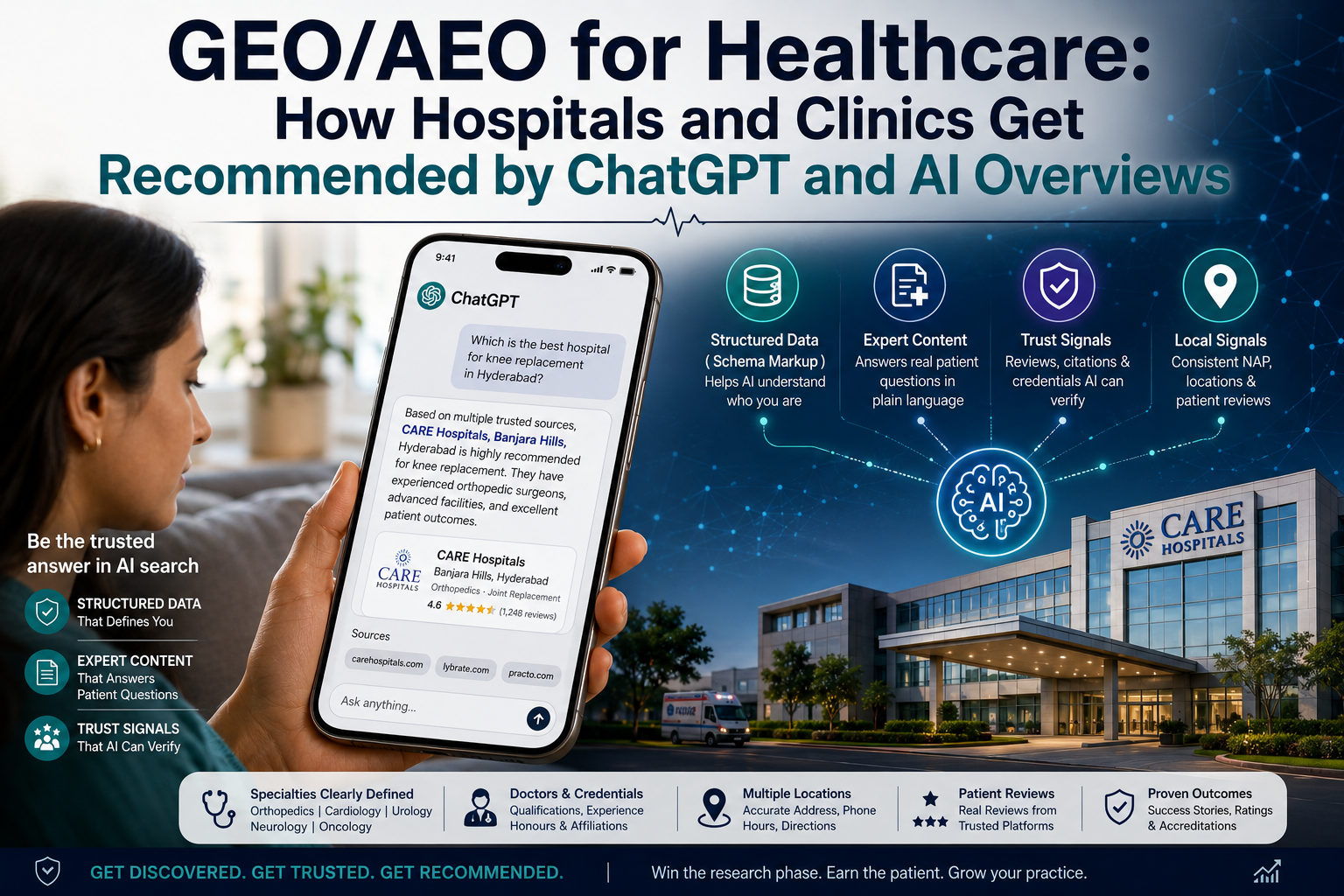
Quick answer: Hospitals and clinics get recommended by ChatGPT and Google AI Overviews the same way they get trusted by patients — by being clearly defined (structured data that names your specialties, doctors, and locations), clearly written (content that answers real patient questions in plain language), and independently verified (reviews, citations, and credentials AI systems can check). That means combining healthcare schema markup, condition-and-treatment content built for extraction, and consistent local signals — not just a Google Business Profile and a hope. Patients are already asking AI platforms things like “best cardiologist for a second opinion” or “which hospital near me treats kidney stones without surgery.” If your hospital or clinic isn’t structured for AI to find and trust, you’re invisible in that conversation — even if you rank on page one of Google. This guide breaks down exactly how AI recommendation works for healthcare, and what a hospital, multi-specialty clinic, or individual practitioner needs to do about it in 2026. Why This Matters Right Now for Healthcare Providers Search behavior for health information has shifted faster than most hospital marketing teams have caught up with. For any hospital competing against larger, better-funded health systems, this is either a serious threat or a serious opportunity — depending on who moves first. Why AI Tends to Recommend Hospitals Over Independent Clinics (And What Smaller Practices Can Do) Recent research auditing thousands of AI health queries found a consistent pattern: when patients ask AI platforms for a doctor or specialist recommendation, the names that come back are disproportionately attached to larger hospital systems rather than independent practices — because AI can only cite a source it has structured, verifiable information about. If a hospital has organized schema, published condition-specific content, and a visible citation trail, and an independent clinic has none of that, the AI defaults to what it can verify. The same research also found something reassuring for independent clinics and single-specialty centers: patients still read reviews and site content before booking, even after AI gives them a shortlist. That means a well-optimized independent clinic can absolutely compete with large hospital chains for AI citations — it just has to do deliberately what the big systems do by scale: define itself clearly, publish depth on its specialties, and make its credibility verifiable. The Three Layers of Healthcare GEO/AEO GEO for healthcare isn’t one tactic — it’s three layers working together. Skipping any one of them caps how far the other two can take you. 1. Entity Clarity (Structured Data) AI systems don’t “read” your website the way a person does. They extract entities — your hospital, your doctors, your specialties, your locations — from structured data. Without it, an AI system is guessing at who you are from unstructured text, and guessing sources rarely get cited. Minimum schema stack for a hospital or clinic: Schema Type Where to Use It What It Signals MedicalOrganization or MedicalClinic Homepage, About page Establishes you as a verified healthcare entity, not just a generic business Physician Every doctor’s individual profile page Credentials, specialty, medical school, registration/license number, affiliations MedicalProcedure / MedicalCondition Every treatment and condition page Connects what you treat to how you treat it — the entity graph AI relies on MedicalWebPage with reviewedBy + lastReviewed Every clinical blog post or condition page The single strongest E-E-A-T signal for AI citation eligibility — shows medical review, not just marketing copy FAQPage Any page with 4+ genuine patient questions Lets AI extract your exact Q&A wording directly into its answer LocalBusiness properties (nested in MedicalOrganization) Every location page Address, phone, hours, geo-coordinates — must match your Google Business Profile exactly The two most commonly skipped — and highest-impact — are Physician schema on individual doctor pages and reviewedBy/lastReviewed on clinical content. Most hospital websites have neither, which is a fast way for a smaller, better-structured competitor to out-cite them. 2. Content Built for Extraction, Not Just Ranking Generative engines increasingly reward topic comprehensiveness over keyword density — they’re synthesizing an answer, not matching a phrase. That changes how healthcare content needs to be written: 3. Verifiable Authority (Citations, Reviews, and Consistency) AI systems weigh whether other sources agree with what you say about yourself. That means: Local and Hyperlocal GEO Tactics Generic “best hospital” content competes with every hospital in the country. Hyperlocal content competes with a handful of providers in your actual service radius — and it’s exactly the kind of specific, well-covered topic AI systems prefer to cite. Practical moves: A Compliance Note Healthcare is treated as YMYL (Your Money or Your Life) content by both Google and AI systems, which means the trust bar is deliberately high. A few non-negotiables: A 30-Day GEO/AEO Action Plan for a Hospital or Clinic Frequently Asked Questions How do I know if ChatGPT or Google AI Overviews already mentions my hospital? Run a set of realistic patient prompts — specialty plus locality, symptom plus “which hospital” — through ChatGPT, Perplexity, and Google directly, and record whether your hospital, a competitor, or neither is named. This costs nothing and takes under an hour, and it’s the starting point for any GEO strategy. Is GEO/AEO different from regular SEO for hospitals? They overlap heavily but aren’t identical. Traditional SEO optimizes to rank a page in a list of links. GEO/AEO optimizes to be the source an AI system extracts and cites inside a synthesized answer — which puts far more weight on structured data, direct-answer content, and verifiable credentials than on keyword placement alone. Do small clinics and individual doctors have a real chance against large hospital chains for AI visibility? Yes. AI citation research shows the deciding factor is structured, verifiable information, not size. A single-specialty clinic with complete schema, medically-reviewed content, and consistent local listings can out-cite a large hospital that has neither. What’s the single highest-impact fix for a hospital website right now? For most sites, it’s adding Physician schema to individual doctor pages and MedicalWebPage schema with reviewedBy/lastReviewed to clinical content — these
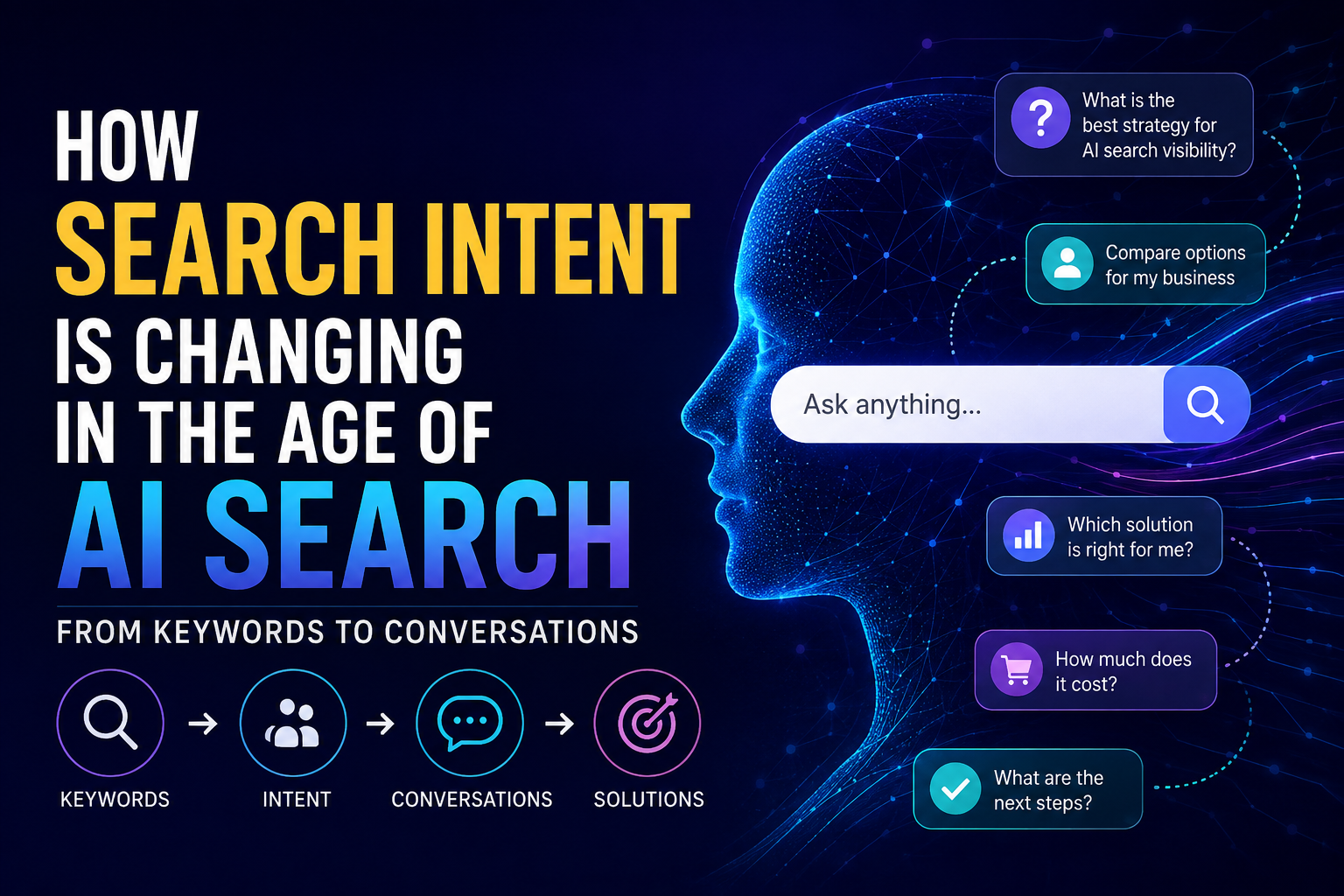
How Search Intent Is Changing in the Age of AI Search: From Keywords to Conversations
Introduction For years, SEO revolved around a relatively simple equation: Keyword → Search Query → Web Page → Ranking A business identified a keyword, created a page around it, optimized the content and attempted to rank in Google’s search results. That model still matters. However, search behavior is becoming considerably more complex. People increasingly use search engines and AI-powered interfaces to ask longer questions, describe situations, compare alternatives and continue conversations instead of entering short keyword phrases. Google’s current documentation describes AI Mode as particularly useful for nuanced questions, exploration and complex comparisons. Google also says its AI features can use a technique called query fan-out, where an initial query is expanded into multiple related searches across subtopics and sources. This changes an important part of SEO: The objective is no longer simply to match a page to a keyword. It is to understand the underlying intent, context and information need behind the search. That is why search intent is becoming increasingly important in the age of AI search. What Is Search Intent? Search intent is the underlying reason why someone performs a search. A person searching for: “what is semantic SEO” is probably looking for an explanation. Someone searching for: “semantic SEO agency” is potentially looking for a service provider. Someone searching for: “semantic SEO vs traditional SEO” is comparing approaches. The words are related, but the intent is different. Traditional SEO often treats these queries as separate keyword opportunities. A stronger approach looks at the relationship between the queries and the user’s journey. The user may be moving through several stages: Understand → Explore → Compare → Evaluate → Decide → Act AI search makes this journey even more conversational. Why Search Intent Is Becoming More Important The rise of AI search does not make traditional SEO irrelevant. In fact, Google explicitly states that the foundational SEO practices used for traditional Search continue to apply to AI features such as AI Overviews and AI Mode. Pages still need to be crawlable, indexable and eligible for Search, while content should be useful, reliable and created for people. What is changing is the way users express their information needs. Consider the difference. Traditional search best CRM software for small business Conversational search I’m running a 20-person company and need a CRM that is affordable, easy for a sales team to learn and integrates with WhatsApp. What should I consider? The second query contains considerably more context. It communicates: The search engine has more information about the user’s actual intent. This is one reason content strategies based solely on individual keywords are becoming less effective. From Keywords to Information Needs Keywords are still useful. They help identify what people search for and provide valuable signals about demand. But keywords are not the complete picture. Consider these searches: A keyword-focused strategy might create a separate article for every variation. An intent-focused strategy asks: What does the searcher actually need? The answers could be: Education The person wants to understand AI SEO. Evaluation The person wants to determine whether AI SEO is relevant to their business. Comparison The person wants to understand AI SEO versus GEO. Implementation The person wants to optimize their website. Commercial investigation The person is looking for an agency or service. The better content strategy reflects these different needs. How AI Search Changes Search Queries AI interfaces make it easier for people to express complex questions. Instead of thinking about the perfect two or three keywords, users can describe their situation naturally. For example: “I have a B2B SaaS company with a strong blog but almost no organic leads. What could be wrong with my content strategy?” A traditional keyword database may not contain that exact sentence. But the query contains several recognizable concepts: B2B SaaS + content strategy + organic traffic + lead generation + content performance An AI search system can interpret these relationships and explore multiple dimensions of the question. Google explains that AI Mode and AI Overviews may use query fan-out to conduct related searches across subtopics and data sources before generating a response. That means businesses need content that addresses topics and relationships, not just isolated phrases. Search Intent Is Becoming More Contextual Search intent has traditionally been divided into categories such as: These categories remain useful. However, modern searches can contain multiple intentions simultaneously. Consider: “What is GEO, does it actually help B2B companies appear in AI search, and how much does a GEO strategy cost?” This single question contains at least three intent layers: Informational: What is GEO? Commercial investigation: Does it help B2B companies? Transactional: How much does the service cost? An AI search experience can address all three within one conversational journey. That means content strategies should become more flexible. The New Search Journey: From Queries to Conversations Traditional search often looks like this: Query 1 → Result → Query 2 → Result → Query 3 → Result AI search can compress part of this journey: Question → Answer → Follow-up → Comparison → Decision For businesses, this creates a new content challenge. Your website should not only answer the initial question. It should also provide enough depth to support the next logical question. For example: Initial question What is Semantic SEO? The next questions might be: How is Semantic SEO different from traditional SEO? Then: Does Semantic SEO improve rankings? Then: How do I implement Semantic SEO? Then: Should I hire a Semantic SEO agency? A strong content ecosystem anticipates this progression. This is where topic clusters, internal linking and semantic relationships become important. Search Intent vs Keyword Intent Keyword intent refers to what a particular keyword suggests about the user’s purpose. Search intent is broader. It considers: For example: Search Likely intent What is GEO? Learn GEO vs SEO Compare GEO strategy Explore implementation GEO agency Find a provider GEO services pricing Evaluate purchase Best GEO agency for SaaS Commercial investigation A good SEO strategy doesn’t simply assign a keyword to a page. It maps intent to
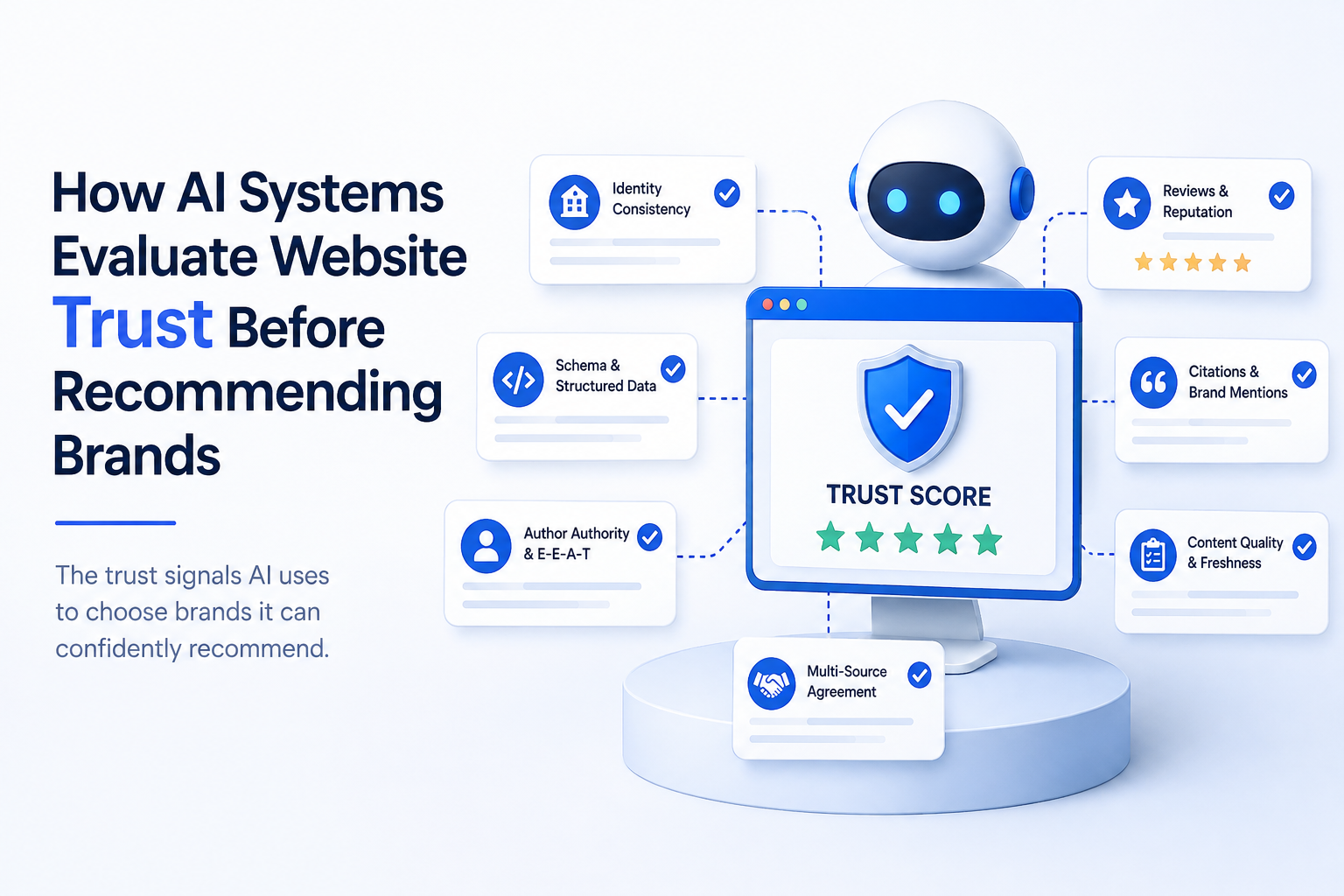
How AI Systems Evaluate Website Trust Before Recommending Brands
Search used to be a straight line: you typed a query, Google ranked ten blue links, and you clicked one. That line is gone. Today, a growing share of buying decisions start and end inside an AI conversation — ChatGPT, Gemini, Perplexity, Google’s AI Overviews — where the model doesn’t hand you a list of options. It picks one, or two, and recommends them. That shift changes the question every brand needs to answer. It’s no longer “how do we rank #1?” It’s “how does the AI decide we’re safe to recommend?” Those are different questions with different answers. Ranking is about relevance. Recommendation is about trust. And trust, to an AI system, isn’t a vibe — it’s a set of measurable, cross-referenced signals the model checks before it puts your name in front of a user. Here’s exactly how that evaluation works, and what it takes to pass it. Why AI Trust Works Differently Than SEO Ever Did Traditional SEO rewarded keyword relevance, backlink volume, and on-page optimization. An AI system is solving a different problem: it has to generate an answer it’s willing to stand behind, in a format that offers no second page of results and very little room to hedge. That forces AI models to be far more risk-averse than a search engine ranking algorithm ever was. A search engine can rank a mediocre or unverified page at position seven and let the user decide. An AI assistant that recommends a bad plumber, an unreliable SaaS tool, or a shady lender wears that mistake directly — it erodes user confidence in the model itself. So before an AI system will name your brand, it needs a high degree of confidence that doing so won’t blow up in its face. That’s why research increasingly shows AI citation behavior doesn’t track neatly with Google rankings. Pages sitting at position one in Google have a strong chance of also appearing in AI Overviews, but that advantage drops off fast by position ten — and a large share of the sources ChatGPT, Gemini, and Copilot actually cite don’t even appear in the Google top ten for the same query. Strong SEO helps, but it isn’t the same game anymore. The Four-Step Process AI Uses to Evaluate a Brand Most generative engines run some version of the same evaluation sequence before they’ll recommend an entity: 1. Entity identification. The model first has to recognize your business as a distinct, real-world entity — not just a domain name, but a company with a name, a category, a location, and a set of offerings that’s consistent everywhere it appears. 2. Signal aggregation. It then pulls in everything it can find about that entity: your website, directory listings, review platforms, social profiles, news coverage, and industry sources — building a composite picture rather than relying on any single page. 3. Contextual weighting. Not every signal counts equally. The model weighs signals differently depending on the industry, the market, and what it thinks the user actually needs — a signal that matters for a medical practice (credentials, citations from health authorities) matters far less for a local moving company (reviews, service-area consistency). 4. Cross-validation and confidence scoring. Finally, the model checks whether independent sources agree with each other. When your website, your reviews, your press coverage, and your directory listings all tell the same story, confidence goes up. When they conflict — different addresses, inconsistent claims, no independent corroboration — confidence drops, and so does your odds of being recommended. This is the core mechanic worth understanding: AI isn’t grading your homepage in isolation. It’s asking whether the entire web’s picture of your brand holds together. The Trust Signals That Actually Move the Needle Based on how AI search platforms behave today, these are the categories carrying the most weight: 1. Identity consistency (NAP + messaging) Your business name, address, phone number, and core service descriptions need to match, word for word, across your website, Google Business Profile, LinkedIn, directories, and any other place you appear. Conflicting details anywhere read as a red flag, not a rounding error. 2. Structured data and schema markup AI systems parse structure far more than they “read” the way a human does. Organization, LocalBusiness, Article, FAQPage, and Author schema give the model an explicit, machine-readable version of who you are and what you know — reducing the guesswork it would otherwise have to do. 3. Author authority and E-E-A-T Content tied to a named author with real, verifiable expertise carries more weight than unattributed marketing copy. Bylines, author bio pages, credentials, and a visible history of expertise in the subject all feed into whether the model treats a piece of content as a credible source or just noise. 4. Third-party citations and brand mentions This is arguably the single biggest lever. Coverage from trusted news outlets, mentions on industry publications, and citations from sites the model already trusts function as implied endorsements. Notably, even unlinked brand mentions matter — AI models process language, not just link graphs, so your brand name showing up consistently alongside your category on authoritative sites builds citation confidence over time, with or without a hyperlink. 5. Reviews and reputation depth Volume, recency, and how a business handles negative feedback all factor in. A 4.8-star rating built on 200 reviews reads as far more trustworthy than a flawless 5.0 built on twelve — and the pattern of how you respond to criticism is itself a signal. 6. Content depth, originality, and freshness AI models favor content that contributes something new rather than repackaging what’s already indexed everywhere else, and they weight recent, actively maintained content over older pages — even ones from historically authoritative domains. There’s a real “citation cliff” effect where content that hasn’t been touched in months starts losing ground to fresher competitors on the same topic. 7. Multi-source agreement Ultimately, everything above rolls up into one test: do independent sources, taken together, confirm the same facts about your brand? A polished
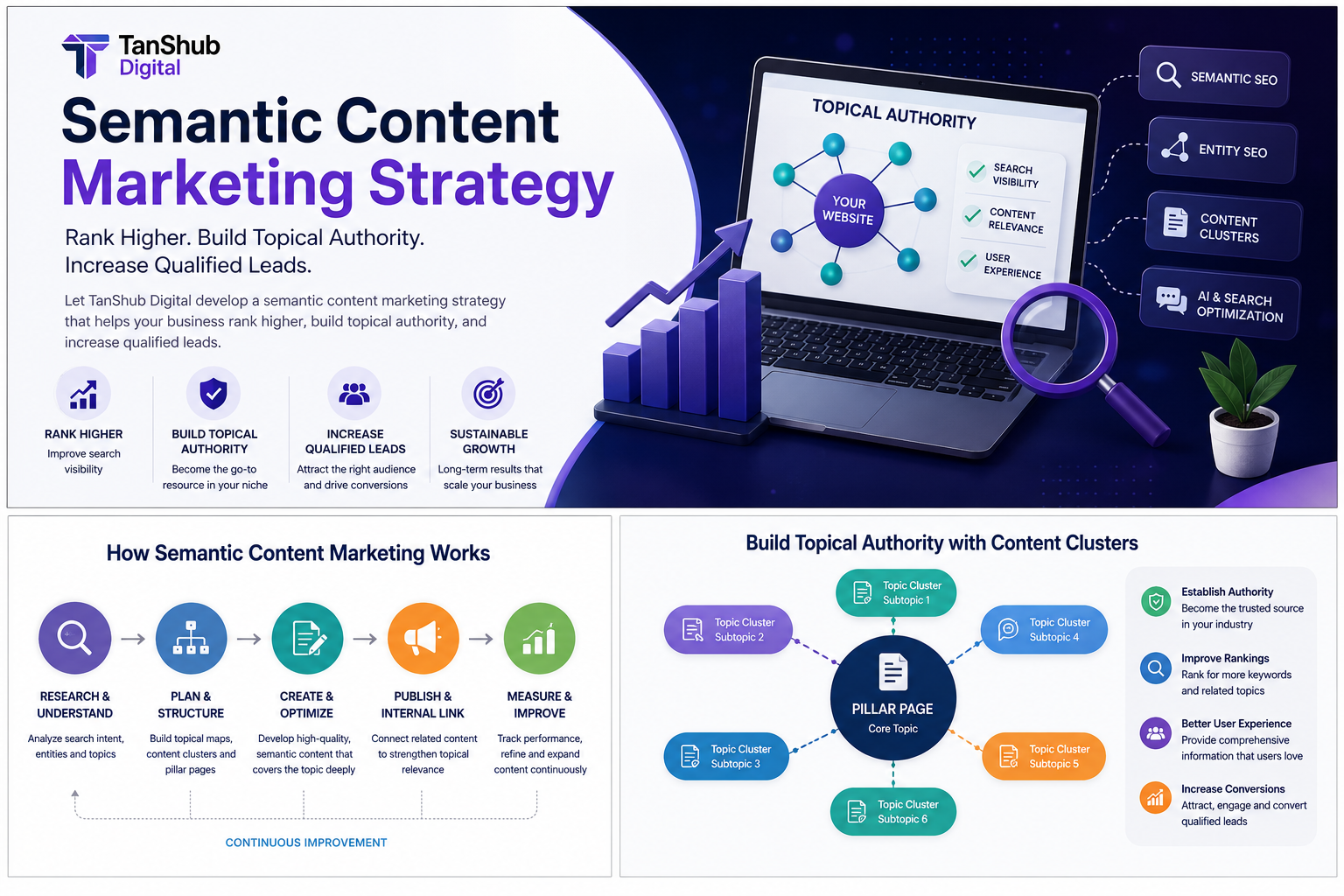
The Complete Guide to Semantic Content Marketing: How to Build Topical Authority and Rank for Everything That Matters
Published: July 30, 2026 In the early days of search engine optimization, content marketing was a relatively simple game. You identified a target keyword, sprinkled it throughout your article a specific number of times, built a few backlinks, and watched your page climb the rankings. That linear, keyword-stuffing approach worked—until it didn’t. Today’s search landscape is radically different. Google’s algorithms have evolved from simple pattern-matching systems into sophisticated artificial intelligence engines capable of understanding context, relationships, and meaning. Welcome to the era of semantic content marketing. If you’re still creating content based on isolated keywords and rigid density formulas, you’re not just behind the curve—you’re invisible. Modern search engines don’t merely index words; they map knowledge, understand entities, and interpret user intent with remarkable precision. Semantic SEO isn’t a buzzword or a fleeting trend. It represents a fundamental shift in how digital content is discovered, evaluated, and ranked. This comprehensive guide will walk you through everything you need to know about building a semantic content strategy that drives sustainable organic traffic, establishes genuine topical authority, and future-proofs your digital presence against algorithmic volatility. What Is Semantic Content Marketing? Semantic content marketing is a strategic approach to creating and optimizing digital content that prioritizes meaning, context, and topical relationships over isolated keyword targeting. Rather than optimizing a single page for a single keyword, semantic content marketing focuses on building comprehensive content ecosystems that cover entire subject areas, address multiple layers of user intent, and signal deep expertise to search engines. The term “semantic” derives from the study of meaning in language. In the context of search and content, it refers to how search engines like Google use natural language processing (NLP), machine learning, and massive knowledge databases to understand the relationships between words, concepts, and entities. When Google processes a query, it doesn’t just look for pages containing those exact words. It interprets what the user is actually looking for, considers related concepts and entities, and surfaces content that best satisfies the underlying informational need. This shift has been driven by several major algorithmic developments. The introduction of the BERT algorithm (Bidirectional Encoder Representations from Transformers) in 2019 marked a watershed moment, enabling Google to better understand the context of words in search queries. The subsequent Helpful Content Update and various core updates have doubled down on rewarding content that demonstrates genuine expertise and comprehensive topical coverage. Search engines now evaluate content not just by the presence of keywords, but by semantic relevance—how well a piece of content covers a topic in its entirety, how it connects to related concepts, and whether it truly serves the user’s underlying intent. Why Traditional Keyword-Based SEO Is No Longer Enough To appreciate the power of semantic content marketing, you need to understand the limitations of the old approach. Traditional SEO operated on a one-to-one mapping principle: one page, one primary keyword, several secondary keywords, exact-match anchor text, and a focus on search volume above all else. This methodology created several critical problems. First, it led to an explosion of thin, repetitive content. Websites would create dozens of nearly identical articles targeting slight keyword variations—”best running shoes,” “top running shoes,” “good running shoes for beginners”—each saying essentially the same thing. This fragmented approach diluted site authority and created poor user experiences. Second, it ignored the complexity of human language and search behavior. Real people don’t think in keywords; they think in questions, problems, and topics. A user searching for “how to train for a marathon” might also be interested in nutrition plans, injury prevention, gear recommendations, and recovery strategies. A keyword-optimized page about “marathon training schedule” might capture the query but miss the broader informational context. Third, and most importantly, traditional keyword targeting fails to build topical authority. Search engines today want to send users to sources that are unquestionably expert in their domain. A website with one excellent article about a topic but nothing else on related subjects signals limited expertise. In contrast, a site with a deeply interconnected web of content covering every facet of a subject area signals genuine authority. This is where semantic content marketing fundamentally changes the game. The Core Pillars of Semantic Content Marketing A successful semantic content strategy rests on several interconnected pillars. Understanding and implementing each of these components is essential for building a content ecosystem that search engines recognize as authoritative and comprehensive. 1. Topic Clusters and Pillar Pages At the heart of semantic content marketing lies the topic cluster model. Instead of creating standalone articles targeting individual keywords, you organize your content into clusters centered around broad pillar pages that cover a core topic in exhaustive detail. Each pillar page links out to multiple cluster content pieces that explore specific subtopics, questions, and related concepts in greater depth. Those cluster pieces, in turn, link back to the pillar page. This architecture does several things simultaneously. It creates clear semantic relationships between your content pieces, helping search engines understand how your articles relate to one another and which pages represent the authoritative center of each topic area. It distributes link equity efficiently throughout your site. And perhaps most importantly, it ensures that no aspect of a topic is left uncovered. When a user lands on any piece of your cluster content, they have access to the entire universe of related information on your site. For example, if you run a financial planning website, you might create a pillar page on “Retirement Planning Strategies.” Your cluster content would then cover subtopics like “401(k) Contribution Limits,” “Roth IRA vs. Traditional IRA,” “Social Security Optimization,” “Retirement Tax Strategies,” “Healthcare Costs in Retirement,” and “Estate Planning Basics.” Each cluster article links back to the main pillar, and the pillar links to every cluster piece. This structure tells Google: “We don’t just know about retirement planning keywords. We understand the entire domain.” 2. Entity-Based SEO and the Knowledge Graph Modern search has moved beyond strings of text to entities—distinct, well-defined concepts, people, places, organizations, and things that exist in Google’s
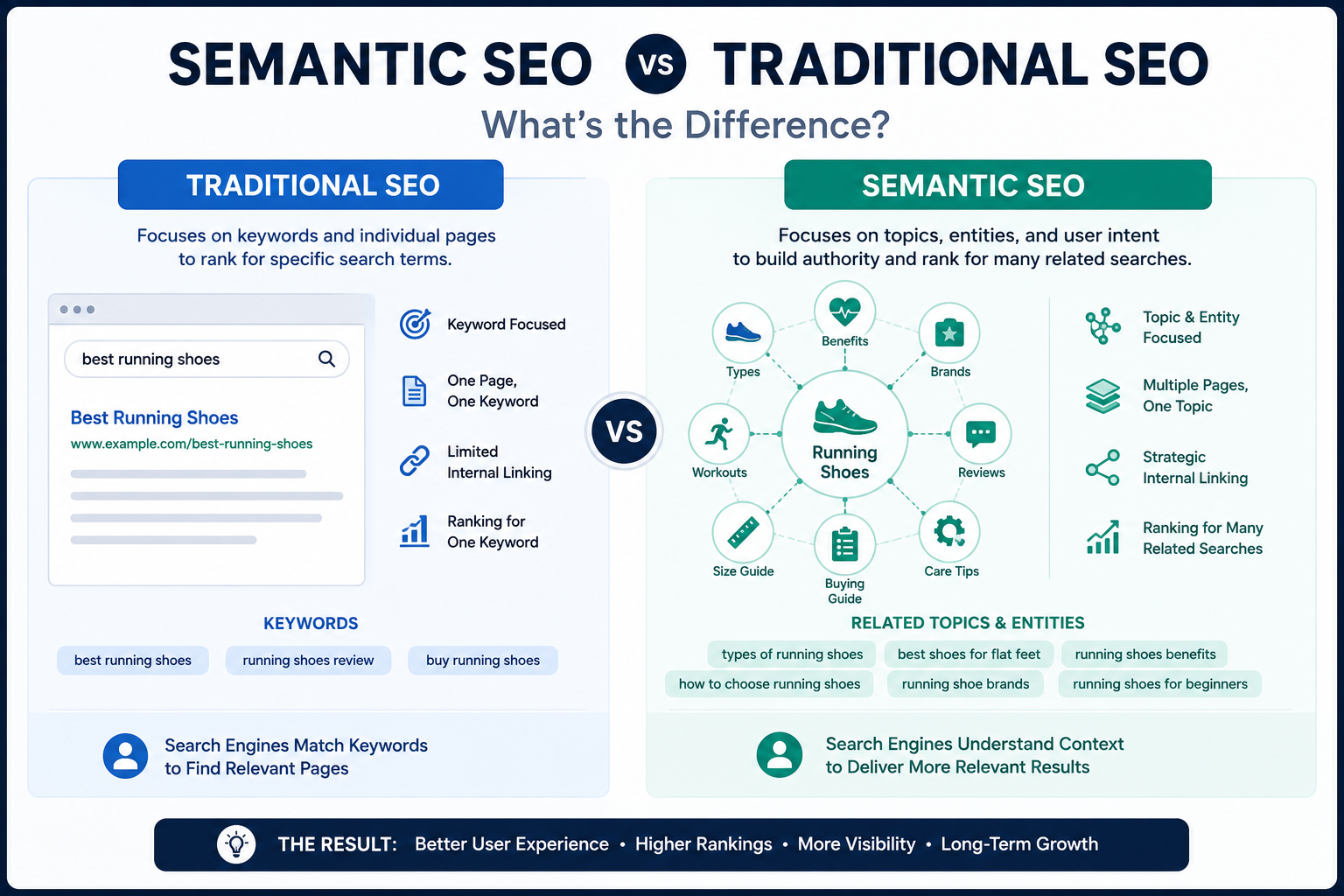
Semantic SEO vs Traditional SEO: What’s the Difference?
SEO has evolved significantly over the last decade. Ranking on Google is no longer about placing a keyword throughout a page and building a few backlinks. Modern search engines understand language, context, entities, and user intent. They evaluate how well your content answers a topic instead of simply matching keywords. This shift has led to the rise of Semantic SEO, a strategy that helps businesses build topical authority and improve visibility across Google Search, Google AI Overviews, ChatGPT, Gemini, and other AI-powered search experiences. If you’re wondering whether traditional SEO is still enough or whether Semantic SEO is the future, this guide explains the differences, benefits, and when your business should adopt a semantic approach. What Is Traditional SEO? Traditional SEO focuses on optimizing webpages for a specific keyword. The goal is to help search engines recognize the target keyword and rank the page when users search for that exact phrase. A traditional SEO strategy typically includes: For many years, this approach produced excellent results because search engines relied heavily on keyword matching. For example, if your target keyword is “best CRM software,” traditional SEO encourages using that phrase in: While these practices remain important, they are no longer enough to achieve sustainable rankings. What Is Semantic SEO? Semantic SEO focuses on the meaning behind search queries rather than exact keywords. It helps search engines understand the relationships between topics, entities, and user intent. Instead of creating one page for one keyword, Semantic SEO builds comprehensive content around an entire subject. A Semantic SEO strategy includes: Rather than asking, “Which keyword should I rank for?”, Semantic SEO asks: “What information does my audience need, and how are these topics connected?” This approach helps search engines better understand your expertise and improves your chances of ranking for hundreds of related searches. Semantic SEO vs Traditional SEO: Key Differences Traditional SEO Semantic SEO Focuses on keywords Focuses on topics and entities Optimizes individual pages Builds topical authority Targets one keyword Targets multiple related searches Keyword density matters Context and relevance matter Limited internal linking Strategic topic clusters Search engine focused User intent focused Works for keyword rankings Works for Google and AI search Keyword Focus Traditional SEO revolves around finding a high-volume keyword and optimizing a page around it. Semantic SEO expands beyond keywords by covering related concepts, questions, and entities that users expect to find. For example: Instead of optimizing only for: Semantic SEO A semantic strategy also covers: This creates a richer content experience for both users and search engines. Search Intent Matters More Than Keywords Modern search engines prioritize why someone searches instead of what they type. For example, someone searching: “Semantic SEO Services” may want to: Semantic SEO aligns content with these different search intents, making it more useful and more likely to rank. Topical Authority Replaces Keyword Stuffing Years ago, publishing dozens of keyword-focused articles was enough. Today, Google rewards websites that demonstrate expertise across an entire subject. Instead of publishing: A semantic strategy connects these pages into a structured content hub supported by pillar pages and topic clusters. This signals expertise and strengthens topical authority. Entity SEO Helps Search Engines Understand Your Business Entities are identifiable people, organizations, products, services, or concepts. Search engines use entities to understand what your content is truly about. For example: If your website discusses: Google understands that your business specializes in modern search optimization rather than simply matching keywords. Entity optimization improves contextual relevance and supports long-term rankings. Internal Linking Becomes Strategic Traditional SEO often treats internal links as navigation. Semantic SEO uses internal linking to establish relationships between topics. For example: A Semantic SEO Services page should naturally connect to articles about: These connections strengthen topical authority and improve crawlability. Schema Markup Supports Semantic Understanding Structured data helps search engines interpret your content more accurately. Schema Markup can identify: Although schema does not directly improve rankings, it enhances how search engines understand and present your content. Semantic SEO Supports AI Search One of the biggest differences between Semantic SEO and Traditional SEO is AI search visibility. AI-powered search platforms analyze context rather than matching keywords. Examples include: These systems prefer content that: Semantic SEO naturally aligns with these requirements. Benefits of Semantic SEO Businesses adopting Semantic SEO often experience: Instead of ranking for one keyword, a single page can rank for hundreds of related search queries. Can Traditional SEO and Semantic SEO Work Together? Absolutely. Traditional SEO still provides an important foundation through: Semantic SEO builds on that foundation by improving context, relationships, and content quality. The strongest SEO strategies combine both approaches rather than replacing one with the other. Which SEO Strategy Is Better in 2026? Traditional SEO remains valuable, but relying on keywords alone is no longer enough. Businesses that want to compete in modern search need to focus on: Semantic SEO prepares your website for how both search engines and AI systems evaluate content today. Why Businesses Should Invest in Semantic SEO Services If your website struggles to rank despite publishing quality content, the issue may not be your keywords. It may be the lack of semantic depth, topical authority, and contextual relevance. Professional Semantic SEO Services help businesses: As search continues to evolve, businesses that adopt Semantic SEO today will be better positioned for long-term organic growth. Conclusion Traditional SEO laid the foundation for modern search optimization, but search engines have become much smarter. Today, success depends on helping Google and AI systems understand the meaning behind your content, not just the keywords it contains. Semantic SEO focuses on topics, entities, search intent, and contextual relevance to create a stronger content ecosystem. By combining the technical strengths of traditional SEO with the depth of Semantic SEO, businesses can improve rankings, build topical authority, and increase visibility across Google Search, AI Overviews, ChatGPT, Gemini, and other AI-powered search experiences. If you’re ready to future-proof your organic strategy, investing in Semantic SEO Services is one of the most effective ways to stay ahead of evolving search
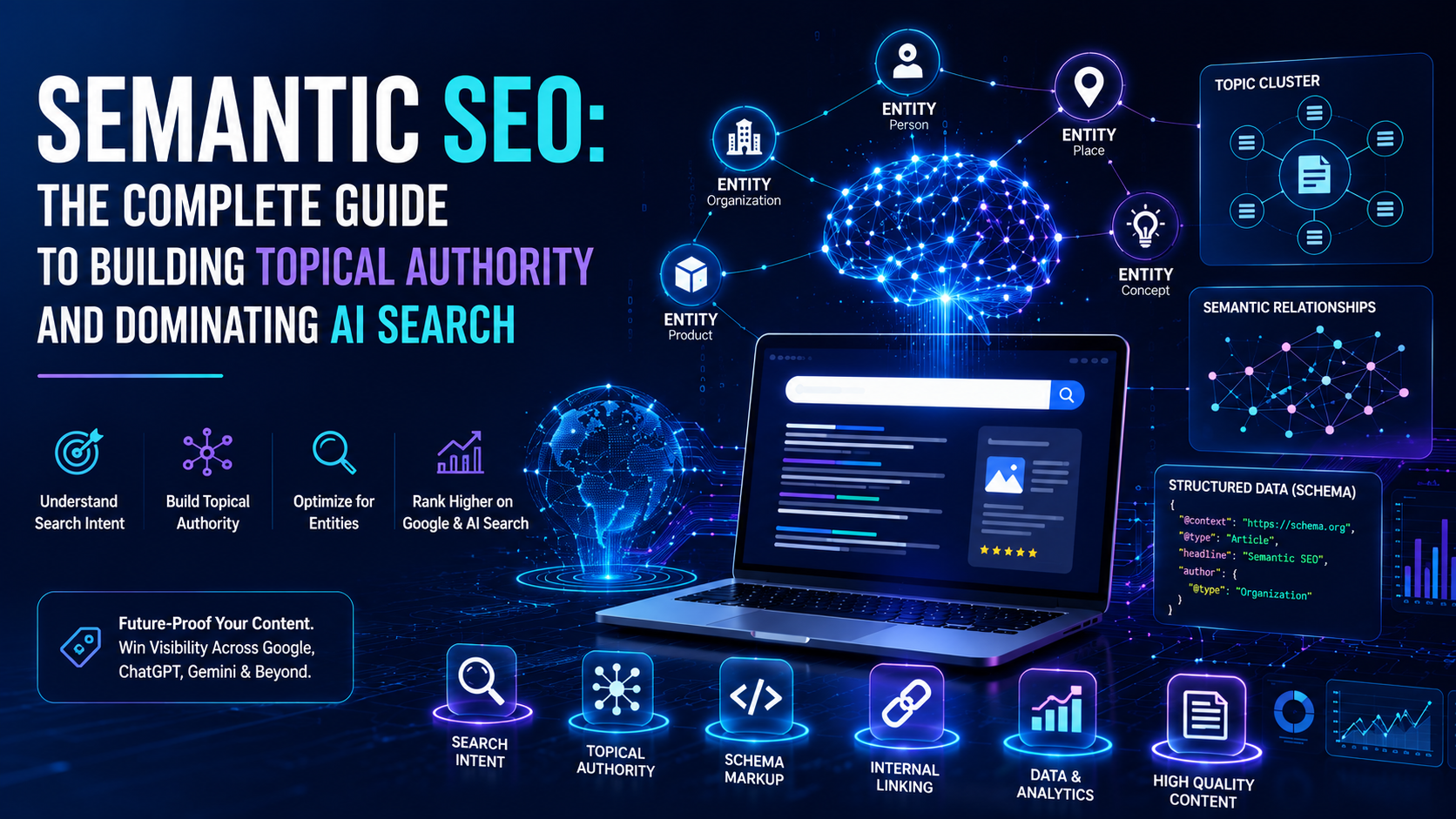
Semantic SEO: The Complete Guide to Building Topical Authority and Dominating AI Search
Search engine optimization has evolved far beyond stuffing pages with exact-match keywords. Modern search engines understand context, relationships, user intent, and entities, making Semantic SEO an essential strategy for businesses that want sustainable organic visibility. Google’s algorithms, powered by natural language processing and artificial intelligence, aim to understand the meaning behind every search rather than simply matching keywords. At the same time, AI-powered search platforms like ChatGPT, Gemini, Perplexity, and Microsoft’s Copilot retrieve and summarize information based on topical authority and semantic relevance instead of keyword density alone. This shift has transformed how content should be created. Businesses that continue relying on outdated SEO tactics risk losing visibility, while those embracing Semantic SEO can improve rankings, increase organic traffic, and become trusted information sources across both traditional search engines and AI-powered platforms. This comprehensive guide explains Semantic SEO, how it works, why it matters, and how you can implement it effectively. What Is Semantic SEO? Semantic SEO is the process of optimizing content around topics, entities, relationships, and user intent instead of focusing only on individual keywords. Rather than creating isolated pages targeting single keywords, Semantic SEO builds comprehensive content that thoroughly answers user questions while establishing topical authority. For example, a traditional SEO strategy may create separate pages targeting: A Semantic SEO strategy combines these related concepts into a structured content ecosystem where each page supports the others through logical relationships and internal links. The goal is not simply to rank for one keyword but to become an authoritative resource for an entire topic. Why Semantic SEO Matters Search engines have become increasingly sophisticated. Google’s Knowledge Graph, BERT, MUM, and AI-powered Search Experience analyze context rather than isolated words. Instead of asking, “Does this page contain the keyword?” Google asks: AI search platforms evaluate content similarly. They prioritize pages that demonstrate expertise, comprehensive topic coverage, and semantic relationships. Businesses adopting Semantic SEO benefit from: Semantic SEO vs Traditional SEO Traditional SEO Semantic SEO Focuses on keywords Focuses on topics Optimizes individual pages Builds content ecosystems Keyword density matters Context matters One keyword per page Multiple related concepts Exact-match optimization Entity optimization Limited internal linking Strategic topic clusters Search engine focused User intent focused Traditional SEO still has value, but Semantic SEO builds upon it by considering how search engines understand language. How Search Engines Understand Meaning Modern search engines use artificial intelligence and natural language processing to understand the relationships between words and concepts. Instead of treating “Apple” as just a word, Google identifies whether it refers to: This understanding comes from entities and context. When someone searches for “best laptops for content creators,” Google connects related concepts such as: Even if these exact phrases aren’t repeated throughout the content, semantic relationships help search engines understand relevance. Understanding Entities Entities are people, organizations, places, products, events, or concepts that search engines recognize independently of keywords. Examples include: Instead of repeatedly using “Semantic SEO,” an optimized article naturally includes related entities such as: This helps search engines understand the depth and context of your content. Search Intent: The Foundation of Semantic SEO Every search has an underlying intent. The four primary types are: Informational Users want knowledge. Example:“What is Semantic SEO?” Navigational Users want a specific website. Example:“Google Search Console” Commercial Users compare solutions. Example:“Best Semantic SEO tools” Transactional Users are ready to buy. Example:“Hire Semantic SEO agency” Optimizing content around the correct intent significantly improves rankings because Google prioritizes pages that satisfy user expectations. Building Topical Authority Topical authority means becoming a trusted source on a subject by consistently publishing comprehensive, interconnected content. Instead of writing dozens of unrelated blogs, create a structured content hub. Example: Pillar Page Semantic SEO Supporting Articles: Each supporting article links back to the main guide while also linking to related content. This interconnected structure signals expertise to search engines. Topic Clusters Topic clusters organize related content around one central subject. A pillar page provides a broad overview, while supporting pages explore individual concepts in depth. Benefits include: For example, if your pillar page covers Semantic SEO, supporting pages can address entity optimization, schema markup, search intent analysis, and AI search optimization. Semantic Keyword Research Keyword research now extends beyond identifying high-volume search terms. A Semantic SEO strategy identifies: Instead of optimizing for only “SEO agency,” include naturally related terms such as: This creates comprehensive coverage without keyword stuffing. Content Depth Matters Thin articles rarely perform well. A high-quality Semantic SEO article should answer every major question users may have. Include: The objective is to eliminate the need for users to return to search results. Internal Linking Strategy Internal linking strengthens semantic relationships across your website. Every relevant page should connect to other related pages using descriptive anchor text. For example: Semantic SEO → Entity SEO Entity SEO → Knowledge Graph Knowledge Graph → Schema Markup Schema Markup → Structured Data Structured Data → AI Search Optimization This creates a logical content network that helps both users and search engines navigate your site. Schema Markup Schema markup provides structured information that helps search engines interpret your content. Important schema types include: Proper implementation improves eligibility for rich results and enhances semantic understanding. E-E-A-T and Semantic SEO Google evaluates content using Experience, Expertise, Authoritativeness, and Trustworthiness. To strengthen E-E-A-T: Strong E-E-A-T supports better visibility in competitive industries. Semantic Content Writing Best Practices When writing content: Start with user intent instead of keywords. Use natural language. Answer related questions. Include semantic variations. Avoid unnecessary repetition. Write comprehensive introductions. Create descriptive headings. Use bullet points where appropriate. Add comparison tables. Explain technical concepts clearly. Maintain logical content flow. Include actionable takeaways. This improves readability while helping search engines understand the page’s subject. Semantic SEO for AI Search AI-powered search platforms retrieve information differently from traditional search engines. Large Language Models analyze: To improve AI visibility: Create comprehensive resources. Use clear heading structures. Answer questions directly. Implement structured data. Publish original research. Maintain topical clusters. Update outdated content. Build a strong internal linking architecture. The more complete

Generative Engine Optimization (GEO): The Future of AI Search Visibility in 2026
Introduction Search is no longer limited to traditional Google rankings. Today, users discover brands through ChatGPT, Google AI Overviews, Gemini, Perplexity, voice assistants, and conversational AI platforms. This shift is transforming how businesses approach SEO and digital visibility. Generative Engine Optimization (GEO) helps brands improve discoverability across AI-powered search ecosystems. Instead of optimizing only for search engine rankings, GEO focuses on semantic relevance, topical authority, entity relationships, and AI-generated answer visibility. As AI search continues evolving in 2026, businesses adopting GEO strategies early are gaining stronger visibility, higher authority, and better long-term organic growth opportunities. What is Generative Engine Optimization (GEO)? Generative Engine Optimization is the process of optimizing digital content for AI-powered search engines and generative answer platforms. Unlike traditional SEO, GEO focuses on: Modern AI systems analyze meaning, context, and relationships instead of depending only on keyword matching. Why GEO Matters in 2026 AI-driven search platforms are changing how users consume information online. Instead of browsing multiple search results, users increasingly rely on AI-generated answers. This shift creates major opportunities for brands that optimize content for: Businesses that ignore GEO may gradually lose visibility as AI-generated search experiences continue expanding. Key Components of Generative Engine Optimization Semantic Content Optimization AI search engines understand contextual meaning. Content should focus on topics, user intent, and semantic relationships instead of isolated keywords. Topical Authority Development Brands with comprehensive content ecosystems gain stronger authority signals across AI-powered search platforms. Entity Optimization AI systems identify entities such as people, brands, products, industries, and services. Strong entity signals improve discoverability. Conversational Search Readiness Content should answer natural-language queries clearly and directly. Structured Content Architecture Well-organized content improves AI readability and information extraction. GEO vs Traditional SEO Traditional SEO Generative Engine Optimization Focuses on keyword rankings Focuses on AI discoverability Search engine-centric AI ecosystem-centric Depends heavily on backlinks Depends on semantic authority Optimizes for SERPs Optimizes for AI-generated answers Targets keyword matching Targets contextual understanding How Businesses Can Prepare for GEO Build Topic Clusters Create interconnected content around core business themes. Improve Semantic Relevance Use related entities, concepts, and contextual information naturally. Optimize for User Intent Focus on answering questions comprehensively. Create AI-Friendly Content Structures Use headings, bullet points, FAQs, and concise explanations. Strengthen Brand Authority Publish expert-driven, high-value informational content consistently. Industries Benefiting Most from GEO Several industries are already seeing major opportunities through AI search optimization: These industries rely heavily on informational discovery and semantic search visibility. The Future of AI Search Visibility Generative AI will continue transforming search experiences across: Businesses focusing on semantic SEO, topical authority, and conversational optimization will gain long-term advantages in organic visibility. Final Thoughts Generative Engine Optimization is becoming one of the most important digital marketing strategies for the future of search. As AI-generated search experiences continue replacing traditional search journeys, businesses must adapt their SEO strategies beyond keywords and rankings. GEO helps brands improve AI visibility, strengthen semantic authority, and remain discoverable across evolving search ecosystems. Companies investing in GEO today will be better positioned for the next generation of AI-powered digital discovery. Tags Generative Engine Optimization, GEO SEO, AI Search Optimization, Semantic SEO, AI Visibility, AI Overviews, Conversational Search, Future of SEO